





Futures vs Options: Key Differences Explained for Indian Traders
November 6, 2026


TABLE OF CONTENTS
Get AI Summary


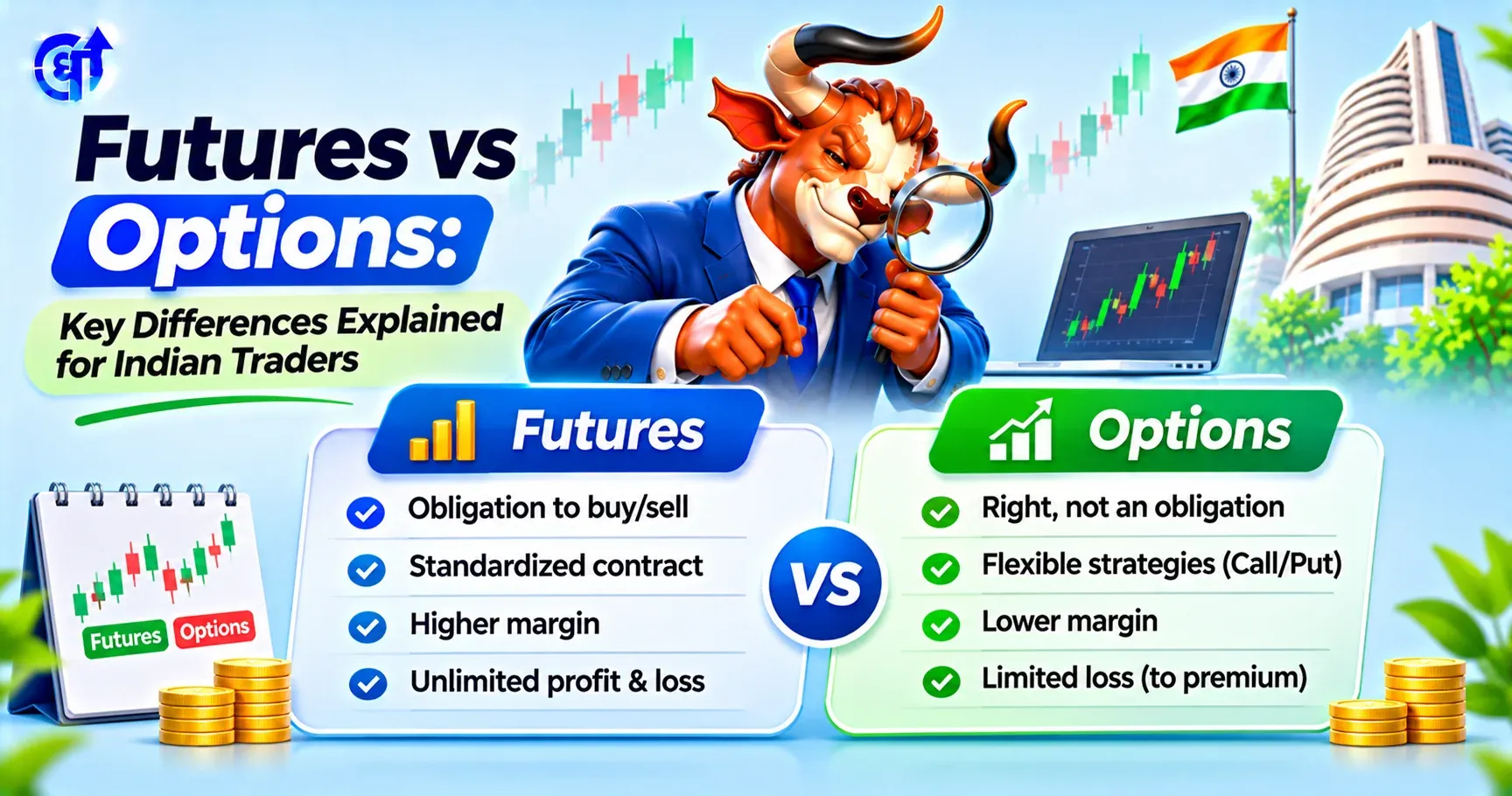
Futures vs options differ mainly in obligation and risk. Futures require both buyer and seller to settle at expiry, while options give the buyer a right without obligation. Indian traders on NSE face different capital needs, with futures needing margin and options buyers paying only premium.
Indian retail traders often compare futures vs options when deciding how to take a directional view on Nifty or stocks. Both trade on NSE under SEBI rules, but the capital, risk and daily mechanics differ sharply. A futures contract binds both sides, while an options contract limits the buyer’s loss to the premium paid. Understanding these differences helps avoid common mistakes such as underestimating mark-to-market losses or ignoring time decay. The stock screener on Dhanarthi helps shortlist quality underlyings before any F&O trade.
Research Stocks Smarter with Dhanarthi AI Screener
Analyze 5,000+ NSE & BSE stocks with 150+ custom filters, real-time volume breakout scans, and transparent fundamental data.
Use Dhanarthi Screener
A futures contract is a standardized agreement to buy or sell an underlying asset at a fixed price on a set future date. Both the buyer and the seller carry an obligation. On NSE, index futures settle in cash, while stock futures settle physically if held to expiry. Daily mark-to-market adjusts the account for gains or losses. As of November 2026, the Nifty 50 lot size stands at 65 units (Source: NSE contract specifications). One lot controls roughly Rs 15.5-16 lakh of notional value near current levels.
Traders use futures for pure directional bets or hedging. The upfront requirement is margin, typically 10-15 percent of contract value under the SPAN plus exposure framework set by NSE Clearing.
An options contract gives the buyer the right, but not the obligation, to buy (call) or sell (put) the underlying at a fixed strike price before or on expiry. The seller of the option carries the obligation if the buyer exercises. Buyers pay a premium upfront. Maximum loss for the buyer equals the premium paid. Sellers face potentially large losses and must maintain margin similar to futures.
Options on Nifty expire weekly on Tuesdays under the current SEBI schedule. Stock options follow monthly cycles. Time decay (theta) erodes premium as expiry approaches, a factor absent in futures.
The core distinction is obligation versus right. Futures force settlement or daily settlement adjustments. Options allow the buyer to walk away if the trade moves against the view.
| Factor | Futures | Options (Buyer) |
|---|---|---|
| Obligation | Both parties obligated | Buyer has right only |
| Upfront capital | Margin (10-15% of value) | Premium only |
| Maximum loss (buyer side) | Unlimited (theoretically) | Limited to premium |
| Daily settlement | Yes (MTM) | No |
| Time decay | None | Yes (theta) |
| Best for | High-conviction directional | Limited-risk directional or hedging |
Data sourced from NSE contract specs and SEBI margin circulars. Last updated: November 2026.
This table shows why many beginners start with buying options: the loss is defined in rupees from day one.
Futures demand margin calculated by the exchange’s SPAN system plus exposure margin. For one Nifty lot near 24,500, contract value is about Rs 15.9 lakh. Typical margin ranges from Rs 1.6 lakh to Rs 2 lakh on a normal day (Source: NSE margin files, November 2026). Brokers may add a buffer.
Options buyers pay the full premium. A Nifty 24,500 call trading at Rs 150 costs Rs 150 × 65 = Rs 9,750 for one lot. No further margin is blocked for long options. Option sellers, however, post margin comparable to futures because they hold the obligation.
SEBI’s peak-margin rules require full margin collection upfront. The 50 percent cash margin rule further restricts pledged collateral. These rules apply equally to futures and short options.
NSE sets lot sizes so that one contract is worth roughly Rs 15-20 lakh. As of November 2026:
At a spot price of Rs 1,313 on 5 November 2026, one Reliance lot equals about Rs 6.57 lakh (Source: NSE end-of-day data). Margin for Reliance futures typically falls in the 12-18 percent range depending on volatility.
Always check the latest NSE lot file before trading, as exchanges revise sizes periodically.
Assume Nifty trades at 24,500. A trader expects a rise to 24,800 within two weeks.
Futures path: Buy one lot of Nifty futures. Margin blocked ≈ Rs 1.8 lakh. If Nifty rises 300 points, profit = 300 × 65 = Rs 19,500 before charges. If it falls 300 points, loss equals Rs 19,500, and the account is debited daily via MTM.
Options path: Buy one 24,500 call at Rs 180 premium. Cost = Rs 11,700. If Nifty closes at 24,800, intrinsic value = 300 points. Profit ≈ (300 – 180) × 65 = Rs 7,800. If Nifty stays flat or falls, the maximum loss is the Rs 11,700 premium.
The futures trade offers higher absolute profit on the same move but requires more capital and carries unlimited downside. The options trade caps loss while still capturing upside, at the cost of time decay.
Reliance Industries closed near Rs 1,313 on 5 November 2026 with a lot size of 500 shares (Source: NSE). One futures lot controls Rs 6.57 lakh. A trader bullish on the stock can buy the future with roughly Rs 1 lakh margin or buy a call option for a few thousand rupees in premium.
Physical settlement applies if the futures position is held to expiry. The trader must arrange cash for the full value of 500 shares or square off earlier. Options buyers face no such delivery risk if they hold long options.
Checking the company’s financial health first matters. Use the financial analysis tools to review the latest quarterly numbers and balance sheet before taking a leveraged view.
Futures carry unlimited loss potential on both long and short sides. A gap opening against the position can produce large MTM debits overnight. Leverage amplifies both gains and losses.
Options buyers face limited loss but high probability of total premium loss due to time decay and wrong direction. Most weekly options expire worthless. Option sellers collect premium but face large losses if the underlying moves sharply.
Common mistake: treating a long option as a cheaper version of a futures trade without accounting for theta. Another mistake is holding stock futures into expiry without preparing for physical settlement.
Beginners with limited capital often start with buying options because the maximum loss is known and small. Traders with higher conviction and adequate margin may prefer futures for cleaner payoff and no time decay.
Hedgers who own stocks can sell futures or buy puts to protect portfolios. Pure speculators should match the instrument to their risk tolerance and time horizon.
The AI Financial Research Assistant can help evaluate the underlying stock’s fundamentals and recent filings before deciding on a leveraged position.
One frequent error is entering futures with capital barely covering the initial margin. A single adverse gap can trigger a margin call or forced exit. Another is buying far out-of-the-money options expecting lottery-style returns. Most expire worthless because the required move never materializes.
Traders also ignore physical settlement on stock contracts. Holding a long Reliance futures position into expiry without cash for 500 shares forces delivery or a last-minute square-off at poor prices. Checking open interest and volume on the chosen contract helps confirm liquidity before entry.
Using the Dhanarthi stock screener to filter companies with stable earnings reduces the chance of trading leveraged instruments on weak businesses.
During the March 2020 COVID crash, Nifty futures fell sharply over consecutive sessions. Traders who held long futures saw large MTM debits that forced many accounts into margin calls. Option buyers who held puts captured the downside with limited risk, while call buyers lost only their premium. The episode showed that leverage in futures can wipe out capital faster than expected when volatility spikes.
In calmer periods, such as the 2023-2024 rally, futures traders who stayed with the trend captured larger absolute gains without theta erosion. Options buyers needed bigger moves to overcome premium decay. These cycles repeat. Position size and defined risk matter more than the instrument label.
Securities Transaction Tax (STT) on futures rose to 0.05 percent of contract value from April 2026 (Source: Union Budget 2026). Options premium attracts 0.15 percent STT. These charges apply on the sell side for both instruments. Brokerage, exchange fees and GST add further costs. High-frequency traders feel the impact more on options because of multiple premium turns.
A trader turning over several Nifty lots daily faces higher effective costs after the 2026 STT hike. Checking total charges on the broker platform before scaling position size prevents surprises.

Confused about chart patterns & stock analysis?
Use
Dhanarthi Stock Guru
to chat, analyze price patterns, and ask questions directly.
Futures vs options is a choice between obligation with higher capital and limited-risk rights with time decay. Nifty lot size of 65 and typical margins near Rs 1.8 lakh illustrate the capital gap. Reliance Industries at 500 shares per lot shows how stock contracts differ. Indian traders should match the instrument to capital, conviction and risk capacity, always verifying latest NSE data and company filings.
This article is for educational purposes only. It does not constitute investment advice. Please consult a SEBI-registered financial advisor before making investment decisions.
1. What is the main difference between futures and options?
Futures obligate both buyer and seller to settle at expiry or through daily mark-to-market. Options give the buyer a right without obligation, so maximum loss equals the premium paid.
2. How much margin is needed for Nifty futures in 2026?
For one Nifty lot of 65 units near 24,500, typical SPAN plus exposure margin ranges from Rs 1.6 lakh to Rs 2 lakh on a normal day. Check the live NSE margin calculator.
3. Can I lose more than the premium in options?
Only if you sell options. Option buyers lose at most the premium paid. Futures buyers and sellers can lose far more than the initial margin through MTM.
4. What is the current Nifty lot size?
The Nifty 50 lot size is 65 units as of November 2026 for contracts from the January 2026 series onward (Source: NSE).
5. Do stock futures require physical delivery?
Yes. Stock futures and ITM options held to expiry settle by physical delivery of the shares. Index futures settle in cash only.
Share Market
IPO
Artificial Intelligence
Semi Conductor