




Best Hydrogen Stocks India 2026: Top Picks Compared
November 4, 2026


TABLE OF CONTENTS
Get AI Summary


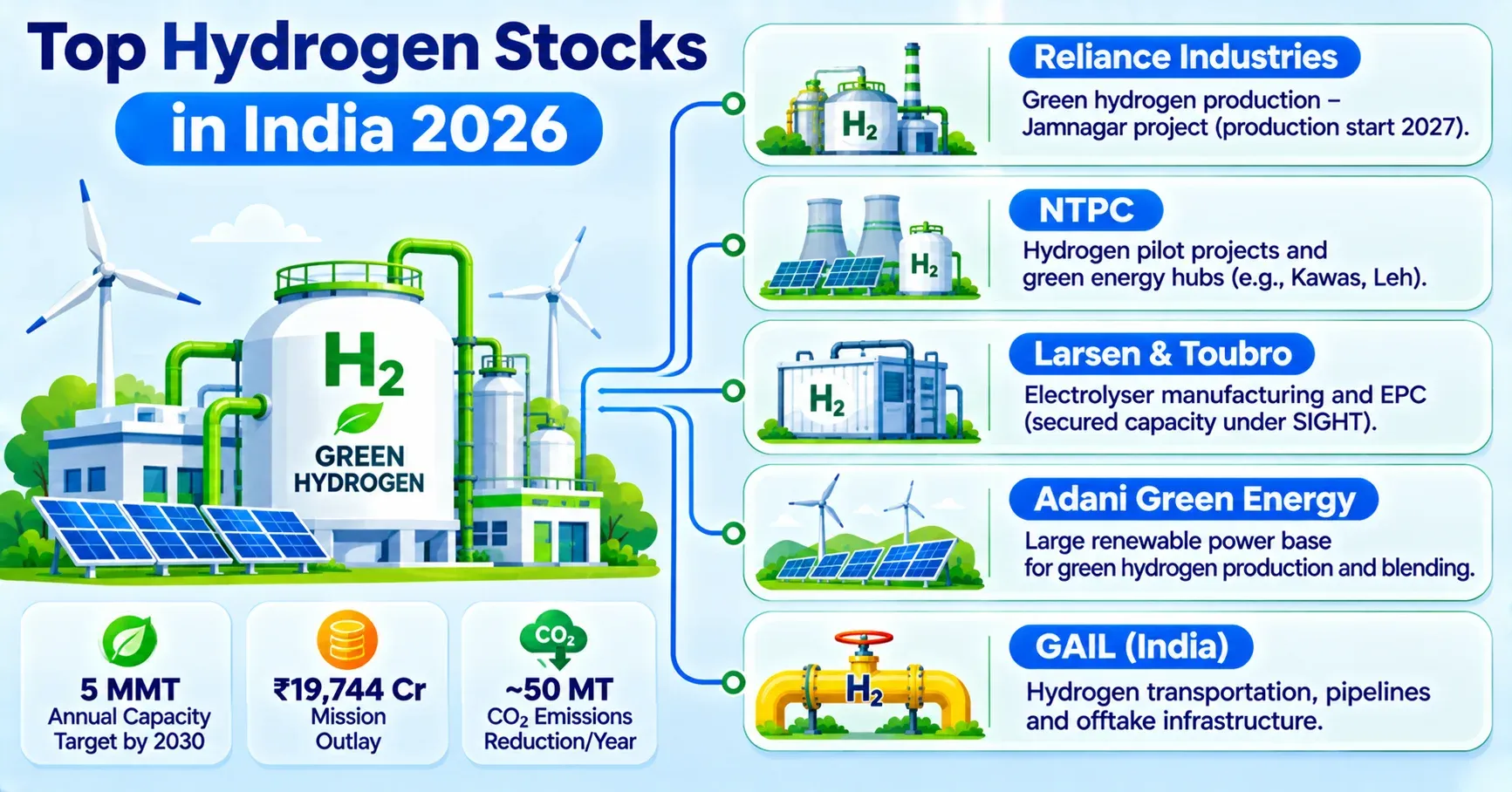
The best hydrogen stocks in India include Reliance Industries, NTPC, Larsen & Toubro, and Adani Green Energy. These companies lead in green hydrogen production, electrolyser manufacturing, and offtake contracts under the National Green Hydrogen Mission. India targets 5 million metric tonnes annual capacity by 2030 with Rs 19,744 crore mission outlay.
Indian investors looking for exposure to the clean energy transition often start with fundamental analysis of large energy and infrastructure companies. Green hydrogen offers one path to cut fossil fuel imports while meeting net-zero goals. The sector remains early stage. Most listed exposure comes through diversified players rather than pure-play hydrogen firms.
Green hydrogen is produced by splitting water using electricity from renewable sources. It emits no carbon during production. Grey hydrogen, made from natural gas, still dominates industrial use in refining and fertilisers.
India imports most of its oil and gas. Green hydrogen can replace some of that demand in steel, shipping, and chemicals. The National Green Hydrogen Mission, approved in January 2023, sets a target of 5 million metric tonnes per year by 2030. The mission has an initial outlay of Rs 19,744 crore up to FY 2029-30. Of this, Rs 17,490 crore supports the SIGHT programme for electrolyser manufacturing and hydrogen production incentives (Source: Ministry of New and Renewable Energy, PIB releases).
By October 2026, Indian companies had signed offtake contracts for over 5.5 lakh metric tonnes per annum. These commitments involve investments of about Rs 90,000 crore. Over 70 percent of the volume is for export markets in Japan, Korea, and Europe (Source: MNRE statement, October 2026).
Research Stocks Smarter with Dhanarthi AI Screener
Analyze 5,000+ NSE & BSE stocks with 150+ custom filters, real-time volume breakout scans, and transparent fundamental data.
Use Dhanarthi Screener
The mission aims to add 125 GW of renewable energy capacity dedicated to hydrogen production. It expects to mobilise over Rs 8 lakh crore in total investment and create more than 6 lakh jobs by 2030. Annual CO2 emissions could fall by about 50 million tonnes.
Pilot projects cover mobility, steel, and shipping. Six states have notified dedicated green hydrogen policies. Gujarat, Andhra Pradesh, and Maharashtra lead in project announcements. Execution risk remains high. Most commercial deliveries start between 2028 and 2030. Cost of green hydrogen still exceeds grey hydrogen in many uses without incentives.
The SIGHT programme forms the core financial support. It offers incentives for domestic electrolyser manufacturing and for actual green hydrogen production. Early awards covered about 3,000 MW of electrolyser capacity across multiple companies. Production incentives target volume-based support over the initial years after commissioning.
Investors should track policy continuity, electrolyser cost declines, and actual plant commissioning rather than announcements alone. A stock screener helps filter companies by debt levels, return on equity, and capital expenditure plans before deeper research.
No pure-play green hydrogen company is listed on NSE or BSE. Exposure comes through energy, power, engineering, and industrial firms. The table below compares key metrics for leading names as of early November 2026.
| Company | Market Cap (approx Rs crore) | Key Hydrogen Activity | PE (approx) | Notes |
|---|---|---|---|---|
| Reliance Industries | 17,50,000 | Jamnagar renewable hydrogen, Samsung offtake >$3 billion | 20 | Production start targeted 2027, ramp by 2028 |
| NTPC | 3,10,000 | Multiple pilots, Pudimadakka hub plans | 11 | Government backing, large balance sheet |
| Larsen & Toubro | 5,40,000 | Electrolyser manufacturing, EPC, Kandla plant | 28 | Infrastructure execution strength |
| Adani Green Energy | 2,20,000 | Renewable capacity for hydrogen, blending pilots | High (100+) | Large RE base, higher debt |
| GAIL (India) | 1,16,000 | Pipeline infrastructure, offtake role | 14 | Transport network advantage |
Reliance Industries plans 3 million metric tonnes annual renewable hydrogen capacity by 2032-2035 at Jamnagar and nearby sites. It has a long-term green ammonia supply agreement with Samsung C&T valued over $3 billion, with deliveries from 2028 (Source: company statements and S&P Global reports, 2026).
NTPC operates hydrogen blending pilots at Kawas and a filling station in Leh. It explores larger hubs. Larsen & Toubro secured electrolyser capacity under SIGHT and plans large-scale plants. Adani Green brings renewable power scale. GAIL focuses on gas infrastructure that can carry blended or pure hydrogen later.
Indian Oil Corporation and Bharat Petroleum have existing grey hydrogen demand in refineries. They can switch portions to green hydrogen as costs fall. Oil India and ONGC explore upstream integration. These oil marketing companies provide additional exposure through offtake and blending potential.
Reliance Industries combines refining, petrochemicals, retail, and digital services. Its new energy arm targets green hydrogen as part of a broader clean energy push. Production at Jamnagar is expected to begin in 2027. The company has qualified for production-linked incentives. Renewable power will come from large Kutch solar and wind projects covering hundreds of thousands of acres.
Financial strength supports heavy capital expenditure. Oil-to-chemicals still drives most revenue and profit. Hydrogen contribution remains small for several years. Investors monitor execution against the 1-1-1 cost target of $1 per kg within a decade, first announced in 2021. The Samsung deal provides demand visibility for the initial ramp-up phase.
Reliance also works on battery storage and electrolyser manufacturing capabilities. The integrated approach aims to control costs across the value chain. Quarterly updates from the new energy division offer the best progress signals.
NTPC is India's largest power producer. It has moved from coal toward renewables and now hydrogen pilots. Government ownership provides policy alignment. Multiple small projects test blending, mobility, and carbon capture. Larger commercial plants require significant renewable capacity addition.
Balance sheet is solid relative to private peers. Power purchase agreements on existing assets generate steady cash flow. Hydrogen is a long-term growth option rather than near-term earnings driver. NTPC Green Energy subsidiary focuses on renewable expansion that can support hydrogen later.
Pilots include hydrogen-blended natural gas and a green hydrogen filling station. Scale-up depends on renewable power availability and offtake agreements with industrial users.
Larsen & Toubro brings engineering and construction expertise. It manufactures electrolysers and executes large infrastructure projects. Plans include a major green hydrogen and ammonia plant at Kandla with phased investment. Order book visibility in EPC supports near-term business while hydrogen capacity builds.
L&T has partnered on offtake arrangements and secured capacity under SIGHT for electrolysers. Its strength lies in project execution at industrial scale. Investors watch order inflows related to green hydrogen infrastructure.
Adani Green Energy supplies renewable power that can feed electrolysers. The company has large operational renewable capacity under long-term PPAs. Blending pilots test hydrogen use in existing gas networks. Higher leverage compared with NTPC requires careful monitoring of interest coverage and project returns.
Indian Oil, BPCL, and Oil India explore refinery hydrogen replacement and offtake. Waaree Energies and Advait Energy Transitions focus more on electrolyser manufacturing and early orders. JSW Energy has commissioned smaller green hydrogen capacity. These names offer varied risk-reward profiles. Smaller firms carry higher execution risk and limited track records in large-scale energy projects.
Thermax and other equipment suppliers participate in components and systems. Power Grid supports the transmission infrastructure needed for renewable power dedicated to hydrogen plants.
Green hydrogen costs remain higher than conventional alternatives without subsidies. Electrolyser prices and renewable power costs must fall further. Water availability, land, and grid connectivity add constraints. Export contracts depend on international carbon pricing and buyer policies.
Policy risk exists if incentives change. Debt levels at some renewable players are elevated. Project delays of 2-3 years are common in large energy infrastructure. Past cycles in solar and wind showed that early leaders can underperform if costs stay high longer than expected.
Track quarterly updates on capacity additions, offtake conversions into firm orders, and actual production volumes. Use AI financial research tools to scan concall transcripts for hydrogen mentions and management commentary.
Start with business quality and balance sheet strength. Diversified large-cap names reduce single-project risk. Check ROE, debt-to-equity, and free cash flow trends. Compare capital expenditure plans against existing cash generation.
Screen for companies with announced offtake agreements and PLI awards. Review annual reports for specific hydrogen project details and timelines. Monitor MNRE updates on mission progress. Combine this with sector screens for energy and industrials.
Historical lesson: early renewable energy investors faced years of low returns before scale and cost declines improved economics. Similar patience may apply here.

Confused about chart patterns & stock analysis?
Use
Dhanarthi Stock Guru
to chat, analyze price patterns, and ask questions directly.
Hydrogen stocks in India offer exposure to a policy-supported energy transition theme. Reliance Industries, NTPC, and Larsen & Toubro stand out for scale, financial strength, and concrete offtake or manufacturing plans. The sector is still in the build-out phase. Commercial volumes arrive mainly after 2028. Investors should size positions carefully, focus on execution, and review fundamentals regularly rather than treat the theme as a short-term trade.
This article is for educational purposes only. It does not constitute investment advice. Please consult a SEBI-registered financial advisor before making investment decisions.
1. What are the best hydrogen stocks in India for 2026?
Reliance Industries, NTPC, and Larsen & Toubro lead due to large offtake contracts, pilot projects, and electrolyser capacity. No pure-play listed company exists yet. Diversified energy and engineering firms provide the main exposure.
2. What is the National Green Hydrogen Mission target?
India targets 5 million metric tonnes of green hydrogen production capacity annually by 2030. The mission has an initial outlay of Rs 19,744 crore. It also aims for 125 GW of additional renewable capacity and Rs 8 lakh crore total investment.
3. Are there pure-play green hydrogen stocks listed in India?
No pure-play green hydrogen companies are listed on NSE or BSE as of November 2026. Investors gain exposure mainly through energy majors, power utilities, and engineering firms involved in production or equipment.
4. What risks should investors consider in hydrogen stocks?
Key risks include high production costs, project execution delays, policy changes, elevated debt at some renewable players, and slower-than-expected demand growth. Most commercial volumes are expected only from 2028 onward.
5. How can I screen for hydrogen-related stocks?
Use a stock screener to filter energy and industrial companies by market cap, ROE, and debt levels. Then review annual reports and concalls for specific hydrogen project mentions, offtake agreements, and capital expenditure plans.
Share Market
IPO
Artificial Intelligence
Semi Conductor