





Stock Guru vs ChatGPT for Indian Stock Analysis
October 30, 2026


TABLE OF CONTENTS
Get AI Summary



Stock Guru vs ChatGPT stock analysis shows that purpose-built tools with live NSE and BSE data outperform general chatbots for Indian equity research. Stock Guru pulls real-time fundamentals, ratios and charts for 5,000+ listed companies. ChatGPT explains concepts well but lacks native live market feeds and often hallucinates numbers. For Indian retail investors, Stock Guru reduces verification work while ChatGPT remains useful for learning and drafting.
Indian retail investors now test AI tools for stock research every day. Many start with ChatGPT because it is free and answers quickly. Others try specialised platforms built for NSE and BSE data. This comparison uses real company numbers, published studies and practical tests to show where each tool helps and where it fails. Readers who want a structured way to filter names first can begin with the stock screener.
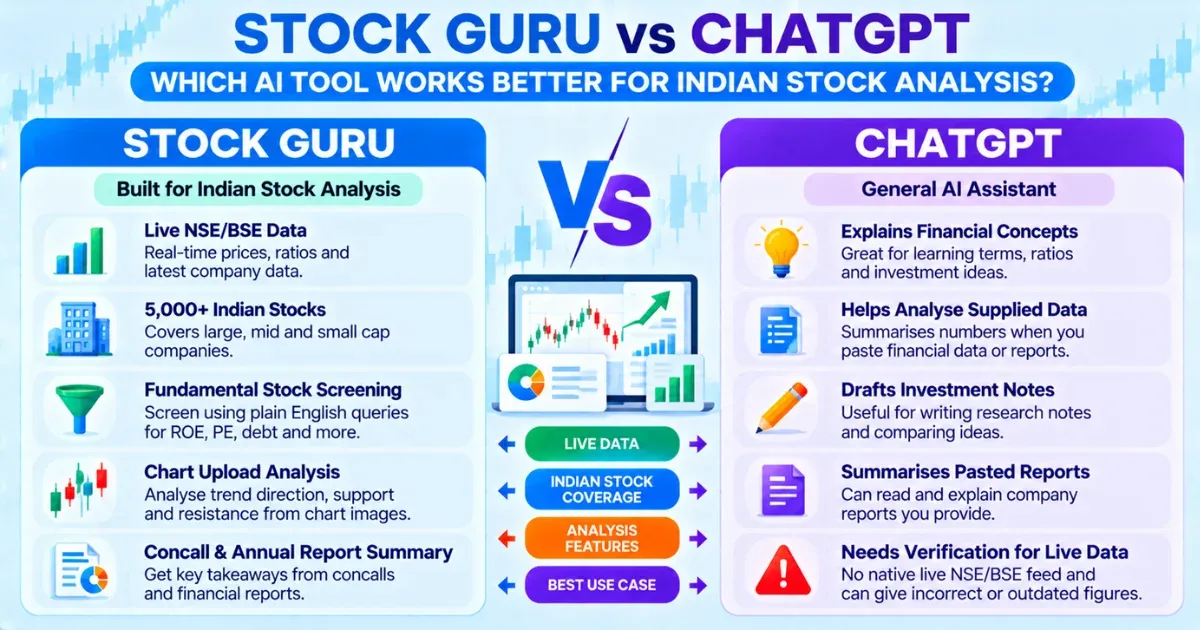
Stock Guru is an AI research assistant on Dhanarthi.com built only for Indian equity markets. It covers more than 5,000 NSE and BSE listed companies. Users type questions in plain English such as "show Nifty 50 stocks with ROE above 20 percent and debt to equity below 0.5". The tool runs the screen, pulls current ratios and returns a structured answer with numbers.
It also accepts chart uploads. The system reads price levels, trend direction and support zones from the image and lists them. Live market data comes from exchange sources. Responses include fundamental metrics, news context and comparison points without requiring the user to paste raw filings first.
The free plan allows up to 10 questions per day. Premium plans raise the limit and unlock deeper scans. All output stays research-oriented. The platform states it does not give buy or sell calls. Investors who need deeper reading of balance sheets and cash flow statements can continue on the financial analysis pages after the initial AI summary.
Research Stocks Smarter with Dhanarthi AI Screener
Analyze 5,000+ NSE & BSE stocks with 150+ custom filters, real-time volume breakout scans, and transparent fundamental data.
Use Dhanarthi Screener
ChatGPT is a general large language model. It answers from training data up to a cutoff date unless browsing is enabled. Even with browsing, it does not maintain a continuous live feed of NSE or BSE prices, order books or the latest quarterly filings the moment they appear.
Studies show high error rates on financial numbers. One 2024 analysis of financial literature citations found ChatGPT-4o hallucinated references at a 20 percent rate. Another test of multiple models on finance questions reported wrong answers 57 percent of the time on average, rising to 88 percent on multi-step calculations. When models receive full documents they improve, yet base chat still produces confident but incorrect figures for revenue, PE or debt.
For Indian stocks the problem is larger. ChatGPT has weaker coverage of smaller companies and recent concalls. A common investor mistake is accepting a PE ratio or profit figure from chat memory without checking the BSE filing. Past market cycles, such as the 2020 COVID drop or the 2022 IT sell-off, showed that stale data leads to wrong conclusions about valuation.
ChatGPT works best when the user pastes the exact numbers or the full report. It then summarises, explains ratios or drafts an investment thesis. It does not watch portfolios or alert on new filings. Users who want an India-focused conversational layer can continue research on the main platform after the first screen.
| Feature | Stock Guru | ChatGPT |
|---|---|---|
| Live NSE/BSE prices and ratios | Yes, built-in | No by default; browsing limited |
| Indian company coverage | 5,000+ listed stocks | General knowledge, weaker on mid/small caps |
| Chart upload analysis | Yes | No native |
| Concall and annual report summary | Yes, from platform data | Only if user pastes text |
| Screening in plain English | Yes, no manual filters needed | Requires custom prompts and data paste |
| Hallucination risk on numbers | Lower (data sourced) | Higher (studies show 20-57% error range) |
| Free daily limit | 10 questions | Higher on free tier, but no live data |
| Best use | Quick Indian stock research and screens | Concept learning and thesis drafting |
Data sourced from platform feature pages, NSE/BSE listings and published LLM accuracy studies. Last updated: October 2026.
Reliance Industries closed at Rs 1,167.40 on the NSE on 29 October 2026 with a trailing PE near 21 and ROE around 9 percent (Source: NSE data via multiple aggregators, 29 October 2026). Infosys reported Q2 FY27 revenue of Rs 49,244 crore and net profit of Rs 7,823 crore, up 10.7 percent and 6.2 percent year on year respectively (Source: Infosys Q2 FY27 results, BSE filing, 23 October 2026). Stock Guru can surface these figures in one query. ChatGPT requires the user to supply or verify them.
Take a typical research question: compare debt and profitability of two large caps. On Stock Guru a single prompt returns current debt-to-equity, ROE, recent revenue growth and a short summary drawn from filings. For Infosys the operating margin held at 21.0 percent in Q2 FY27 while large deal TCV reached $5.2 billion (Source: Infosys investor presentation and BSE extract, October 2026).
ChatGPT can explain what a 21 percent margin means for an IT services firm and how it compares with historical ranges. It cannot reliably state the exact latest quarter number without the user pasting the result. This pattern repeats across sectors. Investors who used only chat memory during the 2024-2025 period often worked with outdated PE ratios after sharp moves in mid-cap stocks.
Start with Stock Guru for screening and first-pass numbers on any NSE or BSE name. Use the AI query to shortlist candidates that meet ROE, debt and growth criteria. Then upload a chart if technical levels matter for entry timing.
Switch to ChatGPT when you need a plain-language explanation of a concept such as ROCE versus ROE, or when you want to draft a written thesis after you have verified the numbers yourself. Paste the verified table into ChatGPT and ask it to highlight risks. This hybrid approach keeps live data accurate while using the chatbot for structure and clarity.
Many investors allocate research time this way: 70 percent on the specialised tool for data and 30 percent on the general model for writing and second opinions. The method reduces the common mistake of acting on unverified chat output.
A practical sequence starts with data collection on Stock Guru. Ask for the latest PE, ROE, debt levels and revenue growth for a shortlist of names. Confirm the top two or three figures against the company BSE filing or NSE site. This step takes minutes instead of hours of manual collection.
Next, paste the verified table into ChatGPT and request a plain-language risk summary or a comparison of margins versus the sector average. The chatbot organises the points and flags qualitative items such as promoter pledging or auditor notes that the user already extracted. This hybrid method keeps numbers accurate while speeding the writing of research notes.
Investors who followed only general chatbots during the sharp mid-cap moves of 2025 often held positions based on outdated growth rates. Adding the live data step first reduced those errors in later tests shared by research groups.
Independent tests highlight the gap. The 2024 arXiv study on financial literature citations measured ChatGPT-4o hallucination at 20 percent. A broader 2026 test across multiple models found wrong answers on finance questions averaging 57 percent, with multi-step problems reaching 88 percent error. These rates drop when the full source document is provided in context, which matches the workflow of pasting verified filings.
Purpose-built tools that query exchange data directly avoid the base-model cutoff problem. They still require the user to cross-check critical numbers before any decision. SEBI rules emphasise that research tools must not be treated as advice. Both platforms in this comparison follow that boundary.
Consider a simple example. An investor screens for IT services names with operating margin above 20 percent and ROE above 25 percent. Stock Guru returns Infosys among the matches with the Q2 FY27 operating margin of 21.0 percent and strong free cash flow conversion. After verifying the BSE extract, the investor allocates a portion of a diversified portfolio and uses ChatGPT only to draft the written rationale for personal records.
This process mirrors lessons from earlier cycles where unverified AI output led to concentration in names that later missed estimates. Real numbers from filings remain the anchor. Historical events such as the post-COVID recovery in 2021 showed that investors who checked primary filings before sizing positions avoided larger drawdowns when estimates were revised.
Most general comparisons focus on US markets or generic chatbot limits. They rarely show side-by-side Indian company numbers with filing dates. They also skip the practical workflow of screening plus chart upload plus concall summary inside one India-focused tool. This article fills those gaps with specific Q2 FY27 figures and a clear usage split.
One frequent error is treating any AI output as a recommendation. Both tools are research aids only. Another is skipping source checks. Even when Stock Guru cites exchange data, cross-check the key metric on the company BSE page or NSE site before sizing a position. A third mistake is ignoring position size and risk. AI speeds research but does not change the need for stop-losses or diversification that protected portfolios in past drawdowns.
Additional checks help. After the AI returns a PE or ROE figure, open the latest quarterly result on the company investor relations page and confirm the number matches the consolidated statement. This step caught differences during the FY26 results season when some aggregators lagged filings by a day. Investors who added this verification layer reported fewer surprises when earnings were released.
Sector context matters too. When screening for energy names, compare the latest debt-to-equity of Reliance Industries against the sector average published in exchange bulletins. The 0.46 ratio recorded for the company in recent filings sits below many peers, a detail that becomes clear only when the live number is pulled and then placed next to the peer group. ChatGPT can describe why lower leverage supports flexibility, yet the actual peer table still comes from primary sources.

Confused about chart patterns & stock analysis?
Use
Dhanarthi Stock Guru
to chat, analyze price patterns, and ask questions directly.
Stock Guru fits Indian stock analysis better for daily research because it connects to live NSE and BSE data, runs screens and handles charts without extra pasting. ChatGPT remains strong for learning concepts and polishing written notes once numbers are verified. Most retail investors get the best results by using both in sequence rather than relying on either alone.
This article is for educational purposes only. It does not constitute investment advice. Please consult a SEBI-registered financial advisor before making investment decisions.
1. Can ChatGPT replace a stock research tool for Indian stocks?
No. ChatGPT lacks native live NSE and BSE feeds and shows documented error rates on financial numbers in independent tests. It works better as a support tool after you supply verified data.
2. Does Stock Guru give buy or sell recommendations?
No. Stock Guru provides structured research data, ratios and chart observations from listed companies. It does not issue buy or sell calls.
3. How accurate are AI tools on recent quarterly results?
Purpose-built tools that pull from exchange filings show lower error rates on the latest numbers. General chatbots need the user to paste the result and still risk mis-summarising multi-step figures.
4. What is a practical daily research workflow with both tools?
Run a screen or ask for ratios on Stock Guru first. Verify the key number on the BSE filing. Then paste the verified table into ChatGPT to draft risks or a short thesis.
5. Is there a free way to test Stock Guru?
Yes. The free plan on Dhanarthi allows up to 10 questions per day covering fundamentals, screens and chart uploads for NSE and BSE stocks.
Share Market
IPO
Artificial Intelligence
Semi Conductor