





Best Banking Stocks in India 2026
October 26, 2026


TABLE OF CONTENTS
Get AI Summary



Best banking stocks in India include HDFC Bank, ICICI Bank, State Bank of India and Axis Bank, which together form the core of the Nifty Bank index. These lenders reported strong Q2 FY27 profits with improved asset quality. Investors look at net interest margins, loan growth and gross NPA levels before deciding.
Indian banks form the backbone of the equity market. The Nifty Bank index tracks the largest listed lenders and moves with credit growth, interest rate cycles and overall economic activity. For many retail investors, banking stocks offer a way to participate in India's expanding formal credit system. You can review sector trends on the sectors page before narrowing your choices.
Banking stocks rise when loan books expand, net interest margins stay healthy and bad loans remain under control. Private banks such as HDFC Bank and ICICI Bank have shown consistent execution on these metrics for several years. Public sector banks like State Bank of India bring scale and a large branch network that still matters for deposit gathering in smaller towns.
Asset quality improved across the system after the clean-up years. Gross NPA ratios for the largest private banks stayed below 1.3 percent in recent quarters. This stability supports higher valuations for quality names while leaving room for public sector banks that trade at lower multiples.
The table below lists five large banking stocks with recent financial highlights. Figures come from company filings and exchange data as of mid-October 2026.
| Company | Segment | Q2 FY27 Net Profit | Key Driver | Main Risk |
|---|---|---|---|---|
| HDFC Bank | Private | Rs 19,510 crore (+4.7%) | Large deposit franchise, steady advances | Margin pressure from deposit costs |
| ICICI Bank | Private | Rs 14,843 crore (+20.1%) | Strong credit growth, lower credit costs | Competition in retail loans |
| Axis Bank | Private | Rs 7,003 crore (+37.6%) | Higher other income, improving asset quality | Execution on deposit growth |
| State Bank of India | Public | Large absolute profits | Government backing, vast network | Slower margin recovery |
| Kotak Mahindra Bank | Private | Solid growth reported | High capitalisation, selective lending | Lower loan growth versus peers |
Data sourced from company Q2 FY27 filings and NSE. Last updated: October 2026.
HDFC Bank remains the largest private lender by market capitalisation. Its Q2 FY27 standalone net profit rose 4.7 percent to Rs 19,510 crore while net interest income grew 9.7 percent to Rs 34,620 crore (Source: company filing, October 2026). Gross NPA improved to 1.11 percent. The bank continues to benefit from a wide CASA base even as deposit costs stay elevated.
ICICI Bank delivered stronger earnings momentum. Standalone net profit increased about 20 percent year on year with net interest income up 17.7 percent. Credit growth stayed healthy after adjusting for FCNR deposits. Analysts tracking the stock note stable asset quality with gross NPA near 1.20 percent.
Axis Bank reported the sharpest profit rise among the top three private banks. Net profit climbed 37.6 percent to Rs 7,003.3 crore while net interest income rose 11.8 percent to Rs 15,371 crore. Advances grew at a double-digit rate and the bank improved its asset quality metrics during the quarter.
Private banks control a rising share of incremental credit in retail and SME segments. Their technology platforms allow faster product rollouts and better risk monitoring. ICICI Bank and HDFC Bank have maintained return on assets above 1.7 percent in recent periods despite margin compression.
Public sector banks still hold the majority of system deposits. State Bank of India alone accounts for a large portion of total bank deposits. Its scale helps it price loans competitively, though profitability per asset remains lower than top private peers. Investors who prefer lower valuations often look at SBI and other large public banks when credit growth accelerates.
You can compare valuations across sectors using the sector wise PE ratio India guide. Banking stocks currently trade at varied multiples depending on growth expectations and asset quality.
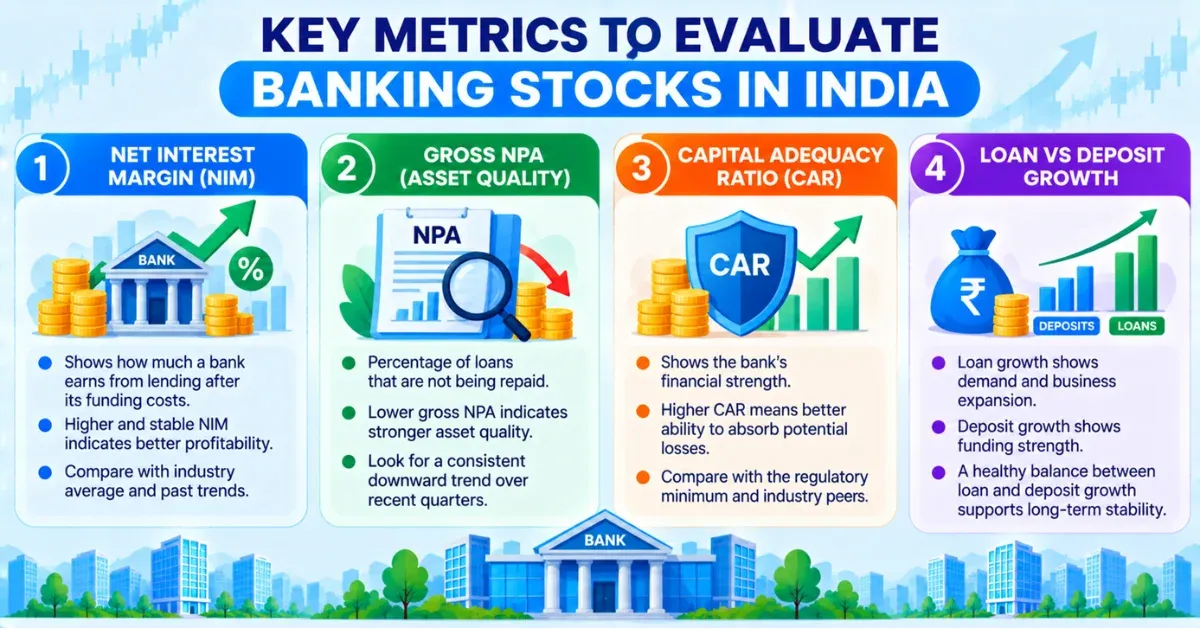
Net interest margin (NIM) shows how much a bank earns on its interest-bearing assets after funding costs. Large private banks reported NIMs between 3.16 percent and 4.18 percent in Q2 FY27. A drop of 10 to 30 basis points from the previous year reflects higher deposit rates.
Gross NPA and net NPA ratios measure credit quality. The top private banks kept gross NPA under 1.3 percent. Provisions relative to advances stayed controlled, which supported bottom-line growth even when treasury income fell.
Capital adequacy remains comfortable. Most large banks reported total capital ratios well above the regulatory minimum of 11.5 percent. This buffer allows them to grow loans without immediate equity raises.
Loan growth versus deposit growth is another practical check. When advances grow faster than low-cost deposits, margins come under pressure. Several banks reported deposit growth outpacing advances in the latest quarter, which helps stabilise funding costs.
Interest rate cycles remain the largest external risk. A sharp rise in policy rates raises deposit costs faster than loan yields, squeezing NIMs. The reverse happens when rates fall and banks reprice deposits lower.
Credit costs can spike if unsecured retail loans or corporate exposures turn sour. Past cycles showed that asset quality deterioration hits public sector banks harder because of legacy books. Private banks have tighter underwriting today, yet concentration in certain retail segments still carries risk.
Regulatory changes and capital rules also matter. SEBI and RBI guidelines on liquidity coverage, priority sector lending and digital payments can alter cost structures. Banks that adapt their systems quickly tend to protect profitability better.
Competition from non-bank lenders and fintech platforms has intensified in personal loans and credit cards. Large banks respond by expanding their own digital channels and partnering with fintechs rather than losing share entirely.
Start with the Nifty Bank constituents. The index holds 14 stocks as of late October 2026, led by HDFC Bank, ICICI Bank and State Bank of India. Their combined weight exceeds 60 percent, so index movement largely reflects these three names.
Check three numbers for each bank: trailing return on assets, gross NPA trend over four quarters, and price to book ratio versus its five-year average. Banks trading below their long-term average P/B with stable or improving NPAs often attract value-oriented investors.
Compare growth rates. Axis Bank showed stronger profit growth in Q2 FY27 than HDFC Bank, yet the latter holds a larger deposit base. Your preference between stability and growth will decide the weight.
Review related metal and industrial stocks on the best metal stocks India page if you want exposure outside financials. Diversification across sectors reduces single-sector concentration.
Many investors buy the highest-returning bank of the previous year without checking current valuations. A stock that rose 50 percent may already price in strong growth, leaving less upside if credit costs rise.
Others ignore the difference between standalone and consolidated numbers. Subsidiaries in insurance, asset management or cards can add or subtract from group profit. Always read the consolidated results for a full picture.
Timing purchases around quarterly results is another frequent error. Stock prices often move on guidance and margin commentary more than the headline profit number. Reading the investor presentation helps more than scanning the profit figure alone.
Finally, some portfolios end up overweight banking simply because the sector is large in the Nifty. A deliberate allocation of 15 to 25 percent of equity exposure to financials is common among balanced portfolios, but higher weights increase sensitivity to interest rate moves.
Credit growth is expected to stay in the low-to-mid teens for the system if economic activity remains steady. Private banks should continue to gain market share in retail and SME segments. Public sector banks benefit when corporate capex picks up and infrastructure lending rises.
Margin recovery depends on deposit cost trends. If the RBI holds rates steady or cuts later in the year, banks that reprice deposits faster can protect NIMs. Asset quality is likely to stay benign unless a sharp slowdown hits unsecured lending.
Investors who bought quality private banks during the 2018-2020 stress period saw strong returns once the clean-up finished. Similar patience may be needed if margins stay compressed for a few more quarters. The long-term case rests on India's under-penetrated credit market and rising formalisation.
Best banking stocks in India for 2026 centre on HDFC Bank, ICICI Bank, Axis Bank and State Bank of India. These lenders combine scale, improving asset quality and clear growth paths. Real Q2 FY27 numbers show profit growth ranging from mid-single digits to nearly 40 percent, with gross NPAs remaining low. Check the latest filings and your own risk tolerance before allocating capital.
This article is for educational purposes only. It does not constitute investment advice. Please consult a SEBI-registered financial advisor before making investment decisions.
1. Which are the best banking stocks in India for long-term investors?
HDFC Bank and ICICI Bank appear frequently in long-term portfolios because of their consistent asset quality and deposit franchises. State Bank of India offers scale at a lower valuation. Choice depends on whether you prefer higher growth or lower price to book.
2. How did top banks perform in Q2 FY27?
HDFC Bank reported net profit of Rs 19,510 crore, up 4.7 percent. ICICI Bank profit rose about 20 percent and Axis Bank profit rose 37.6 percent. Gross NPA ratios stayed between 1.11 percent and 1.20 percent for the large private banks.
3. Is Nifty Bank a good way to invest in banking stocks?
The Nifty Bank index holds the largest listed banks and moves with the sector. Buying the index or an index fund gives exposure to HDFC Bank, ICICI Bank and SBI without selecting individual stocks. Active investors may prefer individual names after checking valuations.
4. What risks should I watch in banking stocks?
Rising deposit costs can pressure net interest margins. A sudden increase in unsecured retail stress can raise credit costs. Regulatory changes on capital or priority sector lending also affect profitability. Past cycles showed that asset quality problems hit public sector banks harder.
5. How can I compare banking stocks on valuation?
Look at price to book ratio, return on assets and the trend in gross NPA over the last four quarters. Banks trading below their historical average price to book with stable NPAs may offer better entry points. Always cross-check the latest quarterly filing on the exchange website.
Share Market
IPO
Artificial Intelligence
Semi Conductor