





Capital Gains Tax on Shares India 2026 Rates
October 23, 2026


TABLE OF CONTENTS
Get AI Summary


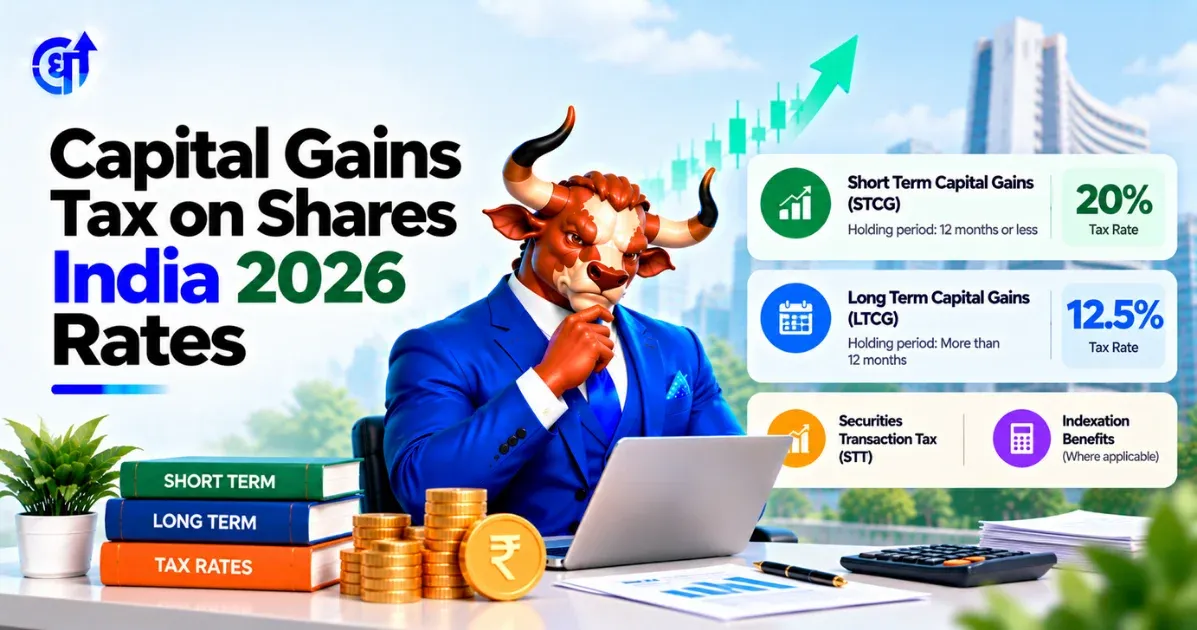
Capital gains tax on shares in India for listed equity shares where Securities Transaction Tax has been paid is 20 percent on short-term gains held for 12 months or less and 12.5 percent on long-term gains held for more than 12 months above an annual exemption of Rs 1.25 lakh. These rates took effect from 23 July 2024 and continue unchanged for financial year 2026-27. A 4 percent health and education cess applies to the computed tax.
Investors selling shares on Indian exchanges must calculate tax based on the holding period and the date of transfer. Rules under the Income Tax Act determine whether a gain is short-term or long-term. SEBI regulates the exchanges where these transactions occur, ensuring contract notes and settlement records support accurate tax reporting.
Capital gains tax on shares in India arises when an investor sells shares for a price higher than the cost of acquisition. The difference is the capital gain. For listed equity shares bought and sold on recognised stock exchanges, the tax rate depends on how long the investor held the shares.
Short-term capital gains apply when the holding period is 12 months or less. Long-term capital gains apply when the holding period exceeds 12 months. The Finance (No. 2) Act, 2024 revised the rates. Short-term capital gains rose from 15 percent to 20 percent. Long-term capital gains rose from 10 percent to 12.5 percent, and the annual exemption increased from Rs 1 lakh to Rs 1.25 lakh. These rates apply to transfers on or after 23 July 2024. Budget 2026 left the rates unchanged for FY 2026-27.
The Income Tax Act, 2025, which commenced on 1 April 2026, renumbered the relevant sections. Short-term gains on listed equity fall under Section 196 (earlier Section 111A). Long-term gains on listed equity above the exemption fall under Section 198 (earlier Section 112A). The tax rates and exemption limit remain the same.
Research Stocks Smarter with Dhanarthi AI Screener
Analyze 5,000+ NSE & BSE stocks with 150+ custom filters, real-time volume breakout scans, and transparent fundamental data.
Use Dhanarthi Screener
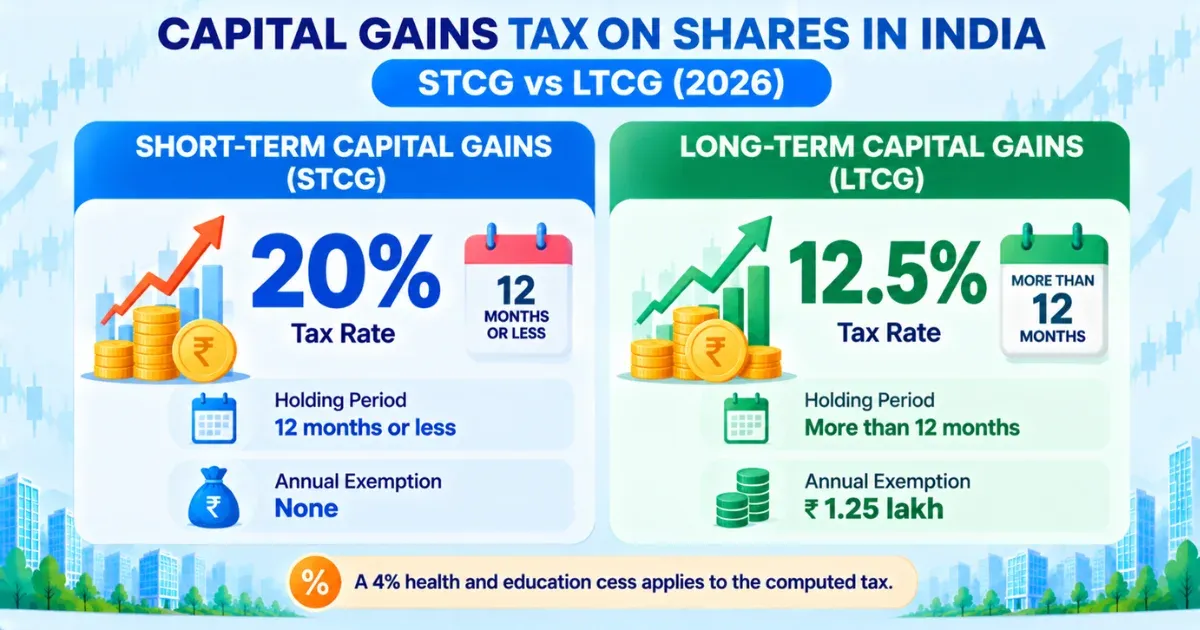
Short-term capital gains on listed equity shares are taxed at a flat 20 percent under the applicable section when Securities Transaction Tax has been paid on the sale. The holding period test is straightforward: 12 months or less from the date of purchase to the date of sale.
No annual exemption applies to short-term gains. Every rupee of short-term capital gain is taxable at 20 percent plus 4 percent cess. The effective rate is therefore 20.8 percent before any surcharge. Chapter VI-A deductions and the Section 87A rebate are not available against this tax.
Example: An investor buys 100 shares of a listed company for Rs 2,000 per share (total cost Rs 2,00,000) on 1 May 2025. The investor sells the same shares on 15 March 2026 for Rs 2,500 per share (total sale Rs 2,50,000). The holding period is about 10.5 months, so the gain of Rs 50,000 is short-term. Tax at 20 percent is Rs 10,000. Cess at 4 percent adds Rs 400. Total tax is Rs 10,400.
Long-term capital gains on listed equity shares held for more than 12 months are taxed at 12.5 percent only on the amount that exceeds Rs 1.25 lakh in a financial year. Gains up to Rs 1.25 lakh are fully exempt. Indexation benefit is not available for listed equity.
The exemption is calculated on the aggregate long-term gains from all eligible shares and equity-oriented mutual fund units sold during the financial year (1 April to 31 March). It is not available per transaction. Unused exemption does not carry forward to the next year.
Example: An investor sells shares held for 18 months and realises a long-term gain of Rs 2,00,000 in FY 2026-27. The first Rs 1,25,000 is exempt. The taxable portion is Rs 75,000. Tax at 12.5 percent is Rs 9,375. Cess at 4 percent adds Rs 375. Total tax is Rs 9,750.
| Particulars | Short-Term Capital Gains | Long-Term Capital Gains |
|---|---|---|
| Holding period | 12 months or less | More than 12 months |
| Tax rate (transfers on or after 23 July 2024) | 20% | 12.5% |
| Annual exemption | None | Rs 1.25 lakh |
| Indexation | Not available | Not available |
| Effective rate with 4% cess | 20.8% | 13% |
| Applicable section (Income Tax Act, 2025) | Section 196 | Section 198 |
Data sourced from Finance (No. 2) Act, 2024 and Income Tax Department guidance. Last updated: October 2026.
Capital gain equals sale consideration minus cost of acquisition minus allowable transfer expenses. For listed shares, the sale price is the amount received through the exchange. Transfer expenses such as brokerage can be deducted.
Consider this worked example for long-term gains. An investor purchased 200 shares of Reliance Industries on 10 January 2024 at Rs 2,500 per share. Total cost is Rs 5,00,000. The investor sells all 200 shares on 20 October 2026 at Rs 3,000 per share. Total sale value is Rs 6,00,000. Holding period is more than 12 months.
Long-term capital gain = Rs 6,00,000 - Rs 5,00,000 = Rs 1,00,000. Since the gain is below Rs 1.25 lakh, tax is zero. If the sale price had been Rs 3,500 per share, the gain would be Rs 2,00,000. Taxable gain after exemption would be Rs 75,000. Tax at 12.5 percent would be Rs 9,375 plus cess.
Investors must retain contract notes and demat statements. These documents show purchase and sale dates, quantities, and prices needed for accurate computation in the Income Tax Return.
Shares acquired before 1 February 2018 receive grandfathering relief for long-term capital gains. Gains that accrued up to 31 January 2018 are not taxed. The cost of acquisition is the higher of the actual purchase price or the lower of the fair market value on 31 January 2018 and the sale price.
Fair market value is the highest quoted price of the share on a recognised stock exchange on 31 January 2018. If the share did not trade on that date, the highest price on the immediately preceding trading day is used.
Example: An investor bought shares in 2016 for Rs 100 each. On 31 January 2018 the highest price was Rs 150. The investor sells in 2026 for Rs 200. The cost for tax purposes becomes Rs 150. The taxable long-term gain per share is Rs 50, subject to the annual exemption and 12.5 percent rate.
This provision continues to apply for eligible shares. Investors should check historical prices on NSE or BSE archives when computing gains on older holdings.
Securities Transaction Tax must be paid for the concessional rates under the listed equity provisions to apply. For delivery-based equity trades, STT is 0.1 percent on both the buy side and the sell side of the transaction value. For intraday equity trades, STT is 0.025 percent on the sell side only.
STT is not deductible while computing capital gains under Section 48. It is a separate levy collected by the exchange. Investors can read more about the current rates and calculation method in the dedicated guide on what is STT.
If STT is not paid, for example on off-market transfers of listed shares, the gains do not qualify for the 20 percent or 12.5 percent rates. They are taxed under the general capital gains provisions, which may result in higher liability.
Listed equity shares held for more than 12 months qualify for long-term treatment at 12.5 percent above the Rs 1.25 lakh exemption. Unlisted shares require a holding period of more than 24 months for long-term treatment. Long-term gains on unlisted shares are taxed at 12.5 percent without indexation and without the Rs 1.25 lakh exemption.
Short-term gains on unlisted shares are added to total income and taxed at the investor’s applicable slab rates. Investors dealing with IPO allotments or pre-listing shares should review the separate rules for capital gains tax on IPO and unlisted shares.
Short-term capital loss can be set off against both short-term and long-term capital gains in the same year. Long-term capital loss can be set off only against long-term capital gains. Unabsorbed losses can be carried forward for up to eight assessment years, provided the Income Tax Return is filed within the due date.
Investors who book losses before the end of the financial year can reduce taxable gains. Records of loss-making transactions must be maintained in the same manner as profitable ones. The Income Tax Department requires reporting of both gains and losses in Schedule CG of the return.
Many investors misclassify the holding period by counting calendar months incorrectly or by using the settlement date instead of the trade date. The relevant date is the date of transfer, which is the trade date on the exchange.
Another frequent error is forgetting the Rs 1.25 lakh exemption when calculating long-term tax or applying the old 15 percent and 10 percent rates to sales made after 22 July 2024. Investors also overlook the 4 percent cess when estimating the final liability.
Failing to report long-term gains that fall below the exemption limit is another mistake. Even exempt gains must be disclosed in the Income Tax Return. Accurate reporting reduces the risk of notices from the tax department.

Confused about chart patterns & stock analysis?
Use
Dhanarthi Stock Guru
to chat, analyze price patterns, and ask questions directly.
Capital gains tax on shares in India for listed equity remains straightforward once the holding period and applicable rate are identified. Short-term gains attract 20 percent tax. Long-term gains attract 12.5 percent tax only above Rs 1.25 lakh per financial year. The rates have stayed stable since July 2024. Investors should maintain proper records, apply the grandfathering rule where relevant, and file returns on time to claim any loss set-off. Consulting a tax professional for complex situations or large portfolios is advisable.
This article is for educational purposes only. It does not constitute investment advice. Please consult a SEBI-registered financial advisor before making investment decisions.
1. What is the capital gains tax rate on shares in India for 2026?
Short-term capital gains on listed equity shares held for 12 months or less are taxed at 20 percent. Long-term capital gains on shares held for more than 12 months are taxed at 12.5 percent only on the amount exceeding Rs 1.25 lakh in a financial year. Both rates are subject to 4 percent cess.
2. Is the Rs 1.25 lakh exemption available every year?
Yes. The exemption of Rs 1.25 lakh on long-term capital gains from listed equity shares and equity mutual funds resets each financial year. It is not a lifetime limit. Gains below this threshold in any year attract no tax, but the gains must still be reported.
3. Can I set off short-term capital loss against long-term capital gains?
Yes. Short-term capital loss can be set off against both short-term and long-term capital gains in the same financial year. Long-term capital loss can be set off only against long-term capital gains. Unused losses can be carried forward for eight years if the return is filed on time.
4. Does the grandfathering rule still apply in 2026?
Yes. For shares purchased before 1 February 2018, the cost of acquisition is determined using the fair market value as on 31 January 2018. This protects gains that accrued up to that date from the long-term capital gains tax.
5. What happens if STT is not paid on the sale of listed shares?
If Securities Transaction Tax is not paid, the special rates of 20 percent and 12.5 percent do not apply. The gains are taxed under the general capital gains provisions of the Income Tax Act, which may result in a higher tax liability depending on the holding period and other income.
Share Market
IPO
Artificial Intelligence
Semi Conductor