




Best Nifty Next 50 Index Fund India 2026
October 20, 2026


TABLE OF CONTENTS
Get AI Summary



Best Nifty Next 50 Index Fund tracks the Nifty Next 50 Total Return Index and gives exposure to the 50 companies ranked 51 to 100 by free-float market capitalisation on NSE. Direct plans of larger funds such as ICICI Prudential and UTI currently show expense ratios between 0.38 percent and 0.43 percent with category AUM of about Rs 28,210 crore as of mid-October 2026 (Source: INDmoney compilation from AMFI data, 19 October 2026).
Indian investors looking for equity exposure beyond the Nifty 50 often turn to the Nifty Next 50. This index holds the next tier of large companies after the top 50 and has delivered higher returns than the Nifty 50 in several recent periods. A Nifty Next 50 index fund replicates the index by buying the same stocks in the same weights. You receive diversified ownership in companies that have already grown into large-cap status but still carry higher growth potential than the largest blue chips.
A Nifty Next 50 index fund is an open-ended mutual fund that aims to match the total returns of the Nifty Next 50 Index. The index selects 50 stocks from the Nifty 100 after removing the Nifty 50 constituents. Weights use free-float market capitalisation, and the index rebalances semi-annually.
NSE launched the index in 1996. As of March 2026, it represented about 11.22 percent of the free-float market capitalisation of all NSE-listed stocks (Source: NSE Indices factsheet). Funds must invest at least 95 percent of assets in the index stocks and related derivatives. The remaining portion sits in cash or money-market instruments to handle inflows and outflows.
Because the fund follows rules instead of active stock selection, the expense ratio stays low. Tracking error arises mainly from cash drag, expense charges, and timing of index changes. Direct plans eliminate distributor commissions and further reduce the total expense ratio.
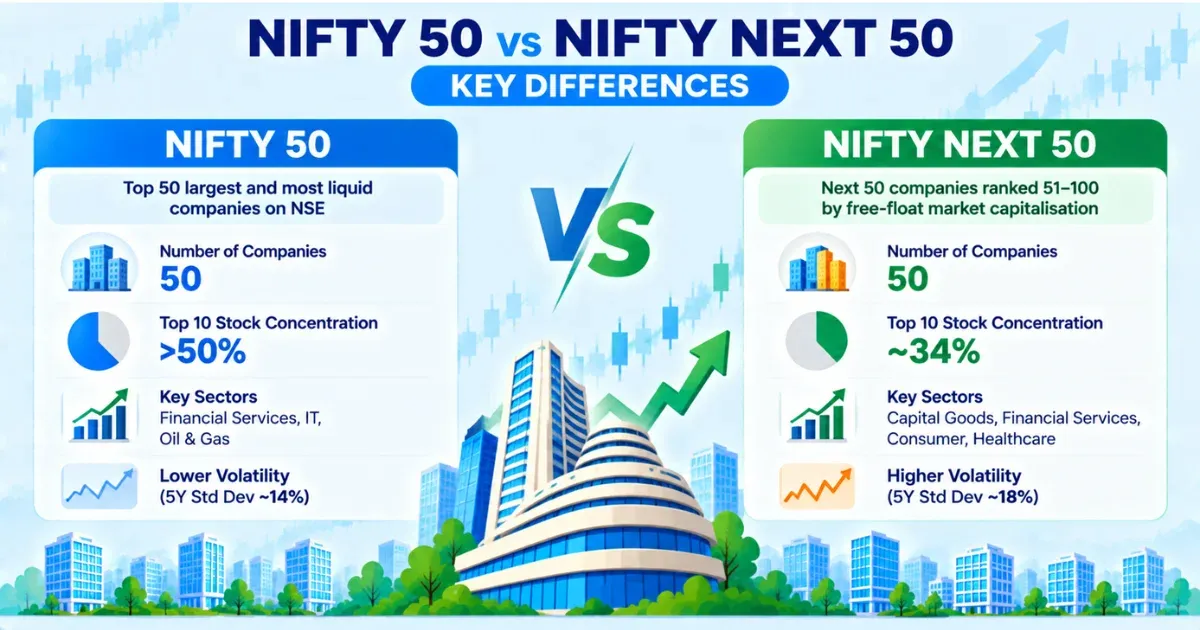
The Nifty 50 holds India’s 50 largest and most liquid companies. The Nifty Next 50 holds the subsequent 50. Concentration differs sharply. The top 10 stocks in the Nifty 50 often account for more than 50 percent of the index. In the Nifty Next 50 the top 10 typically contribute around 34 percent.
Sector weights also diverge. Capital goods form the largest sector in the Nifty Next 50 at roughly 20 percent, followed by financial services at about 18 percent. The Nifty 50 is dominated by financial services, information technology, and oil and gas. As of 30 September 2026, the largest Nifty Next 50 stock was Divi's Laboratories at 4.84 percent, followed by TVS Motor Company at 3.95 percent and Hindustan Aeronautics at 3.63 percent (Source: NSE Indices factsheet dated 30 September 2026).
Recent performance has favoured the Next 50. The Nifty Next 50 Total Return Index returned +1.37 percent year-to-date through 30 September 2026 while the Nifty 50 Total Return Index fell 12.61 percent (Source: independent compilation of NSE data published October 2026). Over five years ending September 2026 the Next 50 TRI delivered 11.44 percent annualised versus 6.38 percent for the Nifty 50 TRI. Higher volatility accompanies the extra return. Five-year annualised standard deviation sits near 18 percent for the Next 50 against roughly 14 percent for the Nifty 50.
Several asset management companies offer Nifty Next 50 index funds. Larger AUM usually supports tighter tracking and better liquidity. The table below lists leading direct-plan growth options as of 19 October 2026.
| Fund Name | AUM (Rs Cr) | Expense Ratio (%) | 1-Year Return (%) | 3-Year Return (%) | 5-Year Return (%) |
|---|---|---|---|---|---|
| ICICI Prudential Nifty Next 50 Index Fund | 9,744 | 0.38 | -0.22 | 15.32 | 9.56 |
| UTI Nifty Next 50 Index Fund | 7,295 | 0.43 | -0.02 | 15.56 | 9.70 |
| HDFC Nifty Next 50 Index Fund | 2,620 | 0.36 | -0.14 | 15.29 | NA |
| SBI Nifty Next 50 Index Fund | 2,318 | 0.37 | -0.07 | 15.51 | 9.69 |
| DSP Nifty Next 50 Index Fund | 1,350 | 0.37 | -0.01 | 15.50 | 9.75 |
| Kotak Nifty Next 50 Index Fund | 1,289 | 0.24 | 0.04 | 15.58 | 9.86 |
| Navi Nifty Next 50 Index Fund | 1,275 | 0.26 | -0.04 | 15.47 | NA |
| Axis Nifty Next 50 Index Fund | 532 | 0.22 | 0.07 | 15.52 | NA |
Data sourced from INDmoney compilation of AMFI and fund house data. Last updated: 19 October 2026. Returns are for direct growth plans. Figures change with market movements.
ICICI Prudential holds the largest AUM at Rs 9,744 crore. UTI follows at Rs 7,295 crore. Both have operated long enough to show five-year track records. Kotak and Axis report the lowest expense ratios at 0.24 percent and 0.22 percent respectively, though their AUM remains smaller. Category total AUM stood at Rs 28,210 crore with net inflows of Rs 656 crore in September 2026 (Source: INDmoney, October 2026).
Expense ratios for direct plans of the bigger funds range from 0.36 percent to 0.43 percent. Regular plans add 0.4 to 0.6 percentage points for distributor commissions. Over a decade the difference compounds. A 0.4 percent annual cost reduction on a Rs 10 lakh investment growing at 12 percent produces roughly Rs 1.1 lakh more after 15 years before tax.
Choose a fund with AUM above Rs 1,000 crore when possible. Larger size reduces the impact of cash inflows on tracking. Check the latest tracking error in the factsheet. Most well-run Nifty Next 50 funds keep tracking error below 0.5 percent annualised.
Prefer the direct plan. You can invest through the fund house website, a registered mutual fund platform, or your broker. Minimum SIP amounts start at Rs 100 to Rs 500 depending on the fund. Exit loads are usually nil or apply only for a short period after purchase.
Review the portfolio turnover and cash level. Index funds rebalance when the underlying index changes. High turnover is normal during semi-annual reviews. Persistent cash above 2-3 percent may signal operational inefficiency.
Compare the same fund’s performance against its benchmark TRI, not against other categories. A fund that trails its own index by 0.3 percent annually is performing as designed. One that trails by 1 percent needs scrutiny.
From 2000 onward the Nifty Next 50 has shown deeper drawdowns than the Nifty 50. The maximum monthly drawdown in one long-term backtest reached about 75 percent versus 55 percent for the Nifty 50. The 2008 calendar year produced steeper losses in the Next 50.
Longer periods reward the higher risk. Ten-year annualised returns for Next 50 index funds have averaged near 12.3 percent in recent data, compared with about 11.1 percent for Nifty 50 index funds (Source: compilation ending September 2026). Fifteen-year SIP calculations in one independent study showed higher XIRR for the Next 50 than for the Nifty 50 across 5-, 10-, and 15-year horizons ending August 2026.
Volatility remains elevated. Investors who need money within three to five years face a higher chance of negative returns. The index has also lagged the Nifty 50 in periods when large-cap quality and defensive sectors led the market.
Investors who already hold a Nifty 50 or large-cap active fund can add a Next 50 fund for broader large-cap coverage. The combination approximates the Nifty 100 while allowing separate allocation control. A typical equity allocation might place 50-60 percent in Nifty 50, 20-30 percent in Next 50, and the rest in mid- and small-cap funds, subject to risk tolerance.
Younger investors with a 10-year or longer horizon often accept the extra volatility for the historical return premium. Those nearing retirement or with lower risk appetite may prefer pure Nifty 50 exposure. The funds suit systematic investment plans because rupee-cost averaging smooths entry points during volatile periods.
Common investor mistakes include treating Next 50 funds as mid-cap substitutes. The stocks remain large-cap by SEBI definition. Another error is ignoring expense ratios when comparing funds that track the same index. A 0.2 percent difference compounds meaningfully over decades.
Equity mutual funds, including Nifty Next 50 index funds, follow equity taxation rules. Short-term capital gains on units held one year or less are taxed at 20 percent. Long-term capital gains above Rs 1.25 lakh in a financial year attract 12.5 percent tax. Dividends are added to income and taxed at slab rates, though most index funds are growth options that reinvest dividends.
No tax arises until you redeem units. SIP investors calculate holding period for each instalment separately. Indexation is not available under the current equity tax regime. Investors in higher tax brackets still benefit from the preferential equity rates compared with debt funds.
Liquidity risk is low because the underlying stocks trade actively on NSE. Tracking error risk exists in every index fund. Sector concentration can amplify moves. Capital goods and financial services together exceed 35 percent of the index in recent snapshots. A sharp correction in either sector affects the fund more than a broad-market index.
Corporate governance risk appears in a few constituents that carry promoter-related or regulatory scrutiny. Index inclusion does not guarantee quality. Investors should understand that passive funds hold every stock in the index regardless of individual fundamentals.
Market-cycle risk is material. When the largest 50 companies outperform, Next 50 funds lag. The reverse occurs when mid-to-large transition stocks lead. No fund manager adjusts weights to reduce exposure during unfavourable cycles.
Open a mutual fund account or use an existing demat and trading account. Search for the chosen fund’s direct growth plan. Set a SIP amount that fits your monthly surplus. Most platforms allow starting with Rs 500 or less. Confirm the expense ratio and AUM on the latest factsheet before the first debit.
Review the investment once a year. Check whether the fund still tracks its index closely and whether your overall asset allocation still matches your goals. Avoid frequent switching between similar index funds. Transaction costs and tax events reduce returns.
For investors who also hold individual stocks, a Nifty Next 50 fund reduces the need to research and monitor 50 separate companies. The fund automatically rebalances when index weights change. This automation is valuable for those who prefer rules-based investing over active decision making.
Many investors already own a Nifty 50 index fund. Adding a Next 50 fund changes the risk-return profile. The combined portfolio tracks closer to the Nifty 100 while retaining the ability to overweight or underweight either segment. Recent five-year data show the Next 50 segment contributing higher returns at the cost of higher volatility.
Expense ratios for large Nifty 50 index funds are often 0.10 to 0.15 percentage points lower than Next 50 funds of similar size. The absolute difference remains small. Liquidity in the underlying stocks is excellent for both indices. Readers comparing options can review dedicated coverage of best Nifty 50 index funds in India for side-by-side data.
An investor aged 35 with a 15-year equity horizon might allocate 40 percent to a low-cost Nifty 50 index fund, 25 percent to a Nifty Next 50 index fund, 20 percent to a mid-cap index fund, and 15 percent to a small-cap or factor fund. The Next 50 sleeve supplies exposure to companies such as Adani Power and Tata Motors without requiring separate research.
During the 2020-2021 recovery the Next 50 outperformed strongly. During the 2022 global rate-hike period it underperformed. Staying invested through both cycles has historically produced competitive long-term results. Investors who panic-sold during drawdowns missed subsequent recoveries.
Check the fund’s factsheet quarterly. Note any large deviation in tracking error or cash levels. Confirm that the top holdings still match the published index weights. NSE publishes the official index constituents and weights on its website.
Rebalance your overall portfolio annually. If the Next 50 allocation has grown beyond the target due to outperformance, trim and redeploy to underweight segments. This maintains the intended risk level. Automated rebalancing features on some platforms simplify the process.
The best Nifty Next 50 index fund depends on AUM, expense ratio, and tracking record. ICICI Prudential and UTI currently lead on size. Kotak and Axis offer the lowest costs among established options. All track the same index, so differences arise mainly from expenses and operational efficiency.
Nifty Next 50 funds provide a rules-based way to own the next tier of Indian large companies. Historical data show higher long-term returns than the Nifty 50 at the cost of higher volatility. Investors with a multi-year horizon and existing large-cap exposure can use these funds to broaden diversification. Always verify the latest factsheet numbers and consult a SEBI-registered advisor for personal allocation decisions. Readers seeking broader passive options can also review our guide to the best index funds in India.
This article is for educational purposes only. It does not constitute investment advice. Please consult a SEBI-registered financial advisor before making investment decisions.
1. What is the best Nifty Next 50 index fund in India right now?
ICICI Prudential Nifty Next 50 Index Fund holds the highest AUM at Rs 9,744 crore as of mid-October 2026 with a direct expense ratio of 0.38 percent. UTI Nifty Next 50 Index Fund follows closely on size. Lower-cost options include Kotak at 0.24 percent and Axis at 0.22 percent.
2. How does a Nifty Next 50 index fund differ from a Nifty 50 index fund?
Nifty Next 50 funds hold the companies ranked 51 to 100 by free-float market capitalisation. Nifty 50 funds hold the top 50. The Next 50 shows lower concentration in the top holdings and different sector weights, with capital goods as the largest sector in recent data.
3. What is the expense ratio range for Nifty Next 50 index funds?
Direct plans of larger funds typically charge 0.22 percent to 0.43 percent. Regular plans cost more because of distributor commissions. Check the latest factsheet because ratios can change.
4. Are Nifty Next 50 index funds suitable for beginners?
Beginners with a long investment horizon can use them for diversified large-cap exposure. The funds require no stock selection. Understand the higher volatility compared with Nifty 50 funds before investing a large sum.
5. What is the tax treatment of gains from Nifty Next 50 index funds?
Gains on units held one year or less are short-term and taxed at 20 percent. Gains above Rs 1.25 lakh in a financial year on units held longer than one year are taxed at 12.5 percent. Growth options do not distribute dividends.
Share Market
IPO
Artificial Intelligence
Semi Conductor