





SGB vs Gold ETF: Which Is Better in 2026?
October 22, 2026


TABLE OF CONTENTS
Get AI Summary



SGB vs Gold ETF comparison shows Sovereign Gold Bonds give 2.5% annual interest plus gold price returns, with capital gains tax-free at maturity only for original RBI subscribers. Gold ETFs offer high liquidity and SIP flexibility but charge 0.35-0.81% expense ratio and face 12.5% LTCG tax after 12 months. No new SGBs issued since February 2024.
Research Stocks Smarter with Dhanarthi AI Screener
Analyze 5,000+ NSE & BSE stocks with 150+ custom filters, real-time volume breakout scans, and transparent fundamental data.
Use Dhanarthi Screener
A Sovereign Gold Bond is a government security issued by the Reserve Bank of India on behalf of the Government of India. Each unit is denominated in grams of gold and redeems at the prevailing gold price after eight years.
RBI pays 2.5% simple interest per year on the original issue price, credited half-yearly to the investor’s bank account. The interest is taxable at the investor’s slab rate. Capital gains on redemption at maturity are exempt for individual investors who subscribed during the original RBI issue window and hold continuously till maturity.
No new SGB tranche has been issued since February 2024 Series IV. Existing bonds remain valid and continue to pay interest as scheduled. Investors can still buy older tranches on the secondary market through demat accounts, but tax treatment changed from 1 April 2026.
A Gold ETF is a mutual fund scheme that holds physical gold of 99.5% purity in a vault. Units trade on NSE and BSE like shares, so investors need a demat and trading account.
Nippon India ETF Gold BeES is the largest, with AUM of Rs 56,982 crore as of 30 September 2026 (Source: AMFI). Expense ratios for popular Gold ETFs range from 0.35% to 0.81%. Units can be bought or sold any trading day during market hours. Minimum investment is typically one unit, currently around Rs 118-125.
Gold ETFs do not pay interest. Returns come only from gold price movement minus the expense ratio. Investors can also start SIPs through some platforms or buy units regularly on the exchange.
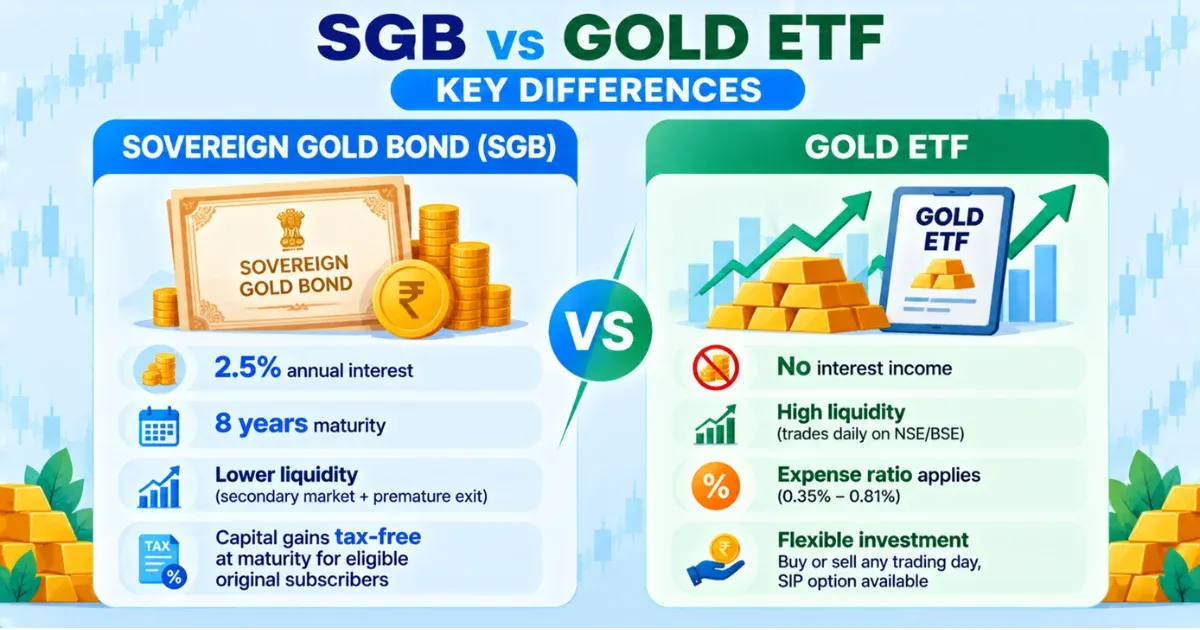
The table below compares the two options using data as of October 2026.
| Feature | Sovereign Gold Bond | Gold ETF |
|---|---|---|
| Issuer | RBI / Government of India | SEBI-registered AMC |
| Additional income | 2.5% p.a. on issue price | None |
| Expense ratio | Nil | 0.35% to 0.81% |
| Liquidity | Secondary market + RBI premature exit after 5 years | Daily on NSE/BSE |
| Minimum investment | 1 gram | 1 unit (~Rs 118) |
| Capital gains tax at maturity | Tax-free for original subscribers only | 12.5% LTCG after 12 months |
| New investment available | No (secondary market only) | Yes |
| Lock-in | 8 years (premature from year 5) | None |
Data sourced from RBI, AMFI and SEBI circulars. Last updated: October 2026.
Tax treatment is the biggest differentiator.
For original SGB subscribers who hold till the full eight-year maturity, capital gains are exempt under Section 47 of the Income Tax Act. Interest of 2.5% remains taxable at slab rates.
From 1 April 2026, secondary market buyers of SGBs no longer receive the maturity tax exemption. Their gains are taxed as long-term capital gains at 12.5% after 12 months holding, the same rate as Gold ETFs. Short-term gains (under 12 months) are added to income and taxed at slab rates for both.
Gold ETF units held more than 12 months qualify for 12.5% LTCG without indexation. Units sold within 12 months are taxed at the investor’s income slab rate. No additional interest income exists.
Example: An investor buys Rs 1 lakh of gold exposure.
RBI’s premature redemption price for SGB 2020-21 Series VII was fixed at Rs 14,614 per unit on 19 October 2026, giving original online subscribers an absolute capital gain of about 192% from the Rs 5,001 issue price (Source: RBI, Business Standard, 19 October 2026). Interest of 2.5% was paid separately and taxed.
Assume gold prices rise at 8% CAGR over 8 years on a Rs 1 lakh investment.
Gold ETF (0.6% average expense ratio): effective return roughly 7.4%. Corpus grows to about Rs 1.77 lakh. After 12.5% LTCG on the gain, net value is approximately Rs 1.67 lakh.
Original SGB subscriber: gold value reaches about Rs 1.85 lakh (tax-free). Plus cumulative interest of Rs 20,000 before tax. Net of interest tax (assume 30% slab), the investor ends with roughly Rs 1.99 lakh.
The gap comes from the 2.5% coupon and the tax exemption available only to original subscribers. Secondary market SGB buyers lose the tax exemption and therefore sit closer to Gold ETF outcomes after costs.
Past data shows early SGB tranches delivered strong absolute returns. The October 2020 series produced 192% capital appreciation by October 2026 excluding interest (Source: RBI redemption price announcement).
Gold ETFs offer the highest liquidity. SBI Gold ETF and Nippon India ETF Gold BeES regularly trade crores of rupees daily on NSE. Investors can exit any market day at near-NAV prices if volumes are sufficient.
SGBs trade on exchanges but volumes are lower for many series. Investors can also request premature redemption from RBI after five years on specified interest payment dates. RBI publishes the calendar in advance. For 2026-27, 32 tranches are eligible for early exit between October 2026 and March 2027 (Source: RBI circular, August 2026).
Secondary market prices of SGBs can trade at a small premium or discount to the IBJA gold reference price. As of mid-October 2026, average premium across active series was about 1% (Source: retail bonds trackers).
Choose existing SGBs (if already held from original issue) when the goal is long-term gold allocation of 5-8 years or more and tax efficiency matters. The 2.5% interest and tax-free maturity remain intact for those holders.
Choose Gold ETFs for new money when flexibility, SIP-style accumulation, or the ability to exit within a few years is important. Lower expense ratio schemes such as Mirae Asset Gold ETF (0.35%) or Aditya Birla Sun Life Gold ETF (0.44%) reduce the cost drag.
Investors who bought SGBs on the secondary market after 1 April 2026 should treat them similarly to Gold ETFs for tax purposes while noting the lower liquidity and fixed maturity date.
A common investor mistake is assuming every SGB purchase still enjoys tax-free maturity. Budget 2026 restricted that benefit to original RBI subscribers only. Checking the purchase channel before buying secondary market bonds avoids this error.
For pure gold price tracking with daily liquidity, many investors also compare Gold ETFs with gold mutual funds. The Gold ETF vs Gold Mutual Fund article covers the demat versus non-demat difference and SIP suitability.
Gold prices in India crossed Rs 1.5 lakh per 10 grams in early October 2026. RBI used the simple average of IBJA closing prices for three business days to set the 19 October 2026 redemption at Rs 14,614 per gram.
Gold ETF inflows remained strong. AMFI data showed continued net inflows into gold ETFs through 2025 and early 2026, with total category AUM exceeding Rs 1.5 lakh crore across top schemes by late January 2026. Nippon India ETF Gold BeES alone stood at Rs 56,982 crore AUM as of 30 September 2026.
No fresh SGB subscription window is open. Existing series continue to mature or become eligible for premature redemption according to the RBI calendar.

Confused about chart patterns & stock analysis?
Use
Dhanarthi Stock Guru
to chat, analyze price patterns, and ask questions directly.
For investors who already hold original-issue SGBs, the combination of 2.5% interest and tax-free capital gains at maturity remains the strongest post-tax outcome for an 8-year gold holding. For new capital in 2026, Gold ETFs provide the practical route with daily liquidity, SIP options and transparent pricing, subject to the 12.5% LTCG after 12 months and the expense ratio. Secondary market SGB purchases now carry similar tax treatment to ETFs while offering lower liquidity. Match the product to the holding period and tax status before allocating.
This article is for educational purposes only. It does not constitute investment advice. Please consult a SEBI-registered financial advisor before making investment decisions.
1. Is SGB better than Gold ETF in 2026?
Original SGB subscribers still receive 2.5% interest and tax-free maturity, which produces higher post-tax returns over 8 years. New investors cannot buy fresh SGBs, so Gold ETFs are the available option with daily liquidity.
2. Can I buy new Sovereign Gold Bonds in 2026?
No. The last tranche was issued in February 2024. Existing bonds trade on NSE and BSE, but no primary subscription window is open.
3. How is Gold ETF taxed in India?
Units held more than 12 months attract 12.5% long-term capital gains tax without indexation. Units sold within 12 months are taxed at the investor’s income slab rate.
4. What is the interest rate on Sovereign Gold Bonds?
SGBs pay 2.5% per annum on the original issue price, credited half-yearly. The interest is taxable at the investor’s slab rate.
5. Which has higher liquidity, SGB or Gold ETF?
Gold ETFs have higher daily liquidity on NSE and BSE. SGB secondary market volumes are lower, though RBI allows premature redemption after five years on specified dates.
Share Market
IPO
Artificial Intelligence
Semi Conductor