





Stock Market Basics for Beginners in India
October 24, 2026


TABLE OF CONTENTS
Get AI Summary



Stock market basics cover how shares of listed companies are bought and sold on regulated exchanges like the NSE and BSE under SEBI oversight. In India, this process requires a demat account and trading account with a registered broker, with settlement happening on a T+1 basis for most equities.
India's capital markets have grown rapidly. The total number of demat accounts crossed 240.59 million by the end of September 2026, according to data compiled from NSDL and CDSL. Unique investors stood at about 135 million as of August 2026 (Source: NSE data reported via Economic Times). This scale makes understanding the basics essential before placing any order.
The stock market is a regulated platform where investors buy and sell ownership stakes in publicly listed companies. When a company issues shares, buyers become partial owners. They share in profits through dividends and benefit if the share price rises due to higher demand or better company performance.
In India, almost all trading happens electronically. Buy and sell orders are matched by the exchange's system. Prices change continuously during market hours based on demand and supply. The Securities and Exchange Board of India (SEBI) sets the rules that protect retail investors and ensure fair dealing. For a detailed look at the regulator's role, see our guide on what is SEBI.
Companies raise fresh capital in the primary market through IPOs. Once listed, existing shares trade among investors in the secondary market on the exchanges. Money from secondary trades goes to the selling investor, not the company.
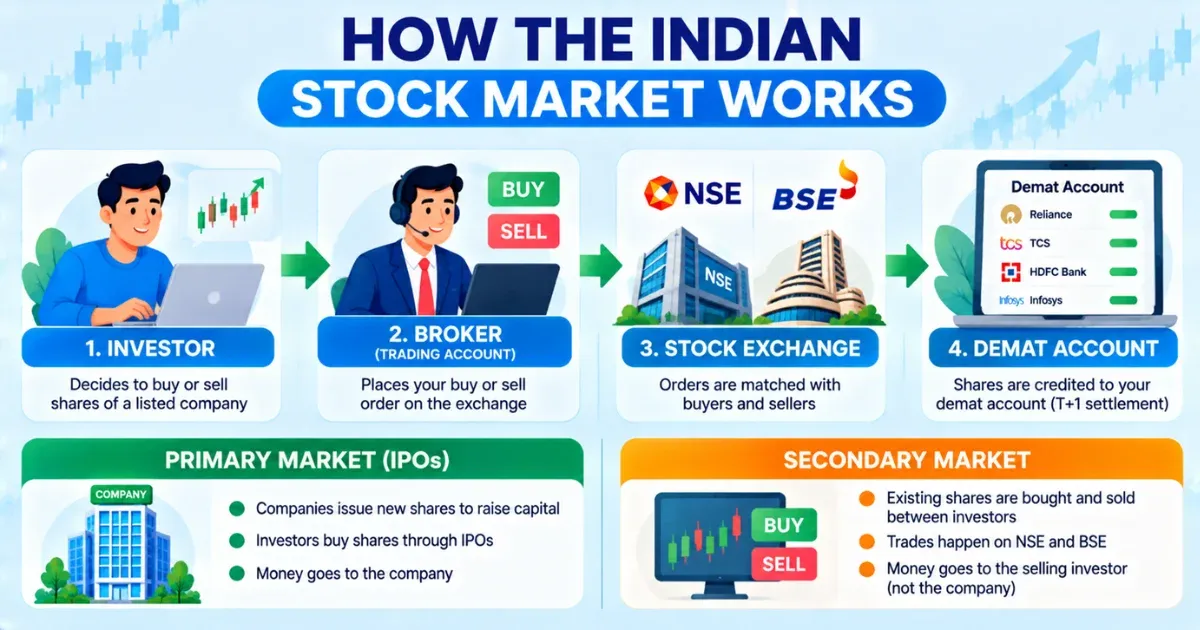
India has two main stock exchanges: the National Stock Exchange (NSE) and the Bombay Stock Exchange (BSE). Both run fully electronic trading systems and list most large companies.
BSE, established in 1875, is Asia's oldest exchange. It lists a higher number of companies, including many smaller ones. Its benchmark index is the Sensex, which tracks 30 large companies.
NSE, started in 1992, handles the majority of trading volume. Its flagship index is the Nifty 50, which follows 50 of the largest and most liquid stocks. As of 23 October 2026, the Nifty 50 closed at 22,600, down 0.39 percent for the day (Source: NSE and multiple market data platforms). The index uses free-float market capitalisation to weight its constituents.
Trading hours run from 9:15 AM to 3:30 PM IST, Monday to Friday, excluding holidays. A pre-open session from 9:00 to 9:15 AM helps set the opening price. Settlement for equity trades is T+1, meaning shares and funds move one trading day after the trade. For a full comparison of the two exchanges, read difference between NSE and BSE.
Most large-cap stocks trade on both exchanges. Liquidity is usually higher on NSE for the Nifty 50 names.
The stock market sits inside the broader capital market. The capital market deals with long-term funds for companies and governments through shares and bonds. The money market handles short-term instruments that mature within one year, such as treasury bills and commercial papers.
| Parameter | Money Market | Capital Market |
|---|---|---|
| Maturity | Up to 1 year | Usually more than 1 year |
| Purpose | Short-term liquidity | Long-term capital formation |
| Risk | Generally lower | Higher, market-linked |
| Main instruments | T-Bills, CDs, CPs | Shares, bonds, debentures |
| Regulator (India) | RBI | SEBI |
| Liquidity | Very high | Varies by security |
Data sourced from standard market classifications and RBI/SEBI frameworks. Last updated: October 2026.
Investors use the money market for parking surplus cash with low risk. They use the capital market, including stocks, for longer-term growth. Understanding the distinction helps beginners decide where their money belongs. Our detailed comparison appears in money market vs capital market.
Demat account: Holds shares in electronic form. Like a bank account for securities. Opened through a depository participant linked to NSDL or CDSL.
Trading account: Used to place buy and sell orders on the exchange. Linked to the demat account and bank account.
Index: A basket of stocks that shows overall market direction. Nifty 50 and Sensex are the most watched.
Bull market: Period when prices rise over time. Bear market: period when prices fall.
Market capitalisation: Total value of a company's shares (price times number of shares outstanding).
P/E ratio: Share price divided by earnings per share. Shows how much investors pay for each rupee of profit.
Dividend: Cash paid by a company to shareholders from profits.
IPO: Initial Public Offering, when a company sells shares to the public for the first time.
T+1 settlement: Trade date plus one business day for delivery of shares and money.
These terms appear daily in market news and broker platforms. Knowing them reduces confusion when placing the first order.
Share prices change because of buying and selling pressure. Higher demand pushes the price up. More sellers push it down. News about company results, economic data, interest rates, global events, and foreign investor flows all influence demand.
Company-specific factors include quarterly revenue, profit margins, new orders, and management guidance. Sector factors include policy changes or commodity prices. Market-wide factors include inflation data, RBI policy, and foreign institutional investor activity.
Tata Consultancy Services reported consolidated net profit of Rs 13,884 crore in Q2 FY27, up 4 percent quarter-on-quarter, with revenue of Rs 73,188 crore, up 11.2 percent year-on-year (Source: company results reported October 2026). Positive earnings often lift the stock and the IT sector.
Indices like the Nifty 50 reflect the collective movement of their constituent stocks. When large companies such as Reliance Industries or HDFC Bank move sharply, the index follows.
Complete KYC with a SEBI-registered broker. You need PAN, Aadhaar, and bank details. Video KYC is common now.
Open a demat and trading account. The process is online and usually takes one to two days.
Link your bank account for fund transfers.
Study basic financials of any company you consider. Check revenue growth, profit margins, debt levels, and return on equity over several years.
Start with a small amount. Many beginners begin with Nifty 50 stocks or index funds to reduce single-stock risk.
Place a limit order or market order through the broker's app or website. Confirm the quantity and price before submitting.
Track your holdings in the demat account. Review periodically but avoid daily checking if your horizon is long-term.
Past market cycles show that staying invested through volatility has rewarded patient investors in Indian equities over multi-year periods. The common mistake is selling after a sharp fall and missing the recovery.
Stock prices can fall. Company profits can disappoint. Economic slowdowns reduce demand. Beginners often overestimate their ability to time the market or pick the next winner.
Diversification across sectors lowers the impact of one bad stock. Using index funds or ETFs provides broad exposure. Keeping an emergency fund outside equities prevents forced selling. Reviewing annual reports and quarterly results builds understanding over time.
SEBI rules require brokers to display risk disclosures. Reading them is part of the process. Past performance of any stock or index does not guarantee future results.
Stock market basics in India centre on regulated trading of company shares on NSE and BSE, electronic holding through demat accounts, and price discovery driven by demand and supply. With over 240 million demat accounts and clear SEBI oversight, the infrastructure supports retail participation. Beginners who learn the key terms, open the required accounts, start small, and focus on company fundamentals rather than daily noise build a stronger foundation.
This article is for educational purposes only. It does not constitute investment advice. Please consult a SEBI-registered financial advisor before making investment decisions.
1. What is the stock market in simple words?
The stock market is a place where people buy and sell shares of companies. In India this happens mainly on the NSE and BSE through brokers. You need a demat account to hold the shares electronically.
2. How do beginners start in the Indian stock market?
Open a demat and trading account with a SEBI-registered broker after completing KYC. Study basic company numbers, start with a small amount in large companies or index funds, and place orders through the broker's platform.
3. What is the difference between NSE and BSE?
NSE handles higher trading volume and hosts the Nifty 50 index. BSE is older, lists more companies, and hosts the Sensex. Most large stocks trade on both exchanges.
4. How long does settlement take in the Indian stock market?
Most equity trades settle on a T+1 basis. Shares appear in your demat account and money reaches the seller one trading day after the trade date.
5. Can I lose money in the stock market?
Yes. Share prices can fall if company results disappoint or the broader market declines. Beginners reduce risk by diversifying, starting small, and avoiding concentration in single stocks.
Economic Times – September demat account addition falls to 2.89 million (7 October 2026) – Total demat accounts 240.59 million at end-September 2026, unique investors 135 million (August 2026, NSE data)
https://economictimes.indiatimes.com/markets/stocks/news/september-demat-account-addition-falls-to-2-89-million-amid-market-selloff/articleshow/134752521.cms
NSE India market data – Nifty 50 close of 22,600 on 23 October 2026
https://www.nseindia.com/
Company results and market reports – TCS Q2 FY27 consolidated net profit Rs 13,884 crore and revenue Rs 73,188 crore (October 2026)
(Publicly reported company filings and market summaries)
Standard classifications – Money market and capital market parameters drawn from RBI and SEBI frameworks and market education materials
Exchange history – BSE established 1875, NSE established 1992 (public records)
Share Market
IPO
Artificial Intelligence
Semi Conductor