




Call vs Put Options: Key Differences Explained
October 28, 2026


TABLE OF CONTENTS
Get AI Summary



Call vs put option contracts form the foundation of options trading on the NSE. A call option gives the buyer the right to buy the underlying at a fixed strike price, while a put option gives the right to sell at that strike. Both cost a premium, both can expire worthless, and both limit the buyer’s loss to the premium paid.
Traders use these contracts on indices such as Nifty and on individual stocks. Understanding the difference helps decide whether a position profits from a rise or a fall in price. This guide covers how each works on Indian exchanges, with real contract details and payoff examples drawn from NSE data.
A call option gives the buyer the right, but not the obligation, to purchase the underlying asset at the strike price on or before expiry. On the NSE, equity and index options are European-style, so exercise happens only at expiry.
Buyers of call options profit when the underlying price rises above the strike plus the premium paid. The maximum loss is the premium. Profit potential is theoretically unlimited because the price can keep rising.
Nifty options use a lot size of 65 units (Source: NSE contract specifications, October 2026). At a Nifty level near 22,750, one lot of a 22,750 call controls exposure worth roughly Rs 14.8 lakh. The buyer pays only the premium, which is a fraction of that notional value.
A put option gives the buyer the right, but not the obligation, to sell the underlying asset at the strike price on or before expiry. Buyers profit when the price falls below the strike minus the premium paid.
The maximum loss remains the premium paid. Profit is limited because the underlying price cannot fall below zero. Puts are commonly used both for directional bets and for portfolio insurance.
On the same Nifty contract, a put with a 22,750 strike gives the holder the right to sell 65 units of the index at that level. If Nifty closes at 22,400 at expiry, the put has intrinsic value of 350 points.
| Feature | Call Option | Put Option |
|---|---|---|
| Buyer’s right | Buy at strike | Sell at strike |
| Typical market view | Bullish | Bearish |
| Profits when | Price rises above strike + premium | Price falls below strike – premium |
| Maximum loss (buyer) | Premium paid | Premium paid |
| Maximum profit (buyer) | Unlimited | Limited to strike minus premium |
| Break-even at expiry | Strike + premium | Strike – premium |
| In-the-money when | Spot > strike | Spot < strike |
| Common use | Directional upside or covered calls | Directional downside or protective puts |
Data sourced from NSE equity derivatives specifications and standard option payoff definitions. Last updated: October 2026.
The table shows the core mechanical difference. Both contracts share the same premium-payment structure for the buyer, yet they move in opposite directions relative to the underlying price.
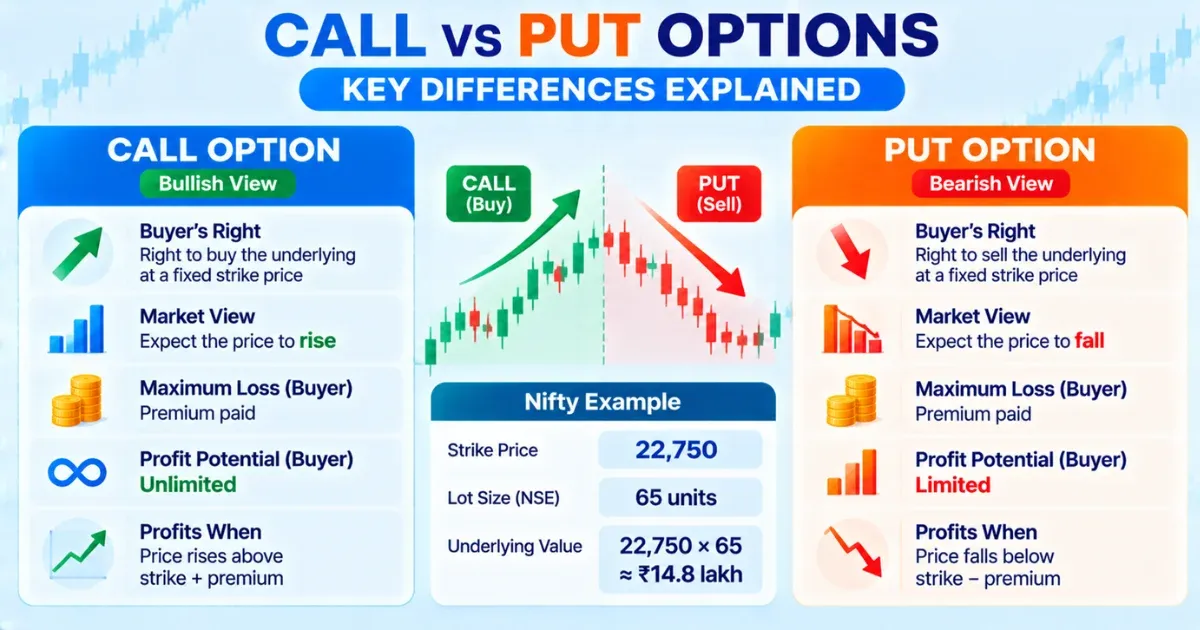
Assume Nifty trades at 22,750. A trader buys one lot of the 22,750 call at a premium of Rs 180. The total cost is 180 × 65 = Rs 11,700.
The same trader buys one lot of the 22,750 put at a premium of Rs 170. Total cost is Rs 11,050.
These figures follow the lot size published by NSE and typical premium relationships observed on the Nifty option chain (Source: NSE option chain data, October 2026). Actual premiums vary with time to expiry and implied volatility.
Moneyness describes the relationship between the spot price and the strike.
All equity and index options on NSE are European-style. Exercise occurs only on the expiry day. Stock options that finish ITM are settled by physical delivery of shares under SEBI rules introduced in 2019. Index options settle in cash.
For individual stocks, physical settlement means a long call that finishes ITM results in the buyer receiving shares and paying the strike price. A long put that finishes ITM results in the buyer delivering shares and receiving the strike price. Traders must hold sufficient funds or shares to meet settlement obligations.
Option buyers face limited risk equal to the premium paid. Option sellers (writers) face larger potential losses and must post margin. SEBI requires brokers to collect at least 50 percent of the total margin in cash or cash equivalents for F&O positions (effective from 2026 rules).
STT on options premium is 0.15 percent. Additional extreme loss margin applies to short options on expiry day. Position limits are monitored on a delta-adjusted basis. These measures aim to reduce retail losses that accompanied the earlier surge in weekly options volumes.
A common mistake is treating cheap OTM options as low-risk lottery tickets. Time decay accelerates as expiry approaches. Most OTM options expire worthless. Historical data from exchanges show that the majority of retail options buyers lose money over multi-month periods.
Buy a call when analysis of the underlying supports an upward move larger than the premium cost before expiry. Covered call writing is used by holders of shares who want to collect premium while capping upside.
Buy a put when analysis supports a decline, or when holding a portfolio that needs temporary protection. Cash-secured put writing is used by investors willing to buy the underlying at the strike if assigned.
Neither contract is inherently better. The choice depends on the price view, time horizon, and whether the position is for speculation or hedging. Before trading stock options, review the underlying company’s financials. The Dhanarthi Stock Screener filters NSE and BSE stocks by valuation, profitability, and debt ratios so the underlying can be checked first.
For deeper research on any listed company, the AI Financial Research Assistant can summarise filings, ratios, and recent news in one place.
Reliance Industries is among the most actively traded stock-option names on NSE. Its options follow the same call and put mechanics. A long call profits if the share price rises above the chosen strike plus premium. A long put profits if the price falls below the strike minus premium.
Because stock options settle by physical delivery when ITM, traders must be prepared to take or give delivery of the actual shares. Lot sizes for Reliance are set by NSE to keep contract value in the regulatory band. Always verify the current lot size and open interest on the NSE option chain before entering a position.
One frequent error is buying options with little time left until expiry. Theta (time decay) erodes value fastest in the final days. Another error is selling naked calls without sufficient margin. A sharp rally can produce large losses for the writer.
Many beginners also ignore the difference between index options (cash settled) and stock options (physically settled). Holding an ITM stock option into expiry without planning for delivery can lead to unexpected margin calls or forced settlement.
Past market cycles show that periods of high implied volatility often reverse. Buying options when volatility is already elevated raises the chance that the premium paid exceeds the subsequent move. Checking historical volatility against current implied volatility on the option chain provides context.
Call and put options give traders defined-risk ways to express bullish or bearish views on Nifty, Bank Nifty, or individual stocks. The buyer of a call profits from a rise; the buyer of a put profits from a fall. Both lose only the premium if the view is wrong. Sellers take on larger risk in exchange for the premium received.
NSE lot sizes, European exercise, and SEBI margin and settlement rules shape how these contracts behave in practice. Combining a clear price view with an understanding of premium cost, time decay, and settlement method reduces avoidable losses. Always verify current premiums and open interest on the official NSE option chain before trading.
This article is for educational purposes only. It does not constitute investment advice. Please consult a SEBI-registered financial advisor before making investment decisions.
1. What is the main difference between a call and a put option?
A call option gives the right to buy the underlying at the strike price. A put option gives the right to sell at the strike price. Call buyers profit if the price rises. Put buyers profit if the price falls.
2. Can I lose more than the premium I paid?
As the buyer of a call or put, the maximum loss is the premium paid. Option sellers can face larger losses and must maintain margin. Most beginners start by buying options only.
3. What do CE and PE mean on the NSE option chain?
CE stands for Call European. PE stands for Put European. All equity and index options on NSE are European-style and can be exercised only at expiry.
4. Are Nifty options cash settled?
Yes. Index options such as Nifty settle in cash. Stock options that finish in-the-money are settled by physical delivery of shares under SEBI rules.
5. Which is better for beginners, call or put options?
Neither is automatically better. The choice depends on whether the analysis points to a rise or a fall. Beginners should understand premium cost, time decay, and lot size before trading either.
Share Market
IPO
Artificial Intelligence
Semi Conductor