




NIFTYBEES vs Nifty 50: Key Differences Explained
August 10, 2026



TABLE OF CONTENTS
Get AI Summary





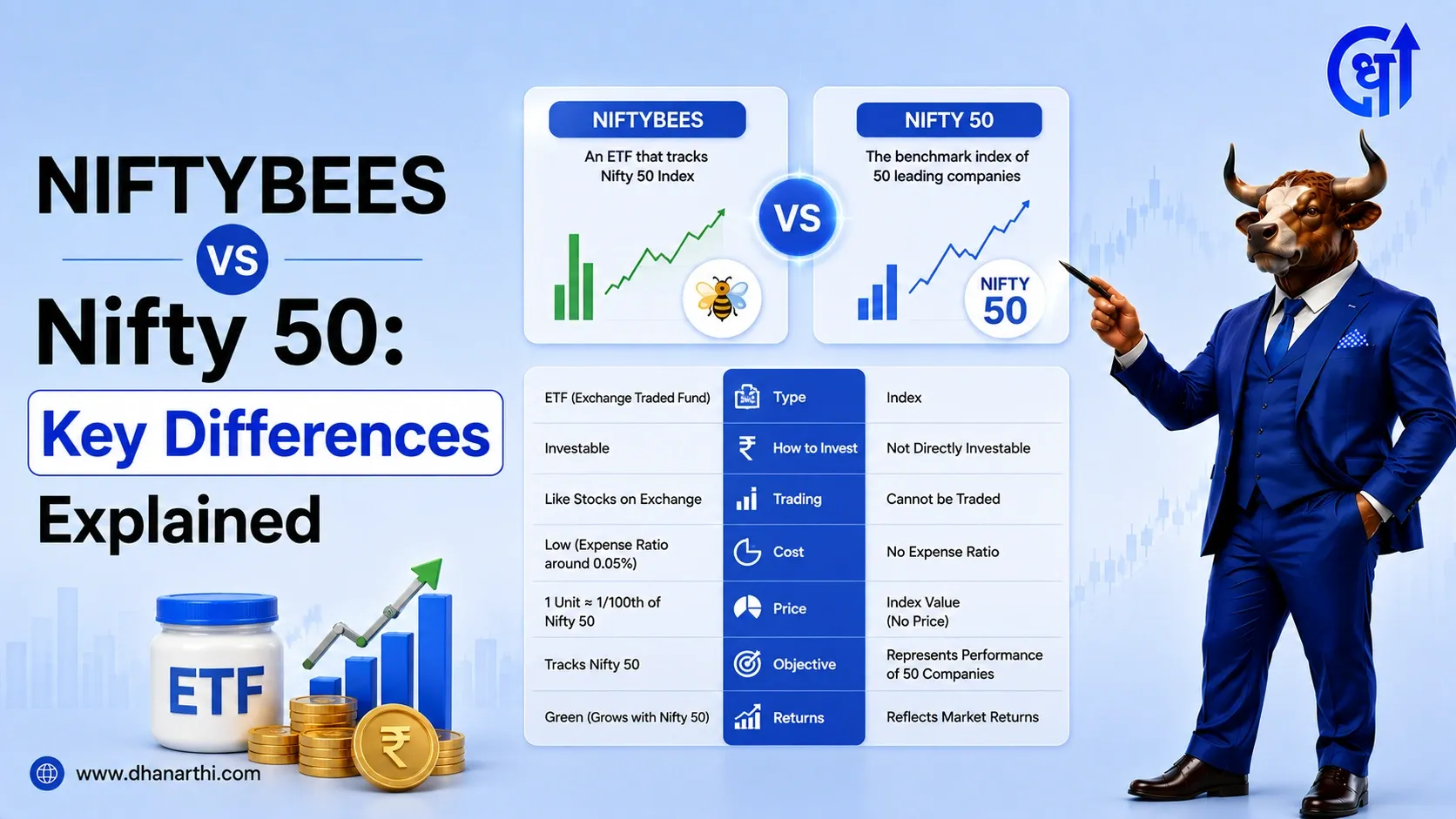
NIFTYBEES is an exchange traded fund that tracks the Nifty 50 index, while Nifty 50 itself is only a benchmark and cannot be bought directly. NIFTYBEES trades on the NSE like a stock, carries a 0.03% expense ratio, and lets investors gain equity exposure to India's 50 largest companies through a demat account.
Nifty 50 is a free-float market capitalization-weighted index of the 50 largest and most liquid companies listed on the NSE, spread across 13 sectors. It was launched on April 22, 1996, with a base date of November 3, 1995, and a base value of 1,000.
You cannot buy the Nifty 50 index itself. It is a number that moves up or down based on the combined performance of its 50 constituent stocks. To gain exposure, investors buy a product that tracks it, such as NIFTYBEES or a Nifty 50 index fund.
NIFTYBEES, formally Nippon India ETF Nifty 50 BeES, was constituted on December 28, 2001, and began trading on the NSE on January 8, 2002, making it India's first exchange traded fund. It was originally managed by Benchmark Asset Management, later acquired by Goldman Sachs AMC in 2011, before Reliance Mutual Fund (now Nippon India Mutual Fund) took over the ETF schemes in 2016.
NIFTYBEES holds the same 50 stocks as the Nifty 50 index in the same proportion. Its units trade on the exchange traded fund segment of the NSE throughout market hours, so the price moves in real time instead of being fixed once a day.
A common beginner mistake is assuming you can search for and buy "Nifty 50" on a broker app. What you are actually buying is a fund like NIFTYBEES, since the index itself is not a tradable security.
| Parameter | Nifty 50 (Index) | NIFTYBEES (ETF) |
|---|---|---|
| What it is | Benchmark index of 50 stocks | Fund that tracks the index |
| Can you buy it directly | No | Yes, via NSE |
| Pricing | Calculated continuously, not tradable | Real-time market price during trading hours |
| Account needed | None | Demat and trading account |
| Expense ratio | Not applicable | 0.03% |
| Launched | April 22, 1996 | December 28, 2001 |
Data sourced from NSE and Value Research. Last updated: August 2026.
NIFTYBEES and a Nifty 50 index fund both aim to replicate the same index, but the buying process and cost structure differ.
UTI Nifty 50 Index Fund (Direct Plan) has an expense ratio of 0.18% and AUM of Rs 28,685 crore, with a 5-year annualised return of 10.09% as of July 31, 2026 (Source: Value Research). NIFTYBEES costs less at 0.03%, but index funds support automatic SIP directly through the fund house, while most brokers do not offer built-in SIP for ETF units.
If you want to invest a fixed amount every month without checking live prices, an index fund is more convenient. If you already have a demat account and want the lowest cost with intraday flexibility, NIFTYBEES works better.
NIFTYBEES is not the only Nifty 50 ETF. SBI, UTI, ICICI Prudential, and HDFC also run Nifty 50 index funds and ETFs with similar structures. The main differentiators are expense ratio, tracking error, and liquidity.
Top Nifty 50 ETFs, including NIFTYBEES, maintain tracking error between 0.03% and 0.04%, which reflects excellent replication accuracy against the benchmark. NIFTYBEES stands out mainly for its high daily trading volume, which keeps the bid-ask spread tight and makes it easier to enter or exit large positions without moving the price.
For most beginners, the practical difference between NIFTYBEES and other major Nifty 50 ETFs is small. Liquidity and expense ratio matter more than brand once tracking error is already low across the category.
| ETF | Expense Ratio | AUM (Aug 2026) | 5-Yr Return |
|---|---|---|---|
| NIFTYBEES (Nippon India) | 0.03% | Rs 64,785 Cr | 9.85% |
| ICICI Prudential Nifty 50 ETF | 0.02% | Rs 42,100 Cr | 9.89% |
| SBI-ETF Nifty 50 | 0.07% | Not disclosed | Not disclosed |
Data sourced from Value Research and NSE.
NIFTYBEES carries the highest AUM among Nifty 50 ETFs, which typically means tighter bid-ask spreads and easier execution for large orders. ICICI Prudential's ETF runs a marginally lower expense ratio, though the difference of 0.01% has little practical impact for most retail portfolios over a typical holding period.
Every Nifty 50 ETF promises to replicate the index, but none does it perfectly. Tracking error captures the gap between an ETF's returns and the index's returns over a period, caused by cash drag, rebalancing costs, and the fund's ability to hold exact index weights.
Nifty 50 undergoes rebalancing twice a year, in March and September, when constituent weights shift or stocks get added and removed. A fund with a well-managed rebalancing process keeps tracking error low even during these windows. NIFTYBEES has historically maintained a tracking error in the 0.03% to 0.04% range, which places it among the more efficient trackers in the category, alongside ICICI Prudential and SBI's Nifty 50 ETFs.
A common investor mistake is choosing an ETF purely on brand recognition or NAV price, without checking tracking error or average daily trading volume. Two ETFs tracking the same index can post noticeably different real-world returns once you account for how closely each one sticks to the benchmark.
NIFTYBEES had a NAV of Rs 280.70 and AUM of Rs 64,785 crore as of August 6, 2026 (Source: Value Research). It delivered a 5-year annualised return of 9.85% as of the same date, against an expense ratio of 0.03%.
The Nifty 50 Total Return Index posted roughly 13.9% per annum over a 3-year period, which serves as the benchmark all Nifty 50 ETFs and index funds aim to match, before their own expense ratio and tracking error are deducted.
To buy NIFTYBEES, you need a demat account and a trading account with a registered stockbroker, since it trades on the NSE like a regular stock. You can place an order at market price or set a limit price during trading hours.
Most brokers do not offer a built-in SIP feature for ETF units, but some, such as Sharekhan and Motilal Oswal, allow a stock SIP where you select NIFTYBEES and a fixed monthly amount. If your broker does not support this, you would need to place manual monthly orders instead.
NIFTYBEES also uses an in-kind creation and redemption mechanism for large institutional transactions, exchanging a pre-defined basket of the underlying stocks rather than cash. This structure helps insulate long-term retail holders from the trading costs generated by short-term activity in the fund, since large redemptions are settled in securities rather than by selling stocks from the pool.
Before placing your first order, check the fund's average daily trading volume on your broker's app. NIFTYBEES typically records one of the highest 21-day average turnovers among Nifty 50 ETFs, which keeps the difference between buy and sell prices small during normal market hours.
NIFTYBEES is taxed as an equity ETF. Under the Finance Act 2024, effective July 23, 2024, the long-term capital gains holding period remains 12 months, with gains above Rs 1.25 lakh in a financial year taxed at 12.5%. Units sold within 12 months are taxed as short-term capital gains at applicable rates.
This tax treatment is identical to what applies to a Nifty 50 index fund, since both are classified as equity-oriented schemes for tax purposes. The Rs 1.25 lakh exemption threshold is combined across all your equity holdings, including direct stocks, mutual funds, and ETFs, in a given financial year rather than applied separately to each product.
Nifty 50 measures the market. NIFTYBEES lets you invest in it. Once this distinction is clear, choosing between NIFTYBEES, another Nifty 50 ETF, or an index fund comes down to expense ratio, SIP convenience, and whether you already have a demat account.
This article is for educational purposes only. It does not constitute investment advice. Please consult a SEBI-registered financial advisor before making investment decisions.
1. What is the difference between NIFTYBEES and Nifty 50?
Nifty 50 is a benchmark index that cannot be bought directly. NIFTYBEES is an ETF that holds the same 50 stocks and trades on the NSE, letting you invest in the index through your demat account.
2. Is it worth buying NIFTYBEES?
NIFTYBEES suits investors who want low-cost, diversified exposure to India's top 50 companies with the flexibility to trade during market hours. Its 0.03% expense ratio is among the lowest for Nifty 50 tracking products, though tracking error and personal goals should also guide your decision.
3. What is the return of NIFTYBEES in 5 years?
NIFTYBEES delivered a 5-year annualised return of 9.85% as of August 6, 2026 (Source: Value Research). Past returns do not guarantee future performance.
4. Is NIFTYBEES good for beginners?
NIFTYBEES is simple to understand since it just tracks the Nifty 50 index without active stock selection. Beginners need a demat and trading account first, and should note that automatic SIP is not always available directly through brokers.
5. Which is better, Nifty 50 or Bank Nifty?
Nifty 50 spans 13 sectors across the 50 largest NSE companies, while Bank Nifty tracks only 12 banking stocks. Nifty 50 offers broader diversification, while Bank Nifty gives concentrated exposure to the banking sector's performance.
6. What is NIFTYBEES vs a Nifty 50 index fund?
NIFTYBEES is bought and sold on the NSE at live market prices through a demat account, while a Nifty 50 index fund is purchased directly from the fund house at end-of-day NAV and supports automatic SIP.
7. Does NIFTYBEES pay dividends?
NIFTYBEES can distribute dividends received from the underlying Nifty 50 companies, though the amount depends on the fund's dividend policy and the payouts declared by constituent companies in a given year.
8. Can I do SIP in NIFTYBEES?
Most brokers do not offer automatic SIP for ETF units. Some brokers like Sharekhan and Motilal Oswal provide a stock SIP feature where you can schedule fixed monthly purchases of NIFTYBEES units.
9. What is the expense ratio of NIFTYBEES?
NIFTYBEES has an expense ratio of 0.03%, among the lowest in the Nifty 50 ETF category, compared to 0.18% for UTI Nifty 50 Index Fund's direct plan (Source: Value Research, August 2026).
10. Is NIFTYBEES safe for long-term investment?
NIFTYBEES carries the same market risk as the Nifty 50 index since it holds the same 50 stocks. It is considered relatively diversified compared to individual stocks, but it still carries equity market risk and is best suited for long-term goals rather than short-term trading.
Share Market
IPO
Artificial Intelligence
Semi Conductor