




ASM in Stock Market: Meaning, Stages and Rules
November 18, 2026


TABLE OF CONTENTS
Get AI Summary


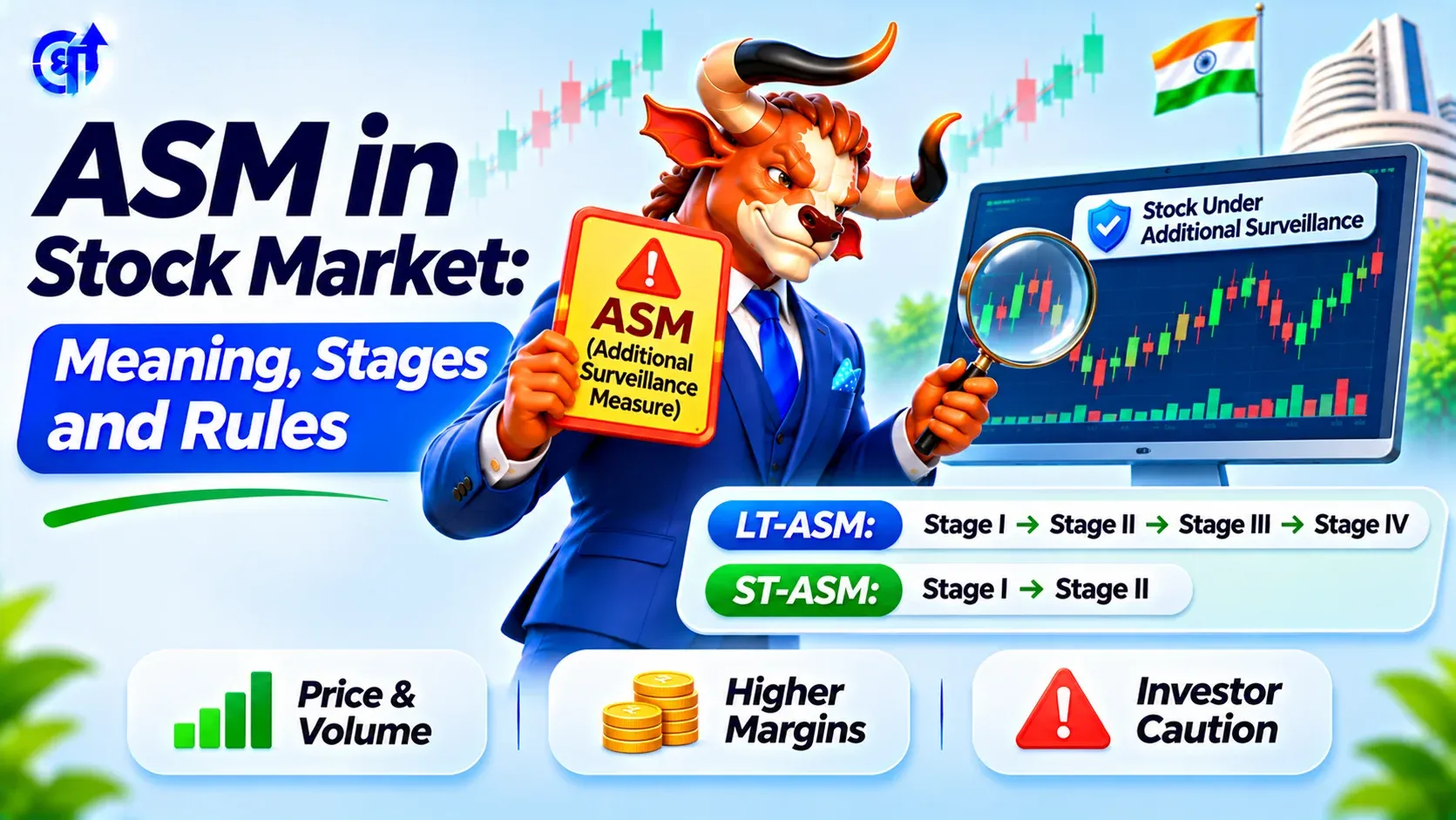
ASM in stock market stands for Additional Surveillance Measure. SEBI and exchanges use it to track stocks with abnormal price swings, volume spikes or concentrated trading. A stock under ASM faces 50% to 100% margin, tighter price bands and, at the top stage, trade-for-trade settlement. It is not a ban and not a fraud label.
A stock under ASM trades with tighter rules, and that changes how you can buy and sell it. ASM means Additional Surveillance Measure, a SEBI and exchange framework that adds margin, price band and settlement limits to stocks with unusual trading patterns. The tag describes trading behaviour, not business quality, so fundamental analysis still decides whether the company deserves your money. This guide covers the stages, the criteria, the live NSE list and what to do.
The ASM full form in stock market is Additional Surveillance Measure. SEBI, NSE, BSE and MSE run it together to watch stocks with unusual price or volume behaviour.
NSE introduced ASM through circular NSE/SURV/37253 on 21 March 2018, and the rules took effect on 26 March 2018 (Source: NSE circular NSE/SURV/37262, 22 March 2018). The additional surveillance measure meaning is simple: an early warning plus a brake on speculation.
A stock enters the list when its trading crosses preset limits. For example, a stock that gains 25% or more in five trading days (adjusted for its beta) while the top 25 clients trade 30% or more of its volume can enter short-term ASM. No bad company news is needed.
NSE says shortlisting is a market surveillance step and not an action against the company. So ASM in stock means "watch this stock closely", not "avoid it".
Research Stocks Smarter with Dhanarthi AI Screener
Analyze 5,000+ NSE & BSE stocks with 150+ custom filters, real-time volume breakout scans, and transparent fundamental data.
Use Dhanarthi Screener
Exchanges shortlist a stock when its price, volume or trader pattern crosses set limits. NSE's ASM FAQ lists eight market-based parameters, and each rule combines several of them.
| # | Parameter | What it checks |
|---|---|---|
| 1 | High-low variation | Gap between the highest and lowest price over a period (3 months for long-term ASM) |
| 2 | Close-to-close variation | Change in closing price over windows from 5 trading days to one year |
| 3 | Client concentration | Share of volume traded by the top 25 clients |
| 4 | Market capitalisation | Size filter. Long-term rules use Rs 100 crore as the floor |
| 5 | Volume variation | Sudden jump in volume against the average |
| 6 | Delivery percentage | Share of traded shares that actually get delivered |
| 7 | Number of unique PANs | How many distinct investors trade the stock |
| 8 | P/E ratio | Negative or very high valuation |
Data sourced from NSE ASM FAQ and NSE circulars. Last updated: November 2026.
Three rules show how the parameters combine:
Long-term entry (criterion 1): High-low variation above 150% plus beta times the Nifty 50 move in 3 months, top 25 clients at 25% or more of combined NSE and BSE volume over 30 days, and market cap above Rs 100 crore.
Short-term 5-day rule: Close-to-close move of 25% or more (beta-adjusted) in 5 trading days, with top 25 clients at 30% or more.
Beta adjustment: Rules add the stock's beta times the Nifty move. A market-wide rally alone does not trigger ASM.
Stocks already under GSM or trade-for-trade are excluded from long-term ASM shortlisting. NSE reviews the criteria with SEBI from time to time, so check the latest circular.
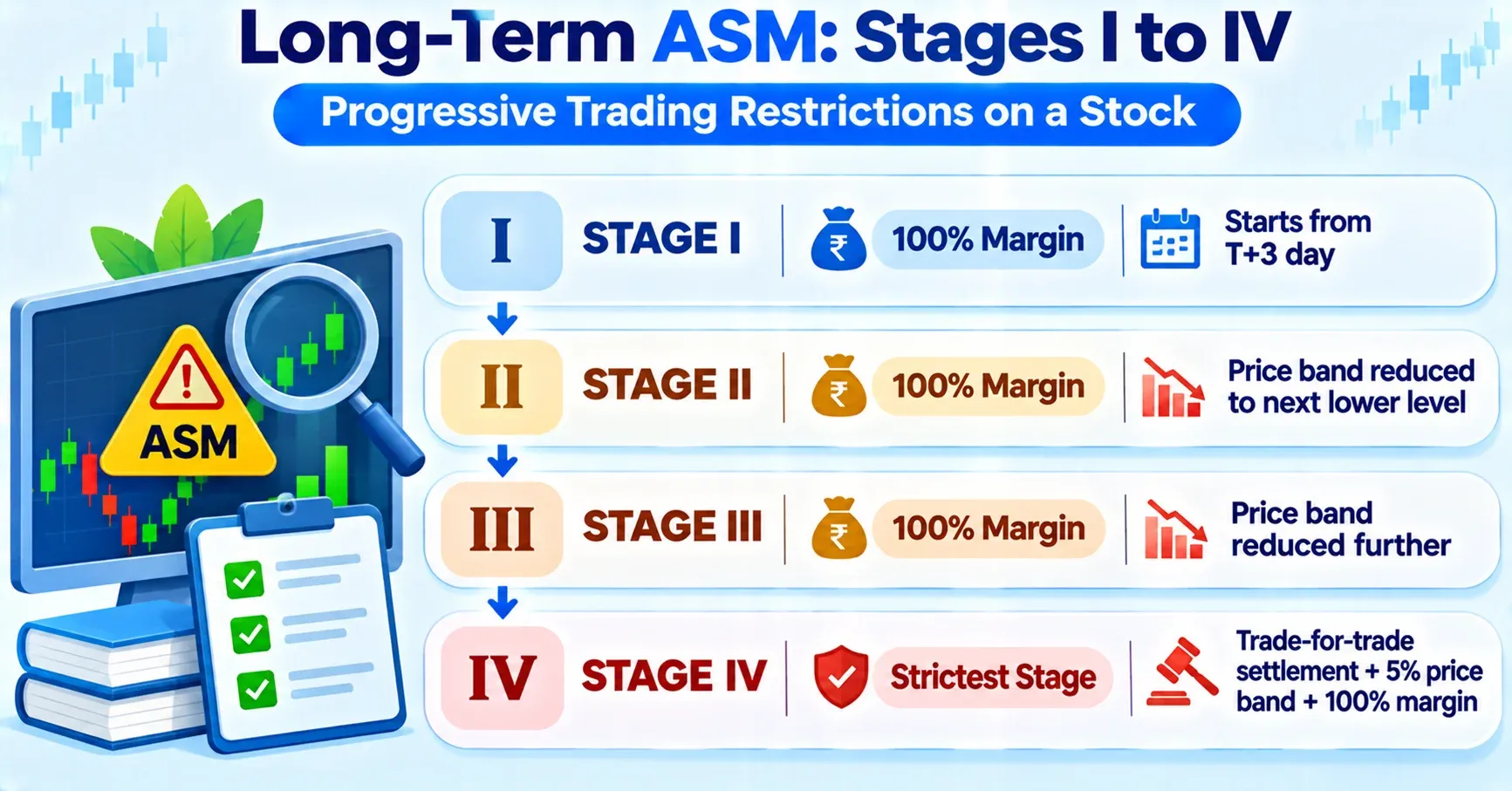
Long-term ASM has four stages. Each stage adds a tighter restriction if the unusual trading continues, and Stage IV is the strictest.
| Stage | How a stock gets here | Action |
|---|---|---|
| I | Meets any long-term entry criterion | 100% margin from T+3 day |
| II | In Stage I, then 25% or more close-to-close move (beta-adjusted) in 5 consecutive days with top 25 clients at 30% or more | Price band cut to the next lower level, 100% margin |
| III | In Stage II, same conditions for 5 more consecutive trading days | Price band cut further, 100% margin |
| IV | In Stage III, same conditions for 5 more consecutive trading days | Trade-for-trade (gross) settlement, 5% price band, 100% margin |
Data sourced from NSE ASM FAQ and NSE circulars. Last updated: November 2026.
T is the day NSE shortlists the stock. In NSE's circular of 23 October 2026, the 100% margin started on 28 October 2026. Stage IV stocks also moved from the EQ series to the BE (trade-for-trade) series that day.
Some stocks skip the ladder. Under NSE criteria 7, a stock with an extreme run-up goes straight to Stage IV. A stock with non-promoter holding below 25% and a large price move also stays in Stage IV while it meets the criteria.
A higher stage measures higher trading risk. It does not rate the business.
Short-term ASM targets sharp moves over days, not months. It has two stages: Stage I asks for 50% margin and Stage II asks for 100%.
| Stage | Margin | Other action |
|---|---|---|
| I | 50% or existing margin, whichever is higher, capped at 100% | Exchange seeks a clarification from the company |
| II | 100% or existing margin, whichever is higher | Stricter margin continues |
Data sourced from NSE ASM FAQ and NSE circular NSE/SURV/73737. Last updated: November 2026.
Three entry rules apply, per NSE's FAQ:
Close-to-close move of 25% or more (beta-adjusted) in any 5 consecutive trading days, with top 25 clients at 30% or more.
Close-to-close move of 40% or more (beta-adjusted) in 15 trading days, with the same client concentration.
One-month high-low variation above 75% (beta-adjusted) with very few unique PANs, for companies above Rs 100 crore market cap.
A stock stays in each short-term stage for at least 5 or 15 trading days, depending on the rule. If it meets long-term criteria, it moves to the long-term framework.
On 13 April 2026, NSE placed 19 securities under ST-ASM Stage I, with the higher margin applying from 16 April 2026 (Source: NSE circular NSE/SURV/73737, 13 April 2026).
ASM in stock market changes margin, leverage, price band and settlement. It does not change your ownership rights, so dividends, bonus shares and splits continue as usual.
Margin: 50% at ST Stage I and 100% at every other stage. At 100%, you pay the full trade value upfront.
Intraday: 100% margin removes leverage, so brokers block MIS, CO and BO orders on most ASM stocks. Broker rules differ. Tradejini's help page says MIS is still open for F&O stocks in ST-ASM Stage I.
Settlement: At LT Stage IV, every trade settles by delivery. You cannot square off a position on the same day.
Pledge: You cannot pledge ASM stocks. If a pledged stock enters ASM, the collateral margin on it ends. You can unpledge it or keep it pledged without credit until it leaves ASM.
Price band: Bands narrow from Stage II and fall to 5% at Stage IV.
Order alert: NSE trading terminals show an alert when you place an order in an ASM stock. Many broker apps add their own tag.
Common mistake 1: Investors assume open positions escape the new margin. They do not. In the 18 September 2026 circular, NSE shortlisted stocks from 21 September and applied 100% margin from 23 September on positions open as at 22 September (Source: NSE circulars NSE/SURV/76428 and 76429).
Common mistake 2: Investors forget that pledged shares carry margin credit. When such a stock enters ASM, that credit drops. Your broker can then show a margin shortfall in the rest of your account.
Check the ASM stocks list on the exchange websites, not on social media tips. NSE and BSE both publish it, and NSE posts a circular for every change.
NSE: Open the NSE ASM page or the ASM report. Download the long-term and short-term lists. Each list shows the stage.
BSE: Open the BSE ASM page. It lists active stocks by framework and stage.
Daily file: NSE publishes a daily REG_IND file under All Reports. It shows every security under a surveillance action.
Decode the label: NSE's indicator list uses ST ASM-1 and ST ASM-2 for short-term stages. It uses LT ASM-1 to LT ASM-4 for long-term stages.
Read the circular: NSE usually issues surveillance circulars after market hours, about one trading day before the change takes effect. The annexures name each stock and stage.
Check your broker app: The order window shows an ASM alert before you confirm.
Dates matter. The shortlisting date and the margin date can differ. In the 18 September 2026 circular, the stocks were shortlisted from 21 September, but the 100% margin started on 23 September.
NSE adds and removes stocks almost every week, so any printed list ages fast. Traders often search for ASM stocks NSE has added this week, and the table below shows recent entries from late October to mid November 2026.
| Stock | Framework and stage | Entry date |
|---|---|---|
| West Leisure Resorts | Long-term ASM, Stage I | 11 Nov 2026 |
| Tourism Finance | Long-term ASM, Stage I | 3 Nov 2026 |
| Purple Agrotech Industries | Long-term ASM, Stage I | 3 Nov 2026 |
| eMudhra | Short-term ASM, Stage I | 23 Oct 2026 |
| Nintec Systems | Long-term ASM, Stage I | 23 Oct 2026 |
| Srestha Finvest | Long-term ASM, Stage I | 22 Oct 2026 |
Data sourced from BSE ASM data as shown on the Trendlyne ASM dashboard. Last updated: November 2026.
These rows come from BSE data. The exchanges apply ASM in a coordinated way, but timing and series can differ. Confirm any stock in NSE's own file before you trade.
Two patterns stand out:
Most new entries start at Stage I. Of the six stocks above, five sit in long-term Stage I.
The list changes every week. NSE put 10 securities into LT ASM Stage I with effect from 21 April 2026 and 5 more from 28 April 2026 (Source: NSE circulars, April 2026).
For scale, SMC Global reported 69 securities on NSE's long-term list and 25 on the short-term list as of 19 March 2026. Treat this section as a dated snapshot, not a trading list.
ASM looks at how a stock trades. GSM looks at whether its price fits its financials. Trade-for-trade is a settlement segment that either framework can trigger.
| Feature | ASM | GSM | Trade-for-Trade |
|---|---|---|---|
| Focus | Price, volume, client concentration | Price not backed by fundamentals | Settlement mode |
| In force since | 26 March 2018 | 14 March 2017 | Not applicable |
| Stages | Long-term: 4. Short-term: 2 | Staged, from Stage 0 upward | Not applicable |
| Typical action | 50% to 100% margin, band cuts, T2T at LT Stage IV | Stage I: 100% margin and 5% band. Stage II: T2T plus 50% extra deposit | Every trade settles by delivery |
| Review | Long-term weekly. Short-term every 5 to 15 trading days | Quarterly, plus monthly relaxation review | Not applicable |
Data sourced from NSE ASM FAQ, NSE GSM FAQ (version 1.1, June 2026) and NSE circulars. Last updated: November 2026.
GSM criteria use earnings, book value, net worth, P/E and market cap. To judge those numbers yourself, learn financial statement analysis for balance sheets, profit and loss accounts and cash flow.
Trade-for-trade is not a tag. It is where ASM Stage IV and GSM Stage II stocks end up, so buyers and sellers must settle each trade by delivery.
No. ASM in stock market flags trading behaviour, so a profitable company can land on the list. eMudhra is a recent case.
BSE's ASM data shows eMudhra in short-term ASM Stage I from 23 October 2026. For the September 2026 quarter, eMudhra reported revenue from operations of Rs 206.99 crore and net profit of Rs 33.48 crore. Net profit rose about 26% year on year (Source: eMudhra Q2 FY27 results, November 2026).
The same results carried a warning. After an October TLS certificate security incident, management cut its FY27 outlook to about Rs 800 crore of revenue and Rs 125 crore of profit after tax.
Read the two facts separately. The ASM tag told traders the stock was moving in an unusual way. The company filing told investors about a business issue. Exchanges shortlist on price and volume rules, so the tag alone never explains the business.
Use an ASM entry as a prompt to read the latest quarterly results, shareholding pattern and exchange announcements.
It depends on your time frame and your ability to exit. An ASM stock suits patient, fully funded investors and does not suit leveraged traders.
| Investor type | Fit | Reason |
|---|---|---|
| Long-term investor with strong fundamentals | Possible | The tag limits trading, not dividends or ownership. Liquidity can fall. |
| Short-term trader | Hard | 100% margin and no MIS at most brokers |
| Beginner | Avoid for now | Price band hits can block exits |
| F&O or leveraged trader | Not suitable | No leverage on ASM stocks |
Data sourced from NSE ASM FAQ and broker help pages. Last updated: November 2026.
If you already hold an ASM stock, check these points:
Pledged shares: Expect the collateral credit to end. Check your margin.
Exit room: At Stage IV, a 5% band means a sell order may not fill when the stock hits the lower band.
Position size: Keep it small. For example, an investor with a Rs 10 lakh portfolio who caps any ASM stock at 3% holds at most Rs 30,000 of it.
Run this checklist before you act:
Note the stage and the entry date from the NSE list.
Read the exchange announcements for the last three months.
Review the last four quarters of results and the promoter holding trend.
Compare average daily traded value with your order size.
Keep the full trade value ready, since margin is 100%.
Write down your exit price before you buy.
For in-depth checks on earnings, promoter holding and cash flow, a deep stock research tool saves time.
A long-term ASM stock must complete 90 calendar days before it can start to exit. It then steps down one stage at a time, and NSE reviews stages weekly.
Stage IV to III, III to II, II to I: The stock moves down when it no longer meets the entry criteria of its current stage.
Stage I to exit: The stock leaves when it no longer meets the long-term entry criteria.
Short-term ASM: The stock leaves if it fails the entry criteria on the review date, from the 6th or 16th trading day.
When a stock leaves, its earlier price band returns. Exit has no fixed date, so a stock can stay in the framework for many months.

Confused about chart patterns & stock analysis?
Use
Dhanarthi Stock Guru
to chat, analyze price patterns, and ask questions directly.
ASM in stock market is a trading label that adds margin, price band and settlement limits. It does not rate the company. Long-term ASM has four stages and short-term ASM has two. Stage IV is the toughest, with trade-for-trade settlement and a 5% band.
Before you trade any ASM stock, check its stage and entry date on the NSE list. Then read the latest results and announcements. The tag tells you how the stock trades. Only the financials tell you what the business is worth.
This article is for educational purposes only. It does not constitute investment advice. Please consult a SEBI-registered financial advisor before making investment decisions.
1. What is ASM in stock market?
ASM, short for Additional Surveillance Measure, is a SEBI and exchange framework that adds margin and trading limits to stocks with unusual price or volume patterns. It has run since 26 March 2018. The tag is a caution signal, not a ban.
2. Is ASM good or bad for a stock?
ASM is neutral on business quality, but it makes trading harder. Margin rises to 50% or 100%, and the price band can shrink to 5% at Stage IV. Liquidity often falls, which can hurt exits.
3. Can we buy ASM stocks?
Yes. You can buy ASM stocks on NSE and BSE, but you pay 50% to 100% margin and often settle by delivery. Check the stage and your exit options first.
4. Can ASM stocks be traded intraday?
At most brokers, no. 100% margin removes leverage, so brokers block MIS, CO and BO orders. At LT Stage IV, trade-for-trade settlement bars same-day square-off. Some brokers allow MIS for F&O stocks in ST-ASM Stage I.
5. How long does a stock stay in ASM?
There is no fixed end date. Under long-term ASM, a stock needs at least 90 calendar days before it can exit, and it steps down one stage at a time. Short-term stages last at least 5 or 15 trading days.
Share Market
IPO
Artificial Intelligence
Semi Conductor