





Gold vs Silver Investment India 2026 Returns Compared
November 17, 2026


TABLE OF CONTENTS
Get AI Summary


Low PE stocks India trade at single-digit or low double-digit price-to-earnings multiples, well below the Nifty 50 average near 21 times earnings. Power Finance Corporation, Indian Oil Corporation, REC, ONGC and Coal India currently sit in this group with PE ratios between 4 and 8 times trailing earnings as of early November 2026. These names often combine high dividend yields with established businesses, yet low PE alone does not guarantee quality.
Investors looking for value in the Indian market frequently start with the PE ratio because it is easy to calculate and widely available. A stock trading at 6 times earnings looks cheaper than one at 25 times if both companies earn the same amount per share. The catch is that earnings can fall, and a low multiple sometimes signals expected decline rather than opportunity. Screening tools help separate the two cases.
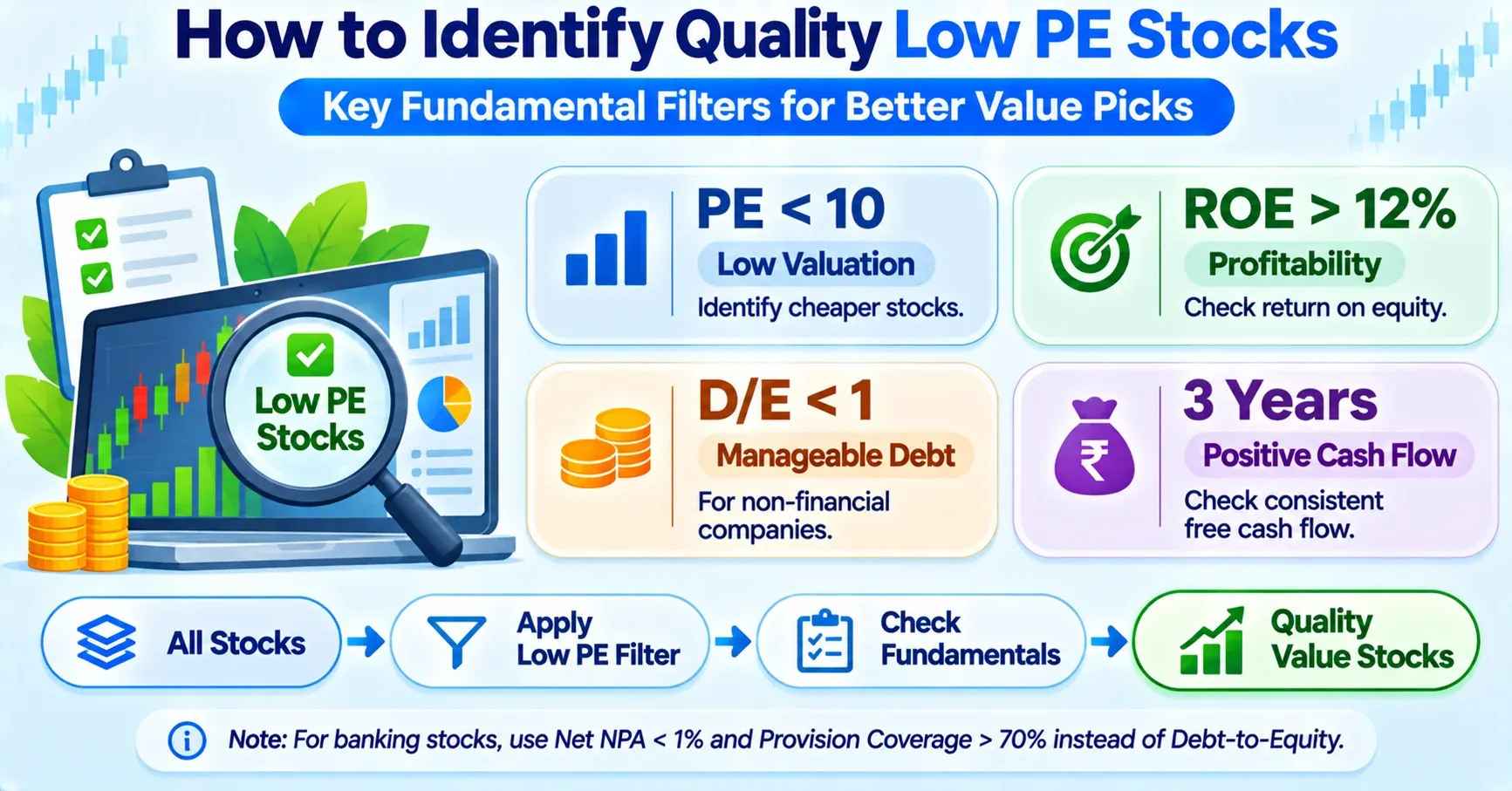
The stock screener on Dhanarthi lets you filter NSE and BSE stocks by PE below 10, ROE above 12 percent and debt-to-equity below 1 in one step. That combination surfaces names with both low valuation and basic quality filters.
Research Stocks Smarter with Dhanarthi AI Screener
Analyze 5,000+ NSE & BSE stocks with 150+ custom filters, real-time volume breakout scans, and transparent fundamental data.
Use Dhanarthi Screener
The PE ratio equals current share price divided by earnings per share for the trailing twelve months. A PE of 5 means investors pay five rupees for every rupee of reported profit. Nifty 50 has traded near 20 to 22 times earnings for much of 2026, so stocks below 12 times sit at a clear discount to the broad market.
Low PE can appear for three reasons. First, the business is cyclical and earnings are temporarily high. Second, growth is slow and the market expects limited expansion. Third, the stock is genuinely undervalued because of temporary concerns or sector rotation. Banks, oil marketing companies and power financiers often fall into the second or third category because their earnings are stable yet the market assigns them lower multiples than IT or consumer names.
Value investors use low PE as a starting screen, then check return on equity, free cash flow and balance sheet strength. A company with PE 6 and ROE 18 percent is more interesting than one with PE 6 and ROE 4 percent. The second case may simply reflect a weak business.
The table below lists large and mid-cap stocks trading at trailing PE below 10 times with positive earnings and market capitalisation above Rs 50,000 crore. Data comes from exchange filings and financial aggregators as of 6 November 2026.
| Company | Market Cap (Rs Cr) | Price (Rs) | PE Ratio | ROE (%) | Dividend Yield (%) | Sector |
|---|---|---|---|---|---|---|
| Power Finance Corporation | 1,08,500 | 329 | 4.1 | 22.8 | 4.9 | Power Finance |
| Indian Oil Corporation | 2,06,500 | 145 | 4.2 | 21.5 | 2.3 | Oil Refining |
| REC Ltd | 77,900 | 296 | 5.2 | 20.1 | 4.9 | Power Finance |
| Canara Bank | 1,10,000 | 123 | 5.5 | 15.2 | 3.6 | Public Bank |
| Punjab National Bank | 1,40,000 | 126 | 6.4 | 12.3 | 2.5 | Public Bank |
| Bank of Baroda | 1,29,000 | 249 | 6.5 | 12.0 | 3.5 | Public Bank |
| ONGC | 2,91,500 | 230 | 6.6 | 13.4 | 5.6 | Oil Exploration |
| Coal India | 2,45,000 | 397 | 7.3 | 26.1 | 10.1 | Mining |
Data sourced from NSE, BSE filings and financial data aggregators. Last updated: November 2026.
Power Finance Corporation leads the list with a PE near 4.1 times. The company finances power projects and has reported consistent profit growth. Its ROE above 20 percent stands out among PSUs. Indian Oil Corporation trades at 4.2 times earnings. Refining margins and marketing volumes drive its profits. Under-recoveries on LPG can create quarterly volatility, yet the scale remains large.
REC Ltd mirrors Power Finance Corporation in the power financing space with a PE of 5.2. Both benefit from government-backed lending to the power sector. Public sector banks such as Canara Bank, Punjab National Bank and Bank of Baroda trade between 5.5 and 6.5 times earnings. Their ROE has improved after years of cleanup, and net interest margins remain positive.
ONGC sits at 6.6 times with a dividend yield above 5 percent. Crude oil prices drive its earnings. Coal India offers the highest yield in the table at over 10 percent and a PE of 7.3. Coal demand from power plants supports volumes, though longer-term energy transition remains a factor.
A raw low PE list includes value traps. Add three filters to improve the shortlist. First, require ROE above 12 percent so the company generates acceptable returns on capital. Second, keep debt-to-equity below 1 for non-financial companies to avoid high leverage. Third, confirm positive free cash flow over the last three years.
The financial analysis reports on Dhanarthi show cash flow statements, segment margins and debt schedules for each stock. Checking these takes minutes once the screener has narrowed the universe. For banks, replace debt-to-equity with net NPA below 1 percent and provision coverage above 70 percent.
Many investors also look at price-to-book below 1.5 times alongside low PE. Several PSU banks and oil companies in the table above trade near or below book value. That combination has historically offered a margin of safety when earnings recover.
Low PE stocks carry specific risks. Earnings can reverse. Oil marketing companies face crude price spikes and government-directed pricing. Power financiers depend on the health of the power sector and government policy on discoms. Public sector banks still carry residual asset quality risk even after cleanup.
Dividend yields look attractive, yet payout ratios can fall if profits decline. Coal India and ONGC have cut dividends in past down cycles. Sector concentration is another issue. The low PE list is heavy in PSUs, energy and banks. A portfolio built only from these names has high exposure to commodity prices and interest rates.
Liquidity is usually good for the large names listed above. Smaller low PE stocks can have wider spreads and lower daily volumes. Always check average daily traded value before sizing a position.
Public sector banks dominate the low PE list because the market assigns them lower multiples than private banks. Private banks such as HDFC Bank and ICICI Bank trade at 14 to 20 times earnings despite higher ROE. The gap reflects perceived differences in growth, asset quality and management quality.
Oil and gas stocks show wide PE ranges. Upstream names like ONGC trade at 6 to 7 times while some refiners sit higher or lower depending on recent margin cycles. Mining stocks such as Coal India benefit from regulated pricing and high payouts.
Power finance companies stand out for their combination of low PE and double-digit ROE. Their business model is lending against power assets with government support. Growth depends on power capacity addition and transmission projects.
Value investors allocate a portion of the portfolio to low PE stocks and rebalance when valuations move. A common approach is to hold 20 to 30 percent in value names, 40 to 50 percent in quality compounders and the rest in growth or cash. Low PE stocks provide the value sleeve.
Historical market cycles show that low PE sectors rotate in and out of favour. Public sector banks underperformed for years before recovering after asset quality improved. Energy stocks fell when crude prices dropped and rose when prices recovered. Timing the cycle is difficult, so many investors dollar-cost average into a diversified low PE basket.
The AI Financial Research Assistant can pull latest quarterly numbers, peer comparisons and management commentary for any name on the list. That speeds up the second level of research after the initial screen.
Low PE stocks have delivered mixed returns depending on the market cycle. During the 2015 to 2018 period, many PSU banks traded at PE below 8 times while asset quality deteriorated. Investors who bought early faced further declines. After the cleanup and capital infusion, the same names recovered strongly from 2020 onward.
Oil stocks followed crude prices. ONGC and Oil India rose sharply when Brent crude moved above 80 dollars per barrel and fell when prices dropped below 60 dollars. Coal India held up better because of regulated pricing and high payouts. Power finance companies stayed relatively stable because their loan books grew with government infrastructure spending.
These examples show that low PE works best when combined with improving fundamentals. A stock that stays cheap for years without earnings growth rarely rewards patient holders. Investors who tracked quarterly results and exited when ROE fell below 10 percent avoided the worst outcomes.
A practical basket can include three to five names from different sectors. One power financier, one oil company, one mining stock and one or two public sector banks create diversification within the value space. Position sizes of 3 to 5 percent each keep single-stock risk limited.
Review the basket every quarter. Replace a name if its PE rises above 15 times or if ROE drops below 10 percent for two consecutive years. Add new names that enter the low PE screen with improving cash flows. This process keeps the portfolio aligned with current valuations without constant trading.
Tax treatment matters for long-term holders. Equity gains above Rs 1.25 lakh are taxed at 12.5 percent after one year. Dividends are taxed at slab rates. High-yield names like Coal India generate regular cash that can be reinvested or used for expenses.
Buying solely because the PE looks low is the most frequent error. Investors ignore declining sales or rising debt. Another mistake is concentrating the entire portfolio in one sector such as PSU banks. When the sector faces policy changes or asset quality pressure, all names fall together.
Chasing the absolute lowest PE without checking liquidity creates problems. Stocks with daily volumes below Rs 1 crore can be hard to exit. Always confirm average traded value over the last three months.
Ignoring management quality and government policy risk is common with PSU stocks. Changes in dividend policy or capital expenditure plans can alter the investment case quickly. Reading the latest annual report and quarterly concall summary helps catch these shifts.
Low PE stocks India currently include Power Finance Corporation, Indian Oil Corporation, REC, several public sector banks, ONGC and Coal India. These names trade at 4 to 8 times trailing earnings with dividend yields from 2 to 10 percent. Screening with ROE, cash flow and balance sheet filters improves the odds of finding sustainable businesses rather than value traps. Investors should still review quarterly results, sector risks and overall portfolio allocation before buying.

Confused about chart patterns & stock analysis?
Use
Dhanarthi Stock Guru
to chat, analyze price patterns, and ask questions directly.
This article is for educational purposes only. It does not constitute investment advice. Please consult a SEBI-registered financial advisor before making investment decisions.
1. What is a good PE ratio for stocks in India?
A PE below 12 to 15 times is often considered low compared with the Nifty 50 average near 21 times. The right level depends on the sector. Banks and oil companies frequently trade below 10 times while IT and consumer stocks trade above 25 times.
2. Are low PE stocks always undervalued?
No. Low PE can mean the market expects earnings to fall. Check ROE, cash flow and debt levels before deciding. A stock with PE 5 and declining profits for three years is different from one with PE 5 and rising profits.
3. Which sectors have the most low PE stocks in India?
Public sector banks, oil marketing and exploration companies, power finance companies and mining names currently dominate the low PE list. These sectors have stable or cyclical earnings that the market values at lower multiples.
4. How often should I rebalance a low PE portfolio?
Review quarterly after results. Rebalance if any stock rises above 15 to 18 times earnings or if fundamentals weaken. Many investors check the basket twice a year.
5. Can I use a stock screener to find low PE stocks?
Yes. Set PE below 10, ROE above 12 percent and market cap above Rs 5,000 crore. Then review the shortlist for cash flow and sector risks. Ready-made screens on major platforms already include low PE filters.
Share Market
IPO
Artificial Intelligence
Semi Conductor