



Best Cement Stocks in India 2026: Top Picks Compared
October 8, 2026



TABLE OF CONTENTS
Get AI Summary






The best cement stocks in India are UltraTech Cement, Ambuja Cements, Shree Cement, Dalmia Bharat, and JK Cement. They lead on capacity, cost control, and EBITDA per tonne. Cement is cyclical, so compare per-tonne margins and regional exposure before buying, not just price or PE.
UltraTech Cement, Ambuja Cements, Shree Cement, Dalmia Bharat, and JK Cement are the best cement stocks in India to research right now, based on capacity and per-tonne profit in the June 2026 quarter. This guide ranks them with Q1 FY27 filings, explains EBITDA per tonne, and shows how the fuel cost shock hit margins. It belongs to our sector-wise stock analysis series for retail investors.
Before you decide which cement stocks to buy, start with the five that lead listed capacity. UltraTech leads on scale, utilisation, and profit per tonne, and Shree, Dalmia, and JK Cement all earned close to Rs 1,000 per tonne in Q1 FY27.
| Company | Installed capacity (MTPA) | Core regions | Q1 FY27 EBITDA per tonne |
|---|---|---|---|
| UltraTech Cement | 200.1 (India) | Pan-India | Rs 1,214 |
| Ambuja Cements | 109 | Pan-India | Rs 931 |
| Shree Cement | About 70 | North, East, South, UAE | Rs 1,024 |
| Dalmia Bharat | 54.7 | East, South, now Central | Rs 1,055 |
| JK Cement | 32.3 | North, Central, South | Rs 980 |
Data sourced from NSE filings and Q1 FY27 result notes of the five companies. Last updated: October 2026.
Research Stocks Smarter with Dhanarthi AI Screener
Analyze 5,000+ NSE & BSE stocks with 150+ custom filters, real-time volume breakout scans, and transparent fundamental data.
Use Dhanarthi Screener
India's cement volumes grew 8.6% in FY26, and ICRA expects 6 to 7% growth in FY27. Housing and infrastructure spending drive most of that demand, which supports cement sector stocks over time.
Seven listed names matter for most retail portfolios, from the 200 MTPA leader to mid-size regional players. Each profile uses Q1 FY27 numbers.
UltraTech Cement is India's largest cement maker, with 200.1 MTPA of domestic capacity and 81% utilisation in Q1 FY27. Net sales rose 16% and profit after tax rose 17% year on year. Operating EBITDA per tonne was Rs 1,214, and management guided costs Rs 130 to 140 per tonne higher in Q2.
UltraTech controls The India Cements, which grew volumes 18.5% in Q1 FY27. Its EBITDA per tonne has climbed from Rs 386 in Q2 FY26, and UltraTech targets Rs 1,000 per tonne by Q4 FY28. This turnaround is the swing factor for the group.
Ambuja Cements, part of the Adani Group, has 109 MTPA of capacity and targets 119 MTPA by the end of FY27. Its EBITDA per tonne rose 27% from the March quarter to Rs 931, helped by a Rs 206 per tonne cost cut. The company reports a debt-free balance sheet. ACC, also an Adani Group company, trades separately and shares the same demand drivers.
Shree Cement sold 10.49 million tonnes in India in Q1 FY27, up 17.2%. Standalone EBITDA fell to Rs 1,074 crore from Rs 1,229 crore a year earlier on West Asia fuel costs. Premium products reached 23.3% of trade volume. Capacity is near 70 MTPA, with a target above 80 MTPA.
Dalmia Bharat bought Jaiprakash Associates' cement assets in Central India at an enterprise value of Rs 2,850 crore, lifting capacity to 54.7 MTPA. EBITDA per tonne was Rs 1,055 against Rs 1,261 a year earlier. Net debt to EBITDA rose to 1.47x from 0.33x, so debt now deserves a closer look.
JK Cement runs 32.3 MTPA of grey and about 3 MTPA of white cement capacity. Volumes grew about 18% in Q1 FY27, but EBITDA per tonne fell about 20% to Rs 980. It targets 40 MTPA by FY28 and 50 MTPA by FY30.
JK Lakshmi reported EBITDA per tonne of Rs 719 in Q1 FY27, down 23.2% year on year. It plans about 30 MTPA of capacity by FY30, but net debt to EBITDA is expected to stay near 2.5x. Brokers value it near 9x EV/EBITDA, below the leaders.
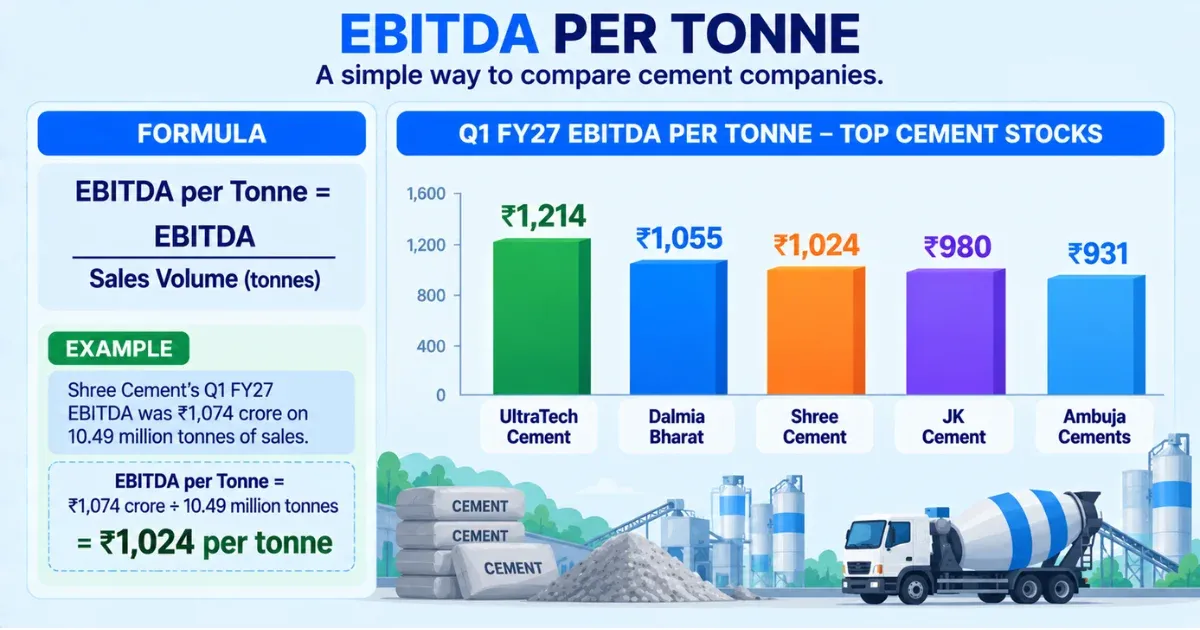
EBITDA per tonne is operating profit divided by tonnes sold, and it is the cleanest way to compare cement companies. Share price and PE hide the cost differences that drive returns.
Formula: EBITDA per tonne = EBITDA ÷ sales volume in tonnes.
Example: Shree Cement's standalone EBITDA was Rs 1,074 crore on 10.49 million tonnes in Q1 FY27. That works out to about Rs 1,024 per tonne.
Sensitivity: A Rs 100 per tonne change on UltraTech's 39.2 million tonnes of quarterly domestic volume moves EBITDA by about Rs 392 crore. UltraTech targets Rs 1,400 per tonne, about 15% above its Q1 FY27 level.
Three rules keep the comparison honest:
Fuel and freight costs, not demand, pulled margins down in the June 2026 quarter. ICRA expects industry EBITDA per tonne of Rs 820 to 870 in FY27, against Rs 950 to 980 in FY26.
Power, fuel, and selling costs make up 50 to 55% of operating costs. ICRA assumes crude oil averages USD 95 per barrel in FY27, against about USD 72 in FY26.
| Company | Q1 FY27 EBITDA per tonne | Change | Cost note |
|---|---|---|---|
| UltraTech Cement | Rs 1,214 | +1.4% YoY | Q2 cost guided Rs 130 to 140 per tonne higher |
| Ambuja Cements | Rs 931 | +27% QoQ | Cost cut of Rs 206 per tonne from Q4 FY26 |
| Shree Cement | Rs 1,024 | -25.4% YoY | West Asia crisis lifted fuel and raw material costs |
| Dalmia Bharat | Rs 1,055 | -16.4% YoY | Higher input costs |
| JK Cement | Rs 980 | About -20% YoY | Cost expected up about Rs 150 per tonne in Q2 |
| JK Lakshmi Cement | Rs 719 | -23.2% YoY | Higher input costs |
Data sourced from NSE filings and Q1 FY27 result notes. Last updated: October 2026.
HDFC Securities expects industry margins to fall by over Rs 100 per tonne in Q2 FY27, to below Rs 880 per tonne.
A plant's region decides how much new capacity it can fill. Industry capacity rose about 43 MTPA in FY26, and ICRA expects 30 to 34 MTPA more in FY27, so utilisation stays near 70 to 71%.
Utilisation in Q1 FY27 shows the gap between companies:
Consolidation adds another layer. UltraTech now controls India Cements, and Dalmia absorbed Jaiprakash Associates' plants in Central India, so share keeps moving toward large groups. A Prabhudas Lilladher sector note dated 1 September 2026 also flagged weak rainfall in southern states, Rajasthan, and parts of Maharashtra and Gujarat as a risk to FY28 demand.
Brokers value large cement stocks at 15 to 17 times FY28 estimated EV/EBITDA, and smaller levered names near 9 times. Treat these as a gauge of relative pricing, not a forecast.
| Company | EV/EBITDA (FY28E basis) | Basis |
|---|---|---|
| UltraTech Cement | 17x | Broker target multiple |
| Shree Cement | 17x | Broker target multiple |
| Ambuja Cements | 15x | Broker target multiple |
| JK Cement | 13.4x | Current multiple on broker estimates (target 15x) |
| JK Lakshmi Cement | 9x | Broker target multiple |
Data sourced from ICICI Direct and Prabhudas Lilladher Q1 FY27 result notes. Last updated: October 2026.
A stock trading below its own three-year average multiple, with steady EBITDA per tonne, offers a fairer entry point.
Cement works as a cyclical holding, not a core one. In May 2019, UltraTech, Ambuja, Orient Cement, and ACC had slipped up to 34% over two years while the Sensex rose 24%, despite healthy demand.
A common mistake is buying after margins peak. Industry EBITDA per tonne was about Rs 950 to 980 in FY26, and ICRA now expects Rs 820 to 870 in FY27.
For illustration only, a Rs 10 lakh equity portfolio might hold Rs 50,000 to Rs 1 lakh in two cement stocks, one large leader and one mid-size name. Pair them with export-driven names such as IT sector stocks, which earn in dollars and move on different drivers than construction.
Cement stocks carry cost, supply, and weather risk at the same time.
Holding cement stocks long term suits investors with a five-year or longer horizon who can sit through cycles. It does not suit anyone who needs steady returns within twelve months.
Skip them if a fall of one-third, as in the 2017 to 2019 stretch above, would force you to sell. Investors who want steadier earnings can compare cement with pharma sector stocks.

Confused about chart patterns & stock analysis?
Use
Dhanarthi Stock Guru
to chat, analyze price patterns, and ask questions directly.
Cement gives exposure to India's housing and infrastructure build-out, but Q1 FY27 shows that margins, not volumes, decide returns. UltraTech leads on scale and profit per tonne, while Shree, Dalmia, and JK Cement offer growth with more cost sensitivity. Track EBITDA per tonne, utilisation, and net debt every quarter, and review your allocation after Q2 FY27 results.
1. Which are the top 5 cement companies in India?
UltraTech, Ambuja with ACC under the Adani Group, Shree Cement, and Dalmia Bharat are among the largest groups by capacity. UltraTech leads with 200.1 MTPA in India, and JK Cement is a leading mid-size name at 32.3 MTPA of grey capacity.
2. Are cement stocks good for long-term investment?
They can be, if you buy at fair valuations and hold through cycles. ICRA expects 6 to 7% volume growth in FY27, but margins swing with fuel costs and new capacity, so returns are uneven.
3. Which cement stock is best to buy now?
No single stock fits everyone. On Q1 FY27 data, UltraTech has the highest EBITDA per tonne at Rs 1,214 and the highest utilisation at 81%. Check valuation and your horizon, and consult a SEBI-registered advisor first.
4. What is EBITDA per tonne in cement?
It is operating profit divided by tonnes sold. Shree Cement's Rs 1,074 crore EBITDA on 10.49 million tonnes gives about Rs 1,024 per tonne. A higher number means more profit on each tonne sold.
5. What drives cement demand in India?
Housing, roads, railways, and urban infrastructure drive most demand. ICRA said volumes grew 8.6% in FY26 on housing and infrastructure activity. Rural income and rainfall also affect offtake.
Share Market
IPO
Artificial Intelligence
Semi Conductor