



Shareholding Pattern Explained: How to Read It
October 7, 2026



TABLE OF CONTENTS
Get AI Summary






Shareholding pattern is a quarterly disclosure every listed Indian company must file with the stock exchanges, showing exactly how its shares are divided between promoters, foreign institutional investors (FIIs), domestic institutional investors (DIIs), and the general public. Reading it correctly reveals ownership concentration, institutional confidence, and changes in who actually controls and backs a company over time.
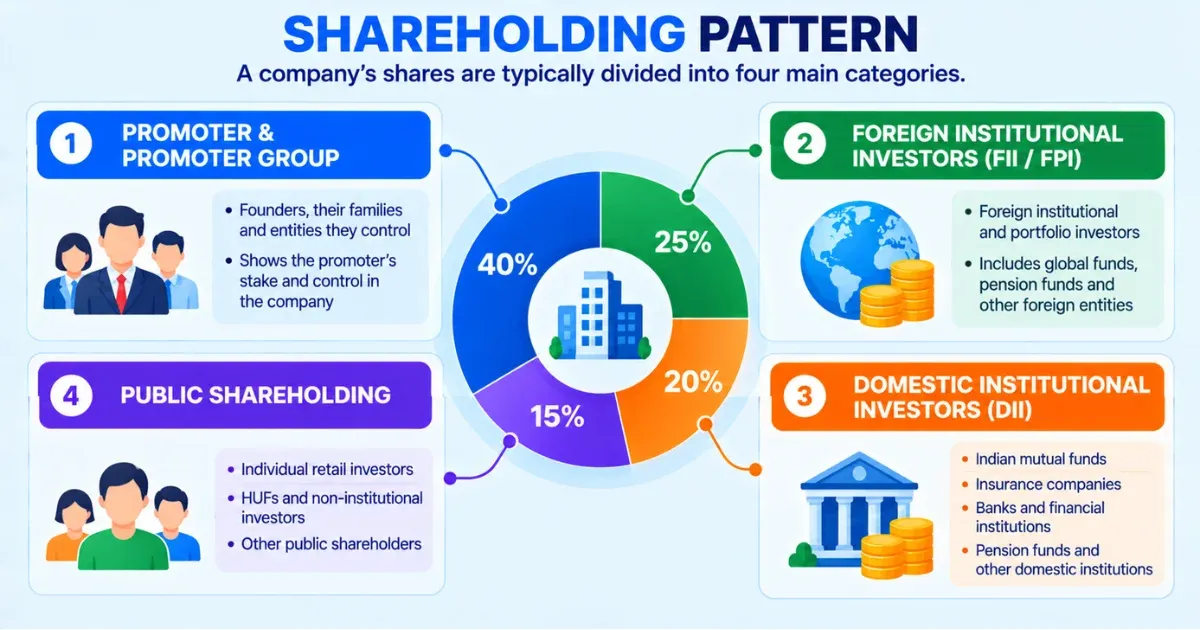
A shareholding pattern is an official document every listed company in India must disclose, breaking down its total equity capital into categories showing exactly who owns what share of the business. Rather than treating "shareholders" as one undifferentiated group, it separates ownership into promoters, institutional investors (both foreign and domestic), and individual public shareholders, revealing the real distribution of control and confidence behind a stock.
This disclosure is standardized and mandatory under SEBI's Listing Obligations and Disclosure Requirements (LODR) Regulations, 2015, meaning every listed company follows the same format, making shareholding patterns directly comparable across companies and over time for the same company.
SEBI's framework organizes shareholding pattern disclosure into three broad tables, which further break down into familiar sub-categories investors actually look at.
| Category | What It Represents |
|---|---|
| Promoter and Promoter Group | Founders, their families, and entities they control |
| Public - FII/FPI | Foreign institutional and portfolio investors |
| Public - DII | Domestic institutions: mutual funds, insurance companies, banks, pension funds |
| Public - Individual/Non-institutional | Retail investors, HUFs, and other non-institutional public holders |
| Non Promoter-Non Public | Shares held by custodians against depository receipts and similar structures |
It's worth noting that in SEBI's own exchange filings, "Public" technically includes institutional holders like FIIs and DIIs alongside individual investors, even though many data platforms and financial media report FII, DII, and individual/retail holding as separate line items for clarity. Both views are correct, they simply use the category boundary differently.
Every listed company must disclose its shareholding pattern within 21 days of the end of each quarter, under Regulation 31(1)(b) of the SEBI LODR Regulations, meaning four disclosures a year, typically appearing shortly after the April, July, October, and January quarter-ends. This filing is public and free, available directly on the NSE and BSE websites under each company's corporate filings section, as well as through most stock research platforms.
A higher promoter holding is often treated as a signal of confidence, the people who know the business best have more of their own wealth tied up in it, and generally have stronger incentive to act in the company's long-term interest. This heuristic is useful, but it isn't universal, and a real example shows exactly where it breaks down.
HDFC Bank's shareholding pattern shows effectively 100% public shareholding, with promoter holding at a negligible 0.003% in the non-promoter non-public category. This isn't a governance warning sign, it's a structural outcome of how India's largest private banks are regulated, RBI rules around bank ownership concentration mean India's major private banks simply don't carry large, family-style promoter stakes the way a typical industrial or consumer company might. Treating near-zero promoter holding as automatically concerning, without checking whether the sector itself explains it, is a common misreading of this metric.
For many years, foreign institutional investors were the single largest non-promoter shareholder category in Indian equities, with their buying and selling decisions carrying outsized influence over market direction. That picture has genuinely shifted. Sustained domestic mutual fund inflows, running close to Rs 90,000 crore in a single quarter during one recent period, narrowed the ownership gap between FPIs and DIIs to an all-time low, and DII ownership share has at points overtaken FPI ownership share amid periods of FII outflows.
This shift matters for how investors read FII and DII movement in a shareholding pattern today. A stock where DIIs are steadily increasing their stake while FIIs reduce theirs no longer automatically signals weakening institutional confidence the way it might have a decade ago, it may simply reflect this broader structural rebalancing of who the dominant institutional buyer in Indian markets actually is. Reading FII and DII trends in isolation, without this broader context, risks misreading a structural market shift as a company-specific signal.
SEBI mandates that listed companies maintain a Minimum Public Shareholding (MPS) of at least 25%, meaning promoter holding cannot exceed 75% for most listed companies. Public shareholding for this specific rule includes FII and DII holdings alongside individual retail holdings, not just the non-institutional slice.
Worked check using Reliance Industries' pattern as an example: If a company's FII holding stands at roughly 22%, DII holding at roughly 17%, and individual/other public holding at roughly 10%, total public shareholding sums to around 49%, comfortably above the 25% MPS threshold, with promoter holding making up the remaining share. Running this same quick addition, FII + DII + individual public holding, for any stock is a simple way to confirm MPS compliance directly from the shareholding pattern filing rather than taking it for granted.
The shareholding pattern filing also discloses what percentage of promoter shares have been pledged as collateral for loans, shown as a distinct line within the promoter holding table. A rising pledge percentage over consecutive quarters is worth tracking closely, since heavy pledging can create pressure on promoters during a falling stock price, one of several warning signs worth weighing together rather than in isolation.
A single quarter's shareholding pattern is a snapshot, the real analytical value comes from comparing it against the prior quarter, and ideally the last several quarters, to spot a genuine trend rather than normal quarter-to-quarter noise. A few consistent patterns worth tracking: promoter holding steadily rising or falling, FII or DII holding moving in a sustained direction rather than fluctuating randomly, and any new or growing pledge percentage appearing in the promoter table.
Comparing these changes against the company's own recent stock price performance and quarterly results adds useful context, institutional buying alongside strong results tells a different story than institutional buying with no clear fundamental trigger behind it.
Shareholding pattern reveals far more than a single ownership percentage, it shows the balance of promoter confidence, institutional participation, and public float behind every listed Indian stock, updated every quarter under SEBI's mandatory disclosure framework. Reading it well means checking trends across several quarters rather than one snapshot, understanding when low promoter holding reflects sector structure rather than risk, as HDFC Bank illustrates, and staying aware of the genuine, ongoing shift in Indian markets where domestic institutions have increasingly rivaled foreign investors as the dominant non-promoter shareholder category. Alongside a broader process for how to pick stocks in India and a full framework for how to analyse a stock before investing, shareholding pattern analysis adds a genuinely useful ownership-level lens most headline financial ratios miss entirely.
1. What is a shareholding pattern?
A shareholding pattern is a quarterly disclosure every listed Indian company must file with stock exchanges, showing how its shares are divided among promoters, foreign institutional investors, domestic institutional investors, and public shareholders.
2. How often is shareholding pattern disclosed?
Shareholding pattern must be disclosed within 21 days of the end of each quarter, under Regulation 31 of SEBI's LODR Regulations, resulting in four disclosures each year.
3. What are the main categories in a shareholding pattern?
The main categories are Promoter and Promoter Group, Public (which includes FII, DII, and individual holdings), and Non Promoter-Non Public, as defined under SEBI's disclosure framework.
4. What is the Minimum Public Shareholding (MPS) rule?
SEBI requires listed companies to maintain at least 25% public shareholding, meaning promoter holding generally cannot exceed 75%, with FII and DII holdings counted as part of this public float.
5. Is low promoter holding always a red flag?
No, low or zero promoter holding can be a structural result of sector regulation, as seen with HDFC Bank's near-100% public shareholding due to RBI rules on large private bank ownership, rather than a governance concern.
Share Market
IPO
Artificial Intelligence
Semi Conductor