

Stock Red Flags Checklist: 7 Warning Signs to Check
October 5, 2026



TABLE OF CONTENTS
Get AI Summary





Red flags in stocks are warning signs in a company's financial statements, ownership structure, or governance that suggest something is wrong before it shows up clearly in the share price. Checking for red flags, receivables growing faster than revenue, heavy promoter pledging, auditor resignations, and related-party transactions, before investing can help you avoid companies where reported numbers don't match underlying business reality.
A red flag is any signal, in a company's financial statements, ownership pattern, or governance structure, that suggests the business may not be as healthy as its headline numbers suggest, or that management's interests may not be aligned with minority shareholders. Red flags don't automatically mean fraud, but they do mean a closer look is warranted before committing capital.
Financial statement red flags and corporate governance red flags often show up years before a company's problems become public knowledge, which is precisely why checking for them proactively, rather than reacting after a stock has already crashed, is the actual point of a red flags checklist.
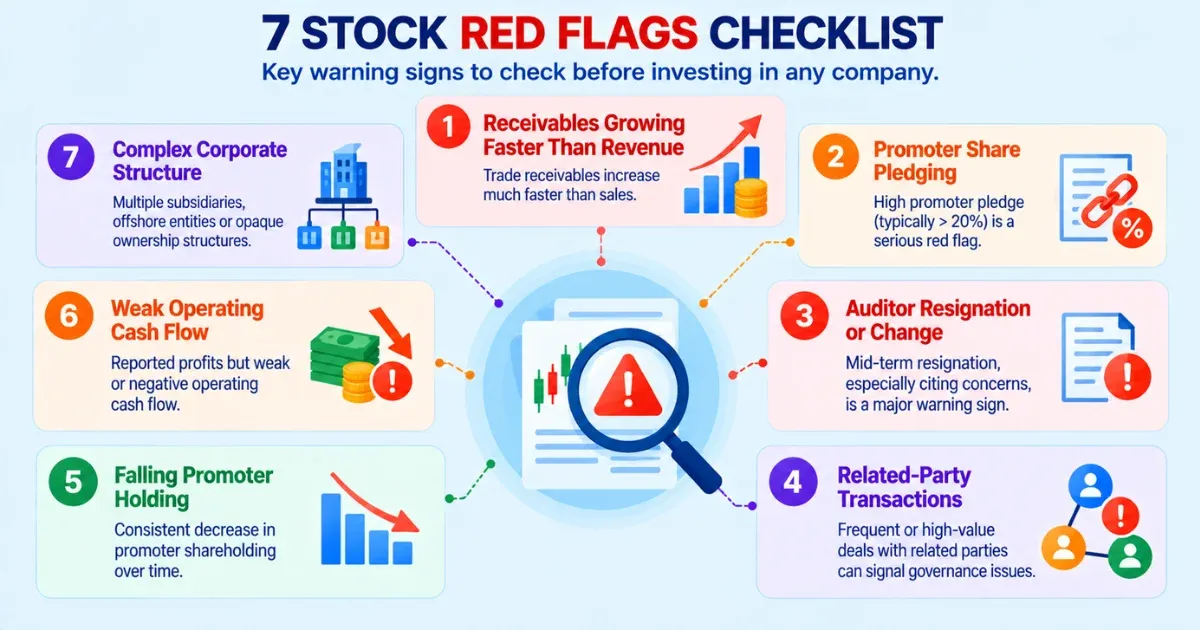
When a company's trade receivables, money owed by customers, grow significantly faster than its reported revenue over several quarters, it can mean the company is booking sales that customers either haven't paid for yet or may never fully pay. This divergence is considered a particularly reliable warning sign of revenue recognition issues, since it builds up quietly in the balance sheet while the income statement still looks healthy.
Manpasand Beverages offers a real, well-documented Indian case. In the years before its auditor resigned and SEBI stepped in, the company's receivables grew more than 40% while revenue grew only around 25%, a widening gap that, in hindsight, was visible in the financial statements well before the broader problems became public. Checking receivables growth against revenue growth over at least 3-4 consecutive quarters is a simple, checkable exercise any investor can do from a company's published results.
Promoter pledging happens when a company's promoters use their own shares as collateral to raise personal or business loans. A modest pledge isn't automatically alarming, but a large one creates a dangerous feedback loop, if the stock price falls, lenders demand more collateral, forcing promoters to pledge even more shares or face forced selling, which itself pushes the price down further.
A commonly used rule of thumb treats promoter pledges above roughly 20% of total promoter holding as a serious red flag, since it signals the promoters themselves may be under financial stress, and because the forced-selling mechanism described above can turn a moderate price decline into a much sharper one. This figure is publicly disclosed in shareholding pattern filings and is one of the easier checks to make quickly.
An auditor stepping down mid-term, rather than at the natural end of their term, is one of the clearest governance red flags available to investors, precisely because it's a specific, legally documented event rather than a matter of interpretation. Under Section 143 of the Companies Act, when an auditor resigns and suspects fraud has occurred or is occurring, they are required to file Form ADT-4 with the Ministry of Corporate Affairs, flagging their concerns formally rather than quietly walking away.
This filing, and the fact of a mid-term resignation itself, is public record and checkable through company disclosures and MCA filings. A pattern of frequent auditor changes, or a resignation immediately followed by a significant stock price move, both deserve a closer look rather than being dismissed as routine housekeeping.
Research Stocks Smarter with Dhanarthi AI Screener
Analyze 5,000+ NSE & BSE stocks with 150+ custom filters, real-time volume breakout scans, and transparent fundamental data.
Use Dhanarthi Screener
Related-party transactions (RPTs) involve a company doing business, loans, asset sales, service contracts, with entities connected to its own promoters or directors. A reasonable level of RPT activity is normal for many businesses, but a pattern of large, recurring, or poorly explained related-party deals can be a mechanism for quietly transferring value out of the listed company and into promoter-controlled entities, at the expense of minority shareholders.
Checking the related-party transactions disclosure in a company's annual report, and specifically whether the scale or frequency of these transactions has been increasing over time, is a meaningful part of red flags in annual report analysis that many retail investors skip entirely.
A steady, multi-quarter decline in promoter shareholding, separate from pledging, can signal that the people with the deepest insider knowledge of the business are reducing their own exposure to it. A single quarter's small reduction isn't necessarily meaningful, but a sustained downward trend over several consecutive quarters is worth investigating, particularly when it isn't accompanied by a clear, disclosed reason like a planned strategic stake sale.
A company can report a healthy net profit while generating little or even negative operating cash flow, a mismatch that often signals the reported profit isn't translating into real, collectible cash. This is one of the more reliable red flags in balance sheet and cash flow analysis, since cash flow is generally harder to manipulate convincingly than accrual-based profit figures over a sustained period.
Comparing operating cash flow to reported profit across several years, rather than checking a single year in isolation, reveals whether this is a recurring pattern or a one-off timing issue tied to a specific large transaction.
An unusually large number of subsidiaries, particularly smaller, loosely explained ones, can sometimes be used to move funds, obscure related-party dealings, or make a group's true financial position harder for outside investors to understand clearly. This isn't automatically a sign of wrongdoing, many large, legitimate conglomerates have complex structures for genuine operational reasons, but an opaque structure that makes it genuinely difficult to understand where profits and cash actually sit deserves added scrutiny rather than being waved through as routine complexity.
Red flags rarely show up in isolation, and when several appear together in the same company, the combined signal is considerably stronger than any single flag alone. WeWork India's roughly Rs 3,000 crore IPO in 2026 became a widely discussed example of exactly this. The issue was structured as a complete Offer for Sale (OFS), meaning the company itself received no fresh capital from the IPO at all, every rupee went to existing shareholders exiting their positions. This structure was combined with separate concerns around promoter financial stress signals and flagged audit and cash flow issues raised around the same offering.
No single element here is automatically disqualifying on its own, a full OFS structure alone doesn't prove anything is wrong, plenty of legitimate IPOs are structured this way. But when a 100% OFS structure, promoter pledge concerns, and audit-related flags appear together in the same offering, the combined picture is a stronger signal than any one of these factors would be in isolation, illustrating why checking several red flags together, rather than screening for just one, gives a more reliable read.

Confused about chart patterns & stock analysis?
Use
Dhanarthi Stock Guru
to chat, analyze price patterns, and ask questions directly.
Stock market fraud warning signs and governance red flags are rarely hidden entirely, they usually sit in plain sight within receivables trends, shareholding patterns, auditor filings, and related-party disclosures, for investors willing to check them. Manpasand Beverages' receivables divergence and WeWork India's stacked 2026 IPO concerns both show that these signals were checkable well before the full picture became widely known. Running through a practical red flags checklist, alongside a broader read of how to pick stocks in India and a full process for how to analyse a stock before investing, gives a far more complete picture than checking valuation or growth numbers alone.
1. What are red flags in stocks?
Red flags in stocks are warning signs in a company's financial statements, ownership structure, or governance that suggest potential problems, such as receivables growing faster than revenue, heavy promoter pledging, or an auditor resignation.
2. What is the receivables red flag in stock analysis?
The receivables red flag occurs when a company's trade receivables grow significantly faster than its reported revenue over several quarters, potentially signaling revenue recognition issues or customers not actually paying for booked sales.
3. What percentage of promoter pledge is considered a red flag?
A commonly used rule of thumb treats promoter pledges above roughly 20% of total promoter holding as a serious red flag, since it signals possible financial stress and can trigger forced selling if the stock price falls.
4. Why is auditor resignation considered a red flag?
An auditor resigning mid-term, especially when Form ADT-4 is filed under Section 143 of the Companies Act flagging suspected fraud, is one of the clearest governance red flags since it is a specific, legally documented event.
5. What is Form ADT-4?
Form ADT-4 is a regulatory filing an auditor must submit to the Ministry of Corporate Affairs under Section 143 of the Companies Act when they suspect fraud has occurred or is occurring at the company they're auditing.
Share Market
IPO
Artificial Intelligence
Semi Conductor