


BTST Trading: Meaning, Benefits, Risks and How It Works
August 12, 2026



TABLE OF CONTENTS
Get AI Summary





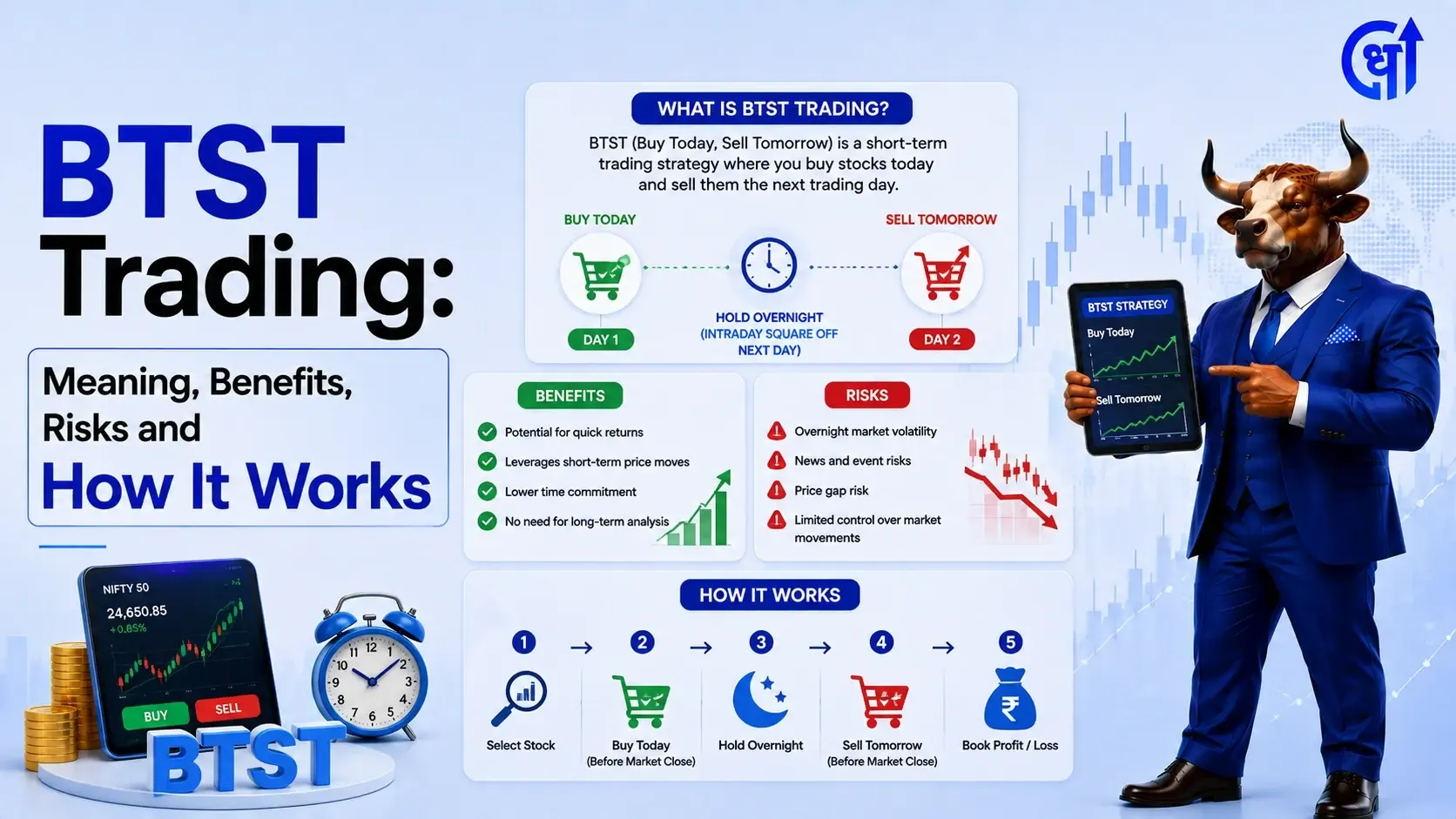
BTST (Buy Today, Sell Tomorrow) is a trading strategy where you buy shares in the cash market and sell them the next trading day, before they are credited to your demat account. It works because of the T+1 settlement cycle, letting traders capture overnight price moves without holding shares for multiple days.
BTST stands for Buy Today, Sell Tomorrow. It is a short-term trading strategy where you purchase shares in the cash equity market on one day and sell them the next trading day, without waiting for the shares to be formally credited to your demat account through the T+1 settlement cycle.
The strategy is sometimes also called ATST, or Acquire Today Sell Tomorrow, and its mirror version on the sell side is called STBT, or Sell Today Buy Tomorrow. Both rely on the same settlement mechanics, just applied in opposite directions.
BTST sits between intraday trading and regular delivery-based investing. You are not required to square off your position on the same day like an intraday trade, but you are also not holding the shares for multiple days like a typical delivery buy.
Indian equities currently settle on a T+1 cycle, meaning shares bought on a given trading day, T, are credited to the buyer's demat account by the next working day, T+1. BTST exploits a specific feature of this cycle: the exchange nets out buy and sell obligations for the same stock rather than requiring your shares to physically sit in your demat account before you can sell them again.
Here is the sequence in practice. On Monday, you buy 100 shares of a stock in the cash market. Normally, these shares would be credited to your demat account by Tuesday. Under BTST, you place a sell order for the same 100 shares on Tuesday morning, before the shares have actually landed in your account. Your broker facilitates this because the exchange's clearing system matches your Monday buy-in with your Tuesday sell-out.
This only works within the settlement window. Once shares are credited to your demat account after T+1, selling them is treated as a regular delivery sale rather than a BTST trade.
BTST is often confused with intraday trading, but the two work differently. Intraday positions must be closed on the same trading day, and if you fail to square off, your broker auto-squares the position near market close. BTST carries the position overnight into the next trading day instead.
Delivery trading, by contrast, involves holding shares in your demat account for an indefinite period, from a single day to several years, with no obligation to sell within a fixed window. BTST is essentially delivery trading compressed into the shortest possible holding period the settlement cycle allows, one trading day.
The key distinction that matters practically is margin and risk. Intraday trades typically get higher leverage from brokers but carry same-day square-off risk. BTST trades usually require full payment like a delivery trade but carry settlement risk instead of same-day price risk.
BTST offers a few clear advantages for active traders who want more flexibility than intraday trading but do not want to commit capital for multiple days.
Overnight Gains: You can capture price movement driven by late-day news, corporate earnings announcements, or global market cues that emerge after Indian markets close, since your position stays open into the next session.
No Intraday Pressure: Unlike intraday trades, you are not forced to square off your position by the end of the same trading day, giving you more room to decide your exit price.
Capital Efficiency: BTST avoids tying up capital for multiple days the way a longer delivery hold would, letting active traders cycle the same funds through more opportunities in a shorter period.
The primary risk in BTST trading is short delivery. This happens when the person who sold you shares on day T fails to deliver them to the exchange by the settlement date, which means your broker never actually receives the shares you are counting on to fulfill your own sell order.
Here is how this plays out with real numbers. Say you buy 100 shares of a stock on Monday. On Tuesday, the stock opens higher and you sell those 100 shares to another trader, locking in your profit. If your original seller from Monday fails to deliver the shares, your broker cannot deliver them to your Tuesday buyer either. The exchange then runs an auction between 2:00 PM and 2:45 PM on T+1 to source the missing shares from the open market. This auction price can be up to 20% higher than the previous day's closing price. That auction cost, plus any penalty, gets debited from your account. If the auction price ends up higher than the price at which you sold, the difference eats into or completely wipes out the profit you thought you had locked in.
There is no fixed flat penalty amount in BTST short delivery cases. The final cost depends on how far the auction price moves from the previous close and on exchange-specific settlement procedures at the time.
Beyond short delivery, BTST also carries ordinary overnight price-gap risk. Negative news between market close and the next day's open can cause a stock to open sharply lower, locking in a loss regardless of whether short delivery occurs.
To place a BTST trade, you need an active demat and trading account with a broker that supports BTST orders. Not every broker enables this by default, and not every stock is eligible, so checking your broker's BTST stock list before trading is a necessary first step.
The process itself is simple from the trader's side. You buy the stock in the cash market on day T, and place a regular sell order for the same quantity on T+1, typically selecting a BTST or "sell against buy" option if your broker's order form requires it. The broker's backend handles the settlement matching, and your profit or loss reflects once the trade fully settles.
Liquid, high-volume stocks are generally safer for BTST, since thinly traded stocks carry a higher chance of the seller failing to deliver shares, which raises your short delivery risk.
SEBI has been phasing in an optional T+0 settlement cycle, where trades settle on the same day rather than the next working day. This started with a small set of stocks and has since expanded, with the top 500 stocks by market capitalization made eligible for the optional T+0 cycle effective January 31, 2026, rolled out in monthly phases starting from the bottom of that list upward.
For stocks trading under the T+0 cycle, the entire BTST setup changes, since same-day settlement removes the overnight gap that BTST is built around. For stocks still settling on the standard T+1 cycle, which remains the vast majority of actively traded stocks as of August 2026, BTST continues to work exactly as described above. The T+0 cycle remains optional for now, and brokers may charge differential brokerage for using it.
BTST trades are taxed the same way as regular delivery trades held for less than 12 months, as short-term capital gains, currently taxed at 20% under the Finance Act 2024 provisions effective from July 23, 2024. This is different from intraday trading, which is taxed as speculative business income rather than capital gains.
Brokerage charges for BTST vary by broker and are often similar to delivery trade charges rather than the discounted rates sometimes offered for intraday trades. Some brokers also levy an additional BTST-specific charge, so checking your broker's fee schedule before placing the trade avoids surprises on settlement.
BTST works because of a one-day gap in India's settlement cycle, and that same gap is where both its benefit and its biggest risk come from. Understanding the T+1 mechanism, the auction process, and which stocks your broker actually supports for BTST matters more than the strategy itself once you are ready to place a trade.
Disclaimer: This article is for educational purposes only. It does not constitute investment advice. This is not a recommendation to buy or sell any security named above. Please consult a SEBI-registered financial advisor before making investment decisions.
1. What is BTST in the stock market?
BTST stands for Buy Today, Sell Tomorrow. It is a trading strategy where you buy shares one day and sell them the next trading day, before the shares are formally credited to your demat account under the T+1 settlement cycle.
2. What does BTST mean in trading?
BTST means a trader is selling shares purchased the previous trading day, relying on the exchange's settlement system to net the buy and sell obligations instead of waiting for the shares to physically appear in the demat account first.
3. Is BTST trading legal in India?
Yes. BTST trading is legal and is offered by most stockbrokers in India for eligible cash-market shares, subject to exchange settlement rules and each broker's own eligibility conditions.
4. What is the biggest risk in BTST trading?
The biggest risk is short delivery, where your original seller fails to deliver the shares by the settlement date. This triggers an exchange auction, and the resulting cost, which can run up to 20% above the previous close, is debited from your account.
5. Can I do BTST on any stock?
No. Not all stocks are eligible for BTST, and brokers maintain their own list of approved stocks for this strategy. Checking your broker's current BTST-eligible list before placing the trade is essential.
6. How is BTST different from intraday trading?
Intraday trades must be closed on the same day or they get auto-squared off by the broker. BTST carries the position overnight into the next trading day and does not require same-day closure.
7. What is the full form of BTST?
BTST stands for Buy Today, Sell Tomorrow, a short-term equity trading strategy built around the T+1 settlement cycle.
8. How is BTST taxed in India?
BTST trades are taxed as short-term capital gains at 20% if held for less than 12 months, under the Finance Act 2024 provisions effective July 23, 2024, since they are treated as delivery trades rather than speculative intraday positions.
9. What happens if my BTST trade faces short delivery?
If short delivery occurs, the exchange conducts an auction between 2:00 PM and 2:45 PM on T+1 to source the missing shares. The auction cost is debited from your account, and if it exceeds your original sell price, it can reduce or wipe out your profit.
10. Does T+0 settlement affect BTST trading?
Yes. For stocks trading under the optional T+0 settlement cycle, which SEBI has been phasing in for the top 500 stocks since early 2026, trades settle the same day, which removes the overnight gap that BTST depends on for those specific stocks.
Share Market
IPO
Artificial Intelligence
Semi Conductor