




Commodity Trading Time in India: MCX Timings 2026
August 11, 2026



TABLE OF CONTENTS
Get AI Summary





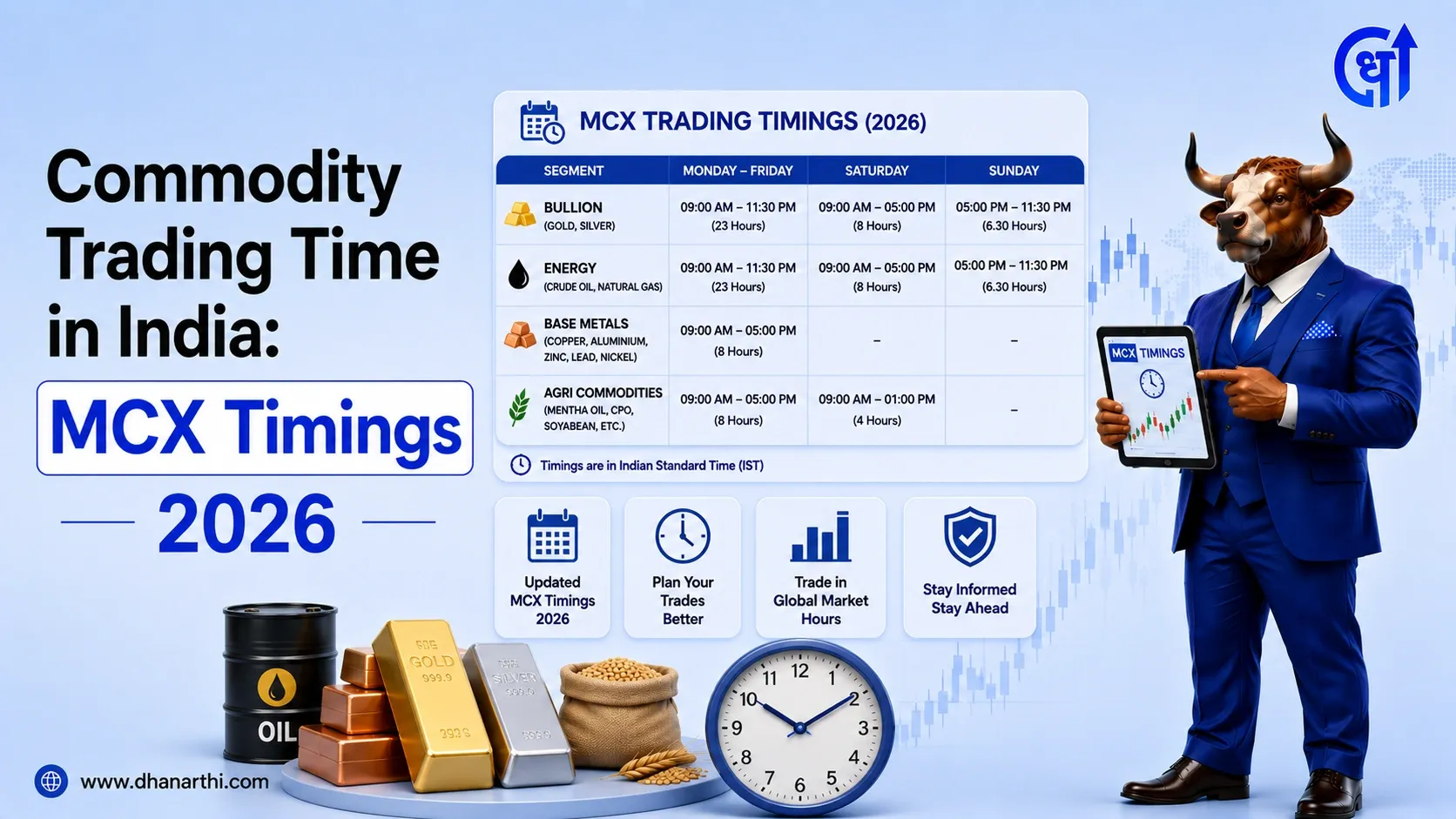
Commodity market timing on MCX runs Monday to Friday, with a morning session from 9:00 AM to 5:00 PM and an evening session from 5:00 PM to 11:30 PM or 11:55 PM depending on US daylight saving. Agricultural commodities close at 5:00 PM, while bullion, metals, and energy trade until the extended evening close.
The Multi Commodity Exchange of India, or MCX, is India's largest commodity derivatives exchange, regulated by SEBI. It handles trading in MCX commodities across bullion, base metals, energy, and agricultural segments.
Unlike the NSE or BSE, which run a single trading window, MCX operates in two separate sessions each trading day. Getting the timing wrong is a common issue for new traders, since a position opened assuming the market is closed at 5:00 PM can miss hours of active trading in gold, silver, or crude oil that continue well past that point.
MCX trading hours are split by commodity category, and each category has its own closing time.
| Session | Timing | Applies To |
|---|---|---|
| Pre-market | 8:45 AM to 8:59 AM | All commodities |
| Morning session | 9:00 AM to 5:00 PM | All commodities |
| Evening session (agri) | 5:00 PM close | Regular agricultural commodities |
| Evening session (international agri) | 5:00 PM to 9:00 PM or 9:30 PM | Internationally referenced agri commodities |
| Evening session (non-agri) | 5:00 PM to 11:30 PM or 11:55 PM | Bullion, base metals, energy |
Data sourced from MCX official circulars.
Gold, silver, crude oil, natural gas, and copper fall under the non-agri category, so they remain open for trading well into the night. Cotton, cardamom, and mentha oil are regular agri commodities and stop trading at 5:00 PM sharp.
MCX revises its evening session closing time twice a year to stay aligned with United States daylight saving changes. During US daylight saving time, roughly the second Sunday of March to the first Sunday of November, the non-agri evening session closes at 11:30 PM IST. Outside this window, the close shifts to 11:55 PM IST.
MCX confirmed this seasonal revision effective March 9, 2026 through an official exchange circular. This adjustment exists because MCX prices for bullion and energy track international benchmarks set on US exchanges, and keeping the closing bell aligned with US market hours reduces the price gap between MCX and global references at the point of closing.
A common mistake among newer traders is assuming the closing time is fixed year-round. Checking today's applicable session end, rather than relying on a number memorised months earlier, avoids placing orders after the market has already closed for the day.
Crude oil on MCX is most active roughly between 7:30 PM and 11:30 PM IST, when the New York trading session for crude oil is live and price discovery is at its sharpest. This window matters more than the full session length, since liquidity and volatility both concentrate here.
The US Energy Information Administration releases its weekly crude oil inventory report every Wednesday at 10:30 AM Eastern Time, which falls around 8:00 PM or 9:00 PM IST depending on the season. This single data release routinely moves crude oil prices sharply within minutes, and traders who track the MCX calendar closely tend to watch this hour more carefully than any other slot in the evening session.
Gold and silver follow a similar pattern, tracking COMEX hours in the US, which is why their MCX price action also tends to pick up after 7:00 PM IST rather than during the earlier daytime session.
A trader placing a crude oil order at 10:00 AM, expecting the same volatility seen in the evening, is often surprised by how flat the morning session feels. Indian daytime hours for crude oil mostly reflect overnight moves already priced in from the previous US session, since fresh US data has not yet arrived. The bulk of intraday price discovery for crude oil genuinely happens after the US market opens, not before it.
MCX and NSE follow very different schedules. Equity trading on the stock market runs from 9:15 AM to 3:30 PM in a single continuous session, while MCX splits its day into a morning and an extended evening session that runs nearly 15 hours in total.
This difference exists because commodities like crude oil and gold are priced globally around the clock, so MCX keeps its evening window open to reflect price movements happening in international markets after Indian equity trading has already closed for the day. A trader used to checking only the NSE clock needs a separate mental model for MCX, since commodity positions can still be active hours after the stock market has shut down.
MCX generally observes 15 to 17 trading holidays each year, tied to national and religious festivals. On most of these days, only the morning session is closed and the evening session opens as usual from 5:00 PM, since global commodity prices do not pause for Indian holidays.
Diwali Laxmi Pujan falls on Sunday, November 8, 2026. Even though it lands on a weekend, MCX will still conduct a special Muhurat trading session that day, typically a one-hour evening window considered auspicious for opening new positions. The exact timing is notified by the exchange closer to the date through an official circular.
MCX does not trade on Saturdays or Sundays under any other circumstance, and there is no compensatory trading day added when a holiday falls on a weekday. In 2026, several holidays such as Mahashivratri and Independence Day already fall on a weekend, so they do not create any additional weekday closure beyond the regular Saturday and Sunday shutdown.
A holiday list matters more for commodity traders than it might for equity traders, since open positions in gold, crude oil, or natural gas continue to carry overnight risk from global price moves even while MCX itself is shut. Checking the holiday calendar before placing a multi-day position helps avoid being caught off guard by a closed exchange during a period of high global volatility.
Before the main morning session begins, MCX runs a 14-minute pre-market session from 8:45 AM to 8:59 AM. This window allows price discovery and order matching before regular trading opens at 9:00 AM, similar in purpose to the pre-open session on NSE equities.
Settlement holidays are a separate category from trading holidays. On a settlement holiday, MCX remains open for trading, but the clearing banks are closed, so no fund or commodity settlement takes place that day even though positions can still be opened or closed.
This distinction trips up a fair number of new traders, since a market that looks fully open on the screen may still delay the actual transfer of funds or commodity units by a day. Checking whether a given date is a settlement holiday, in addition to a trading holiday, matters most around month-end expiry and delivery-based contracts, where a delay in settlement can affect margin requirements.
MCX groups its listed commodities into four broad segments, and knowing which segment a commodity belongs to is the fastest way to know its closing time without checking a table every time.
Bullion covers gold and silver, and trades until the extended evening close of 11:30 PM or 11:55 PM. Base metals such as copper, zinc, aluminium, and lead follow the same non-agri schedule. Energy, which includes crude oil and natural gas, also falls under this late-closing category because both commodities are priced against US benchmarks that stay active well into the Indian night.
Agricultural commodities split into two groups. Domestic-only crops such as cardamom, cotton, and mentha oil close at 5:00 PM, in line with the morning session end. Agri commodities with an international price reference, such as crude palm oil, extend slightly further into the evening, closing at 9:00 PM or 9:30 PM, since their pricing still takes cues from global markets even though the underlying crop is traded domestically.
MCX timing is not a single number to memorise. It changes by commodity category and shifts twice a year for daylight saving, which is exactly where most confusion around commodity trading time in India comes from. Once you know which session your commodity falls under, checking today's applicable close takes a few seconds rather than a guess.
Disclaimer This article is for educational purposes only. It does not constitute investment advice. This is not a recommendation to buy or sell any security named above. Please consult a SEBI-registered financial advisor before making investment decisions.
1. What is the commodity market timing in India today?
MCX runs a morning session from 9:00 AM to 5:00 PM and an evening session from 5:00 PM to either 11:30 PM or 11:55 PM, depending on whether US daylight saving is currently in effect.
2. What is MCX trading time for crude oil specifically?
Crude oil trades within the non-agri evening session, open until 11:30 PM or 11:55 PM IST. Its most active window is roughly 7:30 PM to 11:30 PM IST, when the US market session overlaps.
3. What time does MCX close today?
MCX's non-agri evening session closes at 11:30 PM IST during US daylight saving time, and at 11:55 PM IST outside that period. Agri commodities close earlier, at 5:00 PM.
4. Is MCX open on weekends?
No. MCX does not conduct any trading sessions on Saturdays or Sundays, regardless of holidays or special events during that week.
5. What is the MCX pre-market session timing?
The MCX pre-market session runs for 14 minutes, from 8:45 AM to 8:59 AM, before the regular morning session begins at 9:00 AM.
6. Why does MCX closing time change during the year?
MCX shifts its evening session close between 11:30 PM and 11:55 PM twice a year to stay aligned with US daylight saving changes, since bullion and energy prices on MCX track international benchmarks set on US exchanges.
7. Do all commodities on MCX close at the same time?
No. Regular agri commodities close at 5:00 PM, internationally referenced agri commodities close at 9:00 PM or 9:30 PM, and bullion, metals, and energy trade until 11:30 PM or 11:55 PM.
8. Is there Muhurat trading on MCX for Diwali 2026?
Yes. MCX will hold a special Muhurat trading session on November 8, 2026, for Diwali Laxmi Pujan, with exact timing to be notified by the exchange through an official circular closer to the date.
9. How many trading holidays does MCX have in a year?
MCX typically observes 15 to 17 trading holidays a year. On most of these, only the morning session is closed, and the evening session opens as usual from 5:00 PM.
10. What is the difference between MCX trading time and NSE trading time?
NSE equity trading runs in a single session from 9:15 AM to 3:30 PM. MCX splits its day into a morning session and an extended evening session, running for nearly 15 hours to reflect global commodity price movements.
Share Market
IPO
Artificial Intelligence
Semi Conductor