



How to Make Money in Intraday Trading in India
November 19, 2026


TABLE OF CONTENTS
Get AI Summary


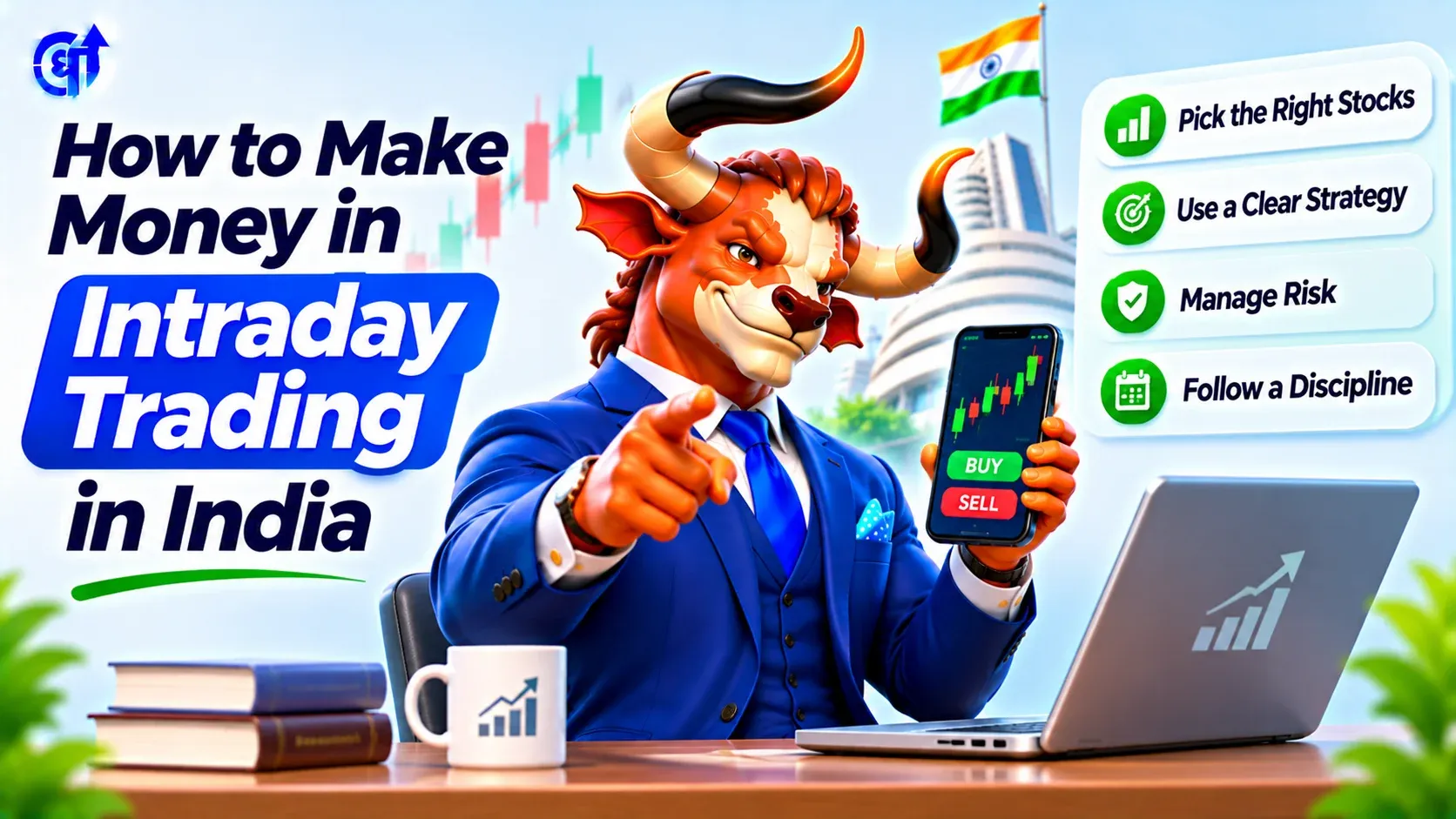
Intraday trading makes money when your total gains from winning trades exceed your total losses plus costs. SEBI data shows 71% of individual intraday traders in the cash segment lost money in FY23. Profit comes from risking 1% per trade, cutting losses fast, and trading few times.
Making money in intraday trading comes down to three things: a small loss on every wrong trade, a bigger gain on every right one, and costs that do not eat the difference. The data shows most traders miss at least one. This guide uses SEBI's 2024 and August 2026 studies, the new NSE timings and real cost math to show what works, starting with basic stock analysis before every trade.
SEBI found that 71% of individual cash-segment intraday traders lost money in FY23, and 87.7% of derivatives traders lost money in FY26.
Break-even is a math problem: at a 1:2 risk-reward ratio you need to win about 36 of 100 trades after costs.
Risk 1% of capital per trade and stop for the day after losing 2%.
NSE timings changed on 3 August 2026 and change again on 7 December 2026, so old timing tables are wrong.
Intraday profit is taxed as speculative business income, and losses carry forward for only 4 years.
Research Stocks Smarter with Dhanarthi AI Screener
Analyze 5,000+ NSE & BSE stocks with 150+ custom filters, real-time volume breakout scans, and transparent fundamental data.
Use Dhanarthi Screener
Intraday trading means buying and selling the same stock within one trading day, so no position stays open overnight.
Here is how intraday trading works in practice:
You can buy first and sell later, or sell first and buy back later (short selling), as long as you close the position the same day.
Brokers offer MIS (margin intraday square-off) orders. These give you leverage, and the broker closes your position automatically if you do not.
Your profit is the sell value minus the buy value, minus brokerage, taxes and exchange fees.
Example: you buy 100 shares at Rs 500 (Rs 50,000) and sell at Rs 506 (Rs 50,600). Gross profit is Rs 600. Costs on this round trip are about Rs 54, so net profit is about Rs 546. If the same trade had lost Rs 6 a share, the loss would grow to about Rs 653 once costs are added.
Costs hit winners and losers alike. That is why a trader who wins half of their trades by equal amounts still loses money over time.
Intraday trading also differs from delivery trading in how it is taxed and charged:
| Feature | Intraday trading | Delivery trading |
|---|---|---|
| Holding period | Same day, no overnight position | Overnight or longer |
| STT | 0.025% on the sell side | 0.1% on both buy and sell |
| Stamp duty | 0.003% on the buy side | 0.015% on the buy side |
| Leverage | Offered by brokers through MIS | Not offered by default (some brokers offer MTF) |
| Tax treatment | Speculative business income | Capital gains |
Data sourced from Zerodha's published charges and Groww's guide to trader taxation. Brokerage and leverage rules differ by broker.
Yes, some traders make money in intraday trading, but SEBI's own data shows most do not.
SEBI's July 2024 study looked at individual traders in the equity cash segment. It found that 71% of intraday traders lost money in FY23 and that the share rose to 80% for traders who placed more than 500 trades a year. The average loss was Rs 5,371. Loss-makers also spent an extra 57% of their losses on trading costs, while profit-makers spent 19% of their profits on costs.
Experience helped only partly: 54% of traders with three years of experience were still loss-makers.
In August 2026, SEBI published two studies on equity derivatives for FY25 and FY26. They cover derivatives, not cash intraday, but they show which habits go with losses:
87.7% of individual traders lost money in FY26.
Among traders who kept trading after losing money in each of the two previous years, 90% lost again in FY26.
Only 0.5% of traders active from FY22 to FY26 made a profit in all five years, and 65.6% lost money in every year.
Experience did not help: the share of loss-makers rose from 91% among first-year traders to 96.5% among four-year traders.
Across all trader-quarters, 84.6% were loss-making, and the median loss in a losing quarter (Rs 10,525) was more than twice the median gain in a winning quarter (Rs 4,366).
| Study | Segment and period | Share of traders who lost money | Key finding |
|---|---|---|---|
| SEBI, July 2024 | Equity cash intraday, FY23 | 71% (80% for very frequent traders) | Average loss Rs 5,371; loss-makers paid costs worth 57% of their losses |
| SEBI, August 2026 | Equity derivatives, FY26 | 87.7% | About 90% of two-year loss-makers lost again |
| SEBI, August 2026 | Equity derivatives, FY22 to FY26 | 65.6% lost money every year (traders active all five years) | Only 0.5% made a profit in all five years |
Data sourced from SEBI studies published in July 2024 and August 2026.
SEBI describes these as associations, not proven causes. Still, the pattern is clear:
Traders active on more than 100 days made up 42% of traders but 87% of total losses.
Traders with higher capital relative to their turnover lost money less often. Among traders using Rs 10 lakh to Rs 1 crore, 67.6% lost money, against 90% for those using under Rs 1 lakh.
Traders with more cash-market activity relative to derivatives activity lost less. 84% of traders whose cash turnover was more than five times their derivatives turnover lost money, against 90% for those whose cash turnover was below 10% of their derivatives turnover.
The takeaway: trade less often, size positions to your capital, and treat intraday trading as one part of your investing, not all of it.
To make money in intraday trading, your win rate and your reward-to-risk ratio must together beat your costs.
The formula is simple: break-even win rate = 1 / (1 + reward-to-risk). The table below adds a typical cost of Rs 83 per round trip on a Rs 1,00,000 position, with Rs 1,000 risked per trade.
| Reward-to-risk | Break-even win rate before costs | Break-even win rate after costs |
|---|---|---|
| 1:1 | 50.0% | 54.2% |
| 1:1.5 | 40.0% | 43.3% |
| 1:2 | 33.3% | 36.1% |
| 1:3 | 25.0% | 27.1% |
Data sourced from Dhanarthi calculations using Zerodha's published intraday charges.
A trader who wins 40% of trades at 1:2 is profitable. A trader who wins 55% of trades at 1:1 only just breaks even. A common beginner pattern is cutting winners early and letting losers run, which can produce a 1:0.5 ratio and needs a win rate above 66%.
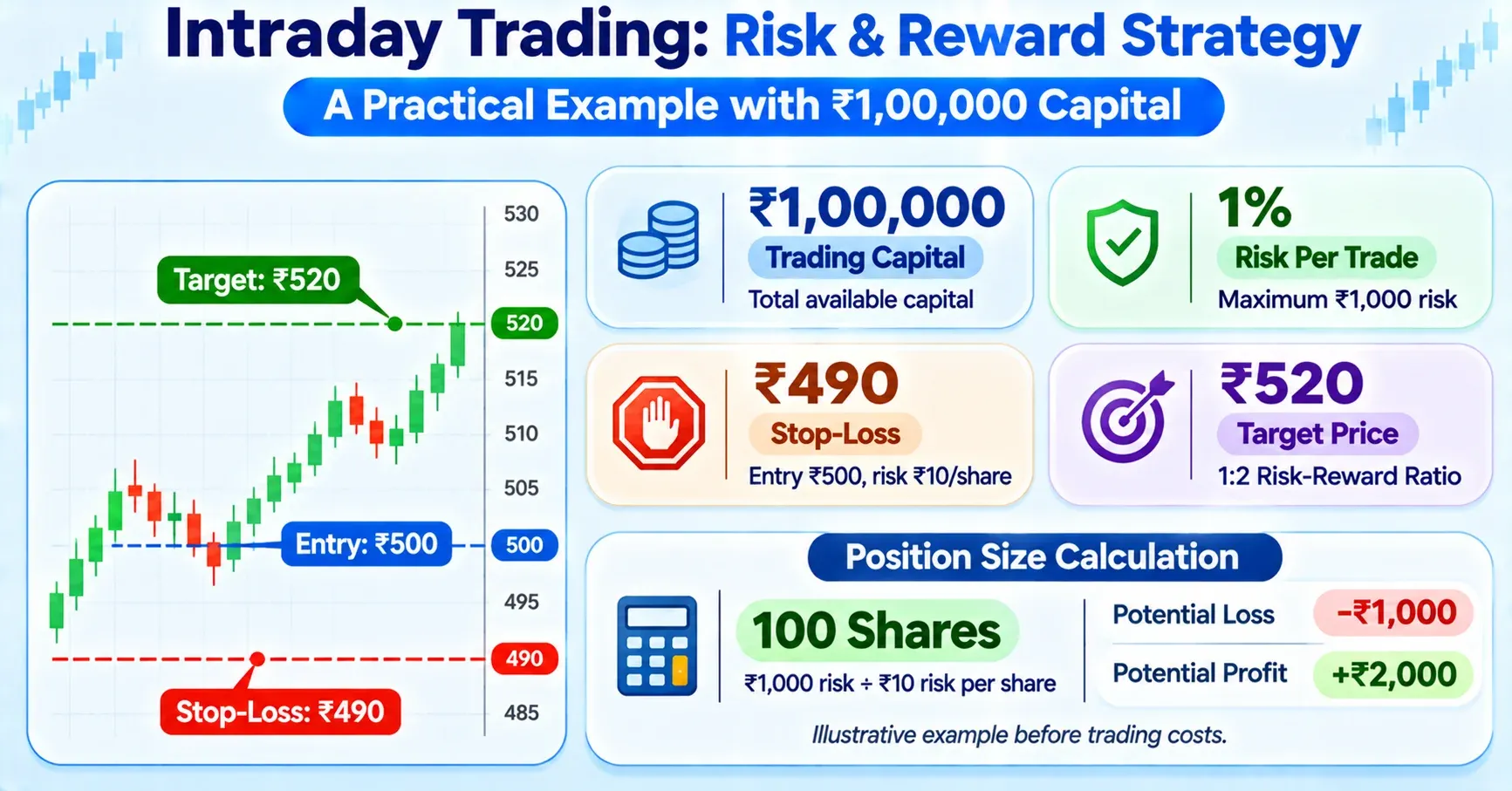
Risk 1% of capital per trade. With Rs 1,00,000, that is Rs 1,000.
Entry: Rs 500. Stop-loss: Rs 490. Risk per share: Rs 10.
Quantity: Rs 1,000 divided by Rs 10 = 100 shares (a Rs 50,000 position).
Target at 1:2: Rs 520, which gives Rs 2,000 or 2% of capital.
Daily loss limit: 2% (Rs 2,000). After two stop-outs, you stop for the day.
Notice that position size comes from the stop distance, not from how much margin the broker offers.
Zerodha charges the lower of Rs 20 or 0.03% per executed intraday order, STT of 0.025% on the sell side, NSE transaction charges of 0.00322%, stamp duty of 0.003% on the buy side, SEBI fees of Rs 10 per crore, and GST of 18% on brokerage and exchange fees. Here is the Rs 600 profit example from earlier:
| Charge | Amount (Rs) |
|---|---|
| Brokerage (buy and sell) | 30.18 |
| STT | 12.65 |
| NSE transaction charges | 3.24 |
| SEBI fees | 0.10 |
| GST | 6.03 |
| Stamp duty | 1.50 |
| Total | 53.70 |
Data sourced from Zerodha's published charges, with Dhanarthi calculations. Rates differ by broker.
Costs took 9% of a Rs 600 gross profit. The stock also had to move about 0.11% just for you to break even. Ten such trades a day would cost about Rs 537 in charges alone.
A target of 1% a day sounds small. Compounded over 250 trading days it turns Rs 1,00,000 into about Rs 12,00,000. No trader sustains that. Set process targets instead: follow your plan, keep losses at 1%, and review every trade.
NSE and BSE open for regular trading at 9:15 AM, but the closing times now depend on the stock, and they change again on 7 December 2026.
From 3 August 2026, stocks that have F&O contracts stop continuous trading at 3:15 PM and move into a closing auction. All other stocks trade until 3:30 PM. SEBI's circular of 15 October 2026 changes this again from Monday, 7 December 2026.
| Session | Until 4 December 2026 | From 7 December 2026 |
|---|---|---|
| Pre-open | 9:00 AM to 9:15 AM | 9:00 AM to 9:15 AM |
| Continuous trading, stocks with F&O | 9:15 AM to 3:15 PM | 9:15 AM to 3:30 PM |
| Continuous trading, other stocks | 9:15 AM to 3:30 PM | 9:15 AM to 3:30 PM |
| Closing auction session | 3:15 PM to 3:35 PM (F&O stocks) | 3:30 PM to 3:40 PM |
| Stock and index F&O trading ends | 3:40 PM | 3:45 PM (expiring index contracts stop at 3:30 PM on expiry day) |
Data sourced from SEBI circular dated 15 October 2026 and Zerodha's Z-Connect notices.
Your broker's auto square-off time matters more than the exchange close. Since 3 August 2026, Zerodha squares off MIS positions at 3:12 PM for stocks under the closing auction, 3:25 PM for other equity, and 3:26 PM for F&O. Check your own broker's current time, especially after 7 December.
No rule says one hour is best. Many traders watch the first 15 minutes without trading, take planned setups when volume is high after 9:30 AM, and avoid forcing trades in the quiet midday period. Treat this as trader habit, not a regulation.
| Time | What to do |
|---|---|
| Before 9:00 AM | Check overnight news, results calendar and your watchlist |
| 9:00 AM to 9:15 AM | Watch pre-open prices. Do not trade |
| 9:15 AM to 9:30 AM | Mark the opening range high and low |
| 9:30 AM to 11:30 AM | Take only trades that match your written setup |
| 11:30 AM to 1:30 PM | Review. Trade only if a clear setup appears |
| 1:30 PM to 3:00 PM | Second window, only if your daily loss limit is intact |
| 3:00 PM onward | Exit all positions well before your broker's square-off time |
| After the close | Write your journal entry |
Data sourced from NSE session timings and Dhanarthi's suggested routine.
Pick liquid stocks that have a reason to move today, because intraday trading today depends on today's news, not last week's list.
Run this checklist before 9:15 AM:
Liquidity: high daily volume and a tight bid-ask spread. Nifty 50 stocks are the usual starting point.
Catalyst: quarterly results, a block deal, a regulatory update or a sector move.
Gap: a stock opening well above or below yesterday's close, with volume.
Range: the usual daily range should be several times your round-trip cost of roughly 0.1%.
Trade category: stocks in the trade-to-trade segment cannot be squared off intraday, so skip them.
F&O status: check whether the stock is in the F&O list, because exit timings differ for those stocks.
A stock screener helps you filter by factors such as volume and price change before the open, so you review a short list instead of the whole market.
Intraday trading strategies for beginners work best when they are simple, rule-based and tested before real money goes in.
| Strategy | Setup | Stop-loss placement | When it fails |
|---|---|---|---|
| Opening range breakout | Enter when price breaks the high or low of the first 15-minute candle on rising volume | Opposite end of the range | Low-volume days and false breakouts after news |
| VWAP pullback | In an uptrend, buy a pullback to VWAP and hold while price stays above it | Below VWAP or the last swing low | Sideways days when price crosses VWAP repeatedly |
| Support and resistance bounce | Trade a reaction at the previous day's high or low | Just beyond the level | When the level breaks on a volume spike |
| Moving average pullback | In a trending stock, enter when price returns to a 20-period moving average on a 5-minute chart | Below the recent swing low | Range-bound markets |
Data sourced from Dhanarthi analysis of common intraday setups. None carries a guaranteed win rate.
Backtest or paper trade any strategy for several weeks. The failure column matters as much as the setup: skip the trade when the conditions listed there are present.
Master one setup. Switching strategies after each loss resets your learning.
Risk 1% per trade. Use the position sizing steps above.
Cap your trades. SEBI links higher trading frequency with higher losses, so aim for two or three planned trades a day.
Set a daily loss limit of 2%. When you reach it, close the platform.
Never average down. Adding to a losing intraday trade turns a small loss into a large one.
Wait out the first 15 minutes. Spreads are wide and prices swing.
Check the reason behind the move. An AI Financial Research Assistant can help you check the news and filings behind a move, so you know whether it has a real catalyst.
Start with free resources, test yourself with paper trades, and pay for a course only after you know what you are missing.
| Resource | Examples | Cost | Best for |
|---|---|---|---|
| Free learning | The Technical Analysis module and the Risk Management and Trading Psychology module on Zerodha Varsity | Free | Chart basics and risk rules |
| Books | Technical Analysis of the Financial Markets by John J. Murphy; Japanese Candlestick Charting Techniques by Steve Nison; Trading in the Zone by Mark Douglas | Book price | Charts, candlesticks and trading psychology |
| Regulator material | SEBI's investor education pages | Free | Understanding the risks |
| Paid intraday trading course | Run by brokers or private trainers | Varies | Structured feedback, if the trainer is credible |
Data sourced from Zerodha Varsity and the book publishers' listings.
Before paying for an intraday trading course, check four things:
The trainer or firm has valid SEBI registration where advice is involved.
No promise of guaranteed or fixed returns.
Real trade records, with losses shown.
A clear refund policy and a fee that makes sense next to free options.
| Weeks | Action | Rule to move on |
|---|---|---|
| 1 to 4 | Learn charts and risk rules, then paper trade one setup | 20 or more logged trades |
| 5 to 8 | Trade real money at minimum quantity, risking about 0.25% per trade | Journal shows costs and mistakes clearly |
| 9 to 12 | Move toward 0.5% to 1% risk only if results are positive after costs | At least 50 trades in the journal |
Data sourced from Dhanarthi suggested practice plan, which is a guideline and not a SEBI rule.
Log these fields for every trade: date, stock, setup, entry, stop, target, exit, quantity, total costs, result in multiples of risk, and one word for your emotion. Review the journal every Saturday.
Intraday equity profit is speculative business income, taxed at your slab rate and reported in ITR-3.
Losses from intraday trading can be set off only against speculative income, and unused losses carry forward for four years, provided you file your return by the due date. F&O income is non-speculative and its losses carry forward for eight years.
| Activity | Income type | Loss carry-forward |
|---|---|---|
| Intraday equity | Speculative business income | 4 years, against speculative income only |
| F&O | Non-speculative business income | 8 years |
Data sourced from Groww's guide to trader taxation for AY 2026-27.
Brokerage, STT and other charges are generally treated as business expenses, but keep contract notes and consult a chartered accountant for your case.
Most intraday losses come from habits, not from missing information.
Overtrading: SEBI found that traders active on more than 100 days accounted for 87% of derivatives losses.
Averaging down: adding to a loser to lower the average price.
No stop-loss: hoping a losing trade will recover.
Ignoring costs: a small gross profit can turn into a net loss.
Over-sizing: SEBI found traders with high turnover relative to capital lost money more often.
Old timing assumptions: planning an exit at 3:30 PM and missing a 3:12 PM or 3:25 PM auto square-off.
A real lesson came on 4 June 2024, the day of the Lok Sabha results. The Nifty fell to an intraday low of 21,281, about 8.5% below the previous close, and ended the day at 21,885, down 5.93%. A trader with a stop-loss and a 1% risk limit takes a defined loss on a day like that, while a trader without a stop faces the full swing. Skip or shrink trades on days with major scheduled events, and never use hope in place of a stop-loss.

Confused about chart patterns & stock analysis?
Use
Dhanarthi Stock Guru
to chat, analyze price patterns, and ask questions directly.
Intraday trading rewards discipline, not prediction. Risk 1% per trade, stop at a 2% daily loss, trade few setups and count every rupee of cost. Learn the new NSE timings, because stocks with F&O contracts now close earlier and the rules change again on 7 December 2026. Treat the first 90 days as training, keep a journal and judge yourself on process. SEBI's data links frequent trading, large turnover on small capital and repeated losses, so protect capital first.
1. Can you really make money in intraday trading?
Yes, but few traders do. SEBI found 71% of intraday cash traders lost money in FY23. Traders who risk 1% per trade, limit trades per day and keep costs low give themselves the best chance.
2. How much money do I need to start intraday trading?
SEBI sets no minimum. Start with money you can afford to lose. With Rs 50,000, a 1% risk is Rs 500 per trade. Very small accounts feel costs most, because each round trip carries fixed charges.
3. What is the best time for intraday trading in India?
Regular trading starts at 9:15 AM. Many traders wait 15 minutes and trade the morning session. Stocks with F&O contracts stop continuous trading at 3:15 PM until 4 December 2026, and at 3:30 PM from 7 December 2026.
4. How much can a beginner earn from intraday trading in a day?
There is no fixed amount. On Rs 1,00,000 capital, 1% is Rs 1,000 before about Rs 83 in costs per round trip. SEBI data shows most traders lose money, so focus on process before income.
5. Which stocks are best for intraday trading for beginners?
Liquid large-cap stocks, such as Nifty 50 members, have tight spreads and steady volume. Pick stocks with a clear catalyst and avoid stocks in the trade-to-trade segment.
6. How is intraday trading different from investing?
Intraday traders close every position the same day and aim to profit from small price moves. Investors hold for months or years and aim to profit from business growth. Costs and tax rules differ too.
7. Which strategy works best for intraday trading for beginners?
No strategy wins every time. Opening range breakout and VWAP pullback are simple starting points. Pick one, paper trade it for several weeks and move on only if the journal shows profit after costs.
8. Are intraday trading courses worth paying for?
Free material from Zerodha Varsity and SEBI covers the basics. Pay only for a course with verifiable trade records, no guaranteed-return claims and a clear refund policy.
9. Which books are good for learning intraday trading?
Technical Analysis of the Financial Markets by John J. Murphy covers charts. Japanese Candlestick Charting Techniques by Steve Nison covers candles. Trading in the Zone by Mark Douglas covers trading psychology.
10. How is intraday trading profit taxed in India?
Intraday equity profit is speculative business income, taxed at your slab rate and filed in ITR-3. Losses carry forward for four years and offset only speculative income.
11. How long does it take to become profitable?
There is no fixed time. SEBI's derivatives study found that more years of trading did not lower the share of loss-makers. Plan for at least 90 days of practice and 50 journaled trades before judging whether you have an edge.
12. Why do most intraday traders lose money?
SEBI links losses to frequent trading, high turnover on small capital and trading costs. Loss-makers spent 57% of their losses on costs, while profit-makers spent 19% of profits.
13. Is intraday trading gambling?
It becomes gambling when there is no tested setup, no stop-loss and no limit on daily losses. With a written plan, a 1% risk rule and a journal, it is a risk-managed activity, though SEBI data shows most traders still lose.
SEBI study finds that 7 out of 10 individual intraday traders in equity cash segment make losses. Securities and Exchange Board of India, July 2024.
Trading Behaviour of Individual Traders in the Equity Derivatives Segment (FY25-FY26). Securities and Exchange Board of India, August 2026.
Review of certain aspects of the Closing Auction Session, market timings and settlement methodology for derivatives contracts. Securities and Exchange Board of India, 15 October 2026.
Everything you need to know about Closing Auction Session (CAS). Zerodha Z-Connect, updated October 2026.
List of all charges and taxes. Zerodha.
Zerodha Varsity modules. Zerodha Varsity.
Stock Markets, June 4: Sensex crashes 4,390 pts, Nifty gives up 22k. Business Standard, June 2024.
Most Intra-Day Traders Incur Losses, Half Of Traders Under 30 Years. Outlook Money, July 2024.
Share Market
IPO
Artificial Intelligence
Semi Conductor